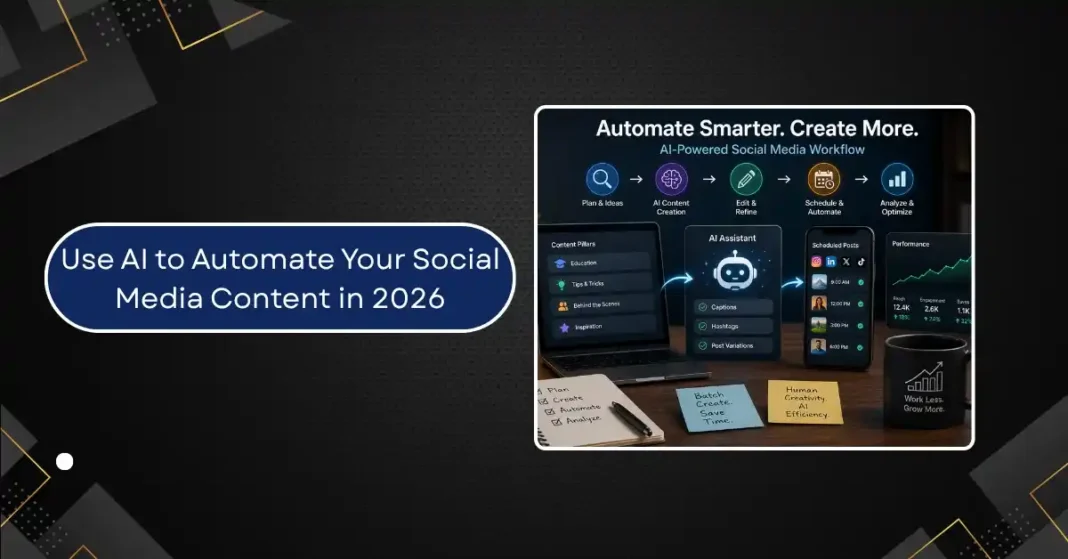
Let’s be honest about what “AI social media automation” actually means in 2026. It is not a robot that posts content while you sleep and grows your account to 100,000 followers. The platforms are too smart for that and the audiences too discerning.
What AI automation actually does well is collapse the production time between having an idea and getting it published. A content process that used to take a full day for a small team can realistically get done in two to three hours with the right tools and workflow. That is a meaningful efficiency gain, and it is achievable without losing the human voice that makes content worth following.
This guide walks through a practical, step-by-step system for using AI to handle the repetitive, time-consuming parts of social content work without letting it make your feed sound like a press release.
Step 1: Audit What You Are Actually Spending Time On
Before adding any tools, map your current content workflow. Most teams waste time on five things that AI handles well: drafting initial copy, resizing and reformatting content for different platforms, writing captions for existing visual content, generating hashtag sets, and scheduling. Everything else, the creative direction, the voice calibration, the judgment calls about what to post, still requires a human.
Write down how long each step takes in a typical week. This gives you a baseline so you can actually measure whether the tools are helping.
The mistake most teams make is using AI to generate ideas and then spending just as much time editing AI output as they would have spent writing from scratch. That is not efficiency, that is just outsourcing the first draft to a tool that writes worse than you do. The goal is to use AI for the steps where it genuinely speeds things up: repetitive formatting tasks, first-draft generation with heavy constraints, and scheduling logic.
Step 2: Set Up a Content Pillar Structure
AI tools produce better output when they have clear constraints. The way to give them those constraints is to define your content pillars before you start generating anything.
A content pillar is a topic category that your brand covers consistently. Most accounts do well with three to five pillars. For a personal finance brand they might be debt payoff, investing for beginners, money mindset, and news commentary. For a fitness business they might be workout tips, nutrition, client transformations, and behind-the-scenes studio content.
Write a one-paragraph description of each pillar, including the tone (practical and no-nonsense versus warm and encouraging), the target audience (people in their 30s paying off student loans versus gym-goers who want structure without obsessiveness), and the specific topics that are in or out of scope.
This document becomes the system prompt you give every AI tool you use for that brand. It is the difference between AI generating generic content and AI generating content that at least sounds like it comes from the right place.
Step 3: Choose Your Tools Based on What You Actually Need
There are dozens of AI social media tools in 2026. Most of them overlap significantly. The ones that are worth paying for depend on your specific bottleneck.
For copy generation, the three tools doing the most consistent work in 2026 are Claude (strong on voice calibration and following complex brand guidelines), ChatGPT (strong on volume and variation, especially for short-form), and Jasper (purpose-built for marketing copy, with template structures for social formats). All three require good prompting to produce usable output on the first try.
For image and video content, Runway ML and Kling AI are the leading tools for AI video generation. For static images, Midjourney and Adobe Firefly both produce usable content at scale. The important caveat: AI-generated imagery is becoming easier to identify, and several platforms are introducing labeling requirements for AI-generated visual content. Use these tools for variations on real photography and content concepts rather than as replacements for genuine visual content.
For scheduling and distribution, Buffer, Later, and Hootsuite have all integrated AI into their scheduling features. The scheduling tools are genuinely useful because they remove a time-consuming logistical task and provide analytics that feed back into content decisions.
For repurposing existing content, tools like Opus Clip (for trimming long video into short clips) and Descript (for transcript-based video editing and repurposing) are the practical workhorses. These are underused by most small teams and overused by the accounts that make every platform feel like they are watching the same clip from five different angles.
Step 4: Build a Weekly Batch Production System
The most effective use of AI for social content is batch production, where you set aside a defined block of time each week to generate and approve a week’s worth of content at once, then schedule everything in one session.
Here is a workflow that works for a team of one or two people producing content for two to three platforms:
Start with a 30-minute planning session at the beginning of the week. Identify one to two ideas per content pillar for the week. Check what is trending in your space that might be worth commenting on or adapting. Write these down as simple topic sentences, not fully formed posts. For example: “Explain why the Fed rate decision this week affects credit card holders differently than it affects mortgage holders” or “Share the counterintuitive thing about saving money that most financial content gets wrong.”
Take those topic sentences into your AI tool of choice. For each one, prompt the tool with your content pillar description, the specific topic, the platform you are writing for, and the format (a three-slide carousel, a 60-second Reel script, a LinkedIn post, etc.). Ask for two or three variations. Review them and pick the closest one, or combine the best elements of two.
For each approved draft, use the same tool to generate platform-specific variations. A LinkedIn post becomes a Twitter/X thread becomes a short Instagram caption becomes a script for a Reel. The core content is the same; the format and length adapt to the platform.
Spend the last part of your batch session scheduling everything. Most scheduling tools let you preview how posts will appear before they go live, which catches formatting errors before they become public.
Total time for a week’s worth of content across three platforms, assuming you have your pillar document ready and your tools set up: three to four hours. Compare that to the traditional workflow of creating each post individually as it goes live, which typically runs eight to twelve hours across a week for the same volume.
Step 5: Use AI for Analytics and Iteration, Not Just Production
The part of AI automation most teams underuse is the analytics side. Most platforms now have AI-assisted reporting that identifies patterns in your performance data and surfaces content recommendations.
Buffer’s AI features can tell you that your Tuesday posts consistently outperform Wednesday ones, that carousels with more than five slides retain more followers than shorter ones, and that posts published at 7 AM in your audience’s time zone get 40 percent more saves than afternoon posts. These are not things you need to derive manually from a spreadsheet anymore.
Build a monthly habit of reviewing these insights and updating your content strategy accordingly. The pillar document you wrote in Step 2 should be a living document. If the analytics are telling you that your news commentary pillar consistently underperforms and your behind-the-scenes content always overperforms, that is information worth acting on.
Step 6: Keep the Human Parts Human
The mistake that makes AI-automated content look bad is applying AI to the parts that require genuine human judgment: the creative direction, the personal stories, the cultural references, the humor, and the real-time responses to what is happening in the world.
AI is good at generating variations on a defined concept. It is bad at having original creative ideas, maintaining a consistent and distinct voice over time without constant direction, and reading the cultural moment accurately enough to know when a joke will land and when it will not.
Build your workflow so that AI handles production tasks (drafting, formatting, resizing, captioning) and humans handle creative direction (what to talk about, what angle to take, what not to say right now). The ratio that tends to work for most content teams is roughly 30 percent human creative input driving 70 percent AI-assisted production output.
One practical technique: write the first draft of anything important yourself, then use AI to generate three or four variations with different tones or framings. Review the variations for ideas that improve your original, then use the best of both. This way the starting point is genuinely yours, and the AI is functioning as an editor and variation generator rather than the primary voice.
What to Expect on Different Platforms
Instagram rewards original content heavily in 2026, with 40 to 60 percent more distribution for original posts versus reposts. AI-generated content is fine but needs strong visual hooks and captions with real keywords, not generated keyword lists.
LinkedIn continues to reward personal insight and professional perspective. AI-generated corporate-sounding posts consistently underperform. Use AI to clean up and structure posts you have written yourself rather than generating posts from scratch.
TikTok and Reels require genuine on-camera presence or strong visual storytelling in the video itself. AI can help with scripts, caption generation, and hashtag strategy, but it cannot replace the human element in video content. The accounts growing fastest on TikTok in 2026 are using AI for scripting and repurposing, not for generating the core content.
X (formerly Twitter) has the highest tolerance for AI-assisted content because the format rewards quick, clear takes. Use AI for variations and thread structuring, then edit heavily for voice.
The Honest Bottom Line
AI automation can meaningfully reduce the time you spend on social media content production. It cannot replace the creative thinking, personal perspective, and genuine audience connection that makes content worth following.
Use it for what it is good at: drafting, formatting, scheduling, analytics interpretation, and variation generation. Keep the creative decisions, the voice, and the judgment calls in human hands. Set up a batch production system rather than using AI tools ad hoc. Review your content performance monthly and update your strategy accordingly.
Done well, this approach cuts production time roughly in half while maintaining content quality. That is the realistic promise of AI social media automation in 2026.