Introduction
If you woke up in late June checking Google Search Console and your traffic graph looked like it fell off a cliff, you weren’t imagining things. Something really did happen.
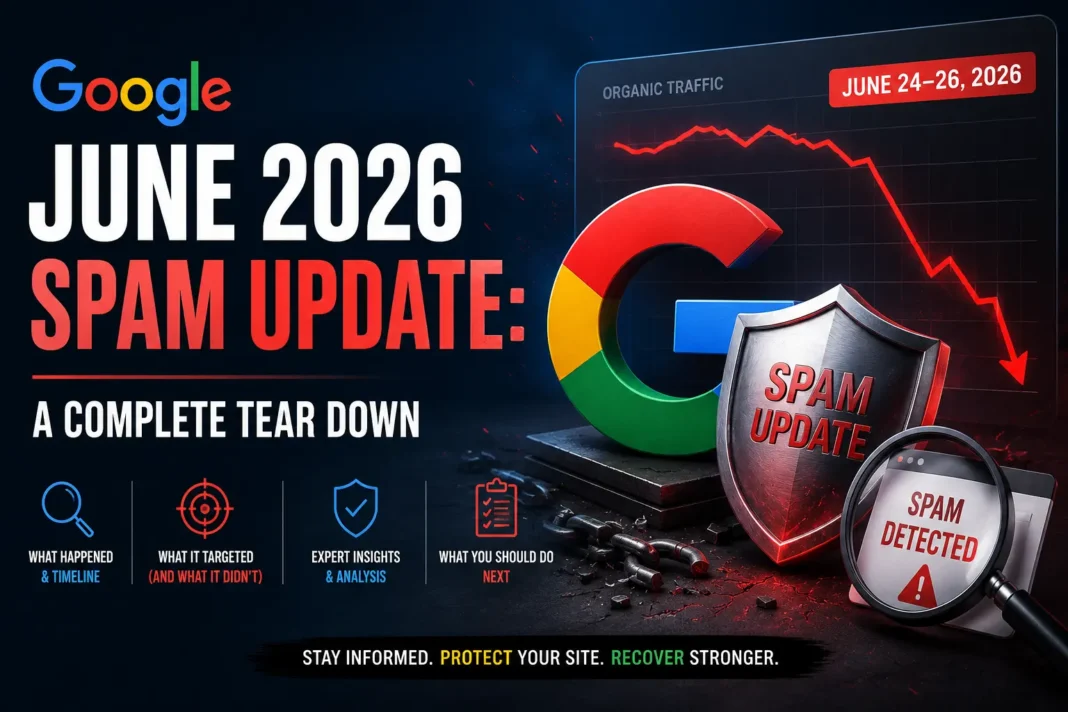
On June 24, 2026, Google quietly flipped the switch on its latest spam update. Two days later, it was done. No fanfare. No detailed blog post. Just a short note on the Search Status Dashboard and a wave of ranking volatility that rippled across nearly every niche.
For site owners, this kind of update is unsettling precisely because Google says so little about it. You’re left staring at a traffic drop, wondering if it’s this update, a competitor pulling ahead, or something else entirely.
In this teardown, we’ll walk through exactly what the June 2026 spam update did, what it didn’t do, how it compares to past updates, and what you should actually do if your site got caught in the crossfire.
By the end, you’ll know how to tell if this update hit you, what “normal” really means in Google’s language, and the practical steps to protect your site from the next one.
What Exactly Happened: The Timeline
Think of a spam update like a building inspector making rounds. They don’t announce which apartments they’re checking. They just show up, note violations, and leave a general warning that “codes are being enforced.”
Here’s the timeline as confirmed by Google’s own Search Status Dashboard:
- June 24, 2026, around 9:00 AM Pacific / noon Eastern — Google begins rolling out the update.
- June 26, 2026, around 10:00 AM Pacific / 2:00 PM Eastern — Google marks the rollout complete.
That’s roughly two days and one hour, start to finish. Google’s own announcement was brief: <cite index=”4-1″>the update was released globally and for all languages, and the rollout could take a few days to complete.</cite>
For comparison, <cite index=”10-1″>the March 2026 spam update was the fastest confirmed spam rollout on record, wrapping up in under a day, while the August 2025 spam update before it dragged on for nearly four weeks.</cite> The June update sits right in the middle of that range.
Expert Tip
Don’t diagnose anything while a rollout is still in progress. Rankings shift daily during an active rollout, and any conclusions you draw mid-update are likely to be wrong. Wait for Google to confirm completion, then start comparing before-and-after data.
What This Update Actually Targeted
Here’s the frustrating part: Google didn’t publish a detailed target list this time. <cite index=”7-1″>The update reflects improvements to the automated systems Google uses to detect violations of its spam policies, and according to Google’s documentation, these systems go after tactics used to deceive users or manipulate rankings — not content that simply underperforms.</cite>
That’s a broad umbrella. Google’s current spam policies cover things like:
- Scaled content abuse — mass-producing pages that add little value to readers
- Site reputation abuse — publishing third-party content on an established site just to borrow its ranking power
- Cloaking, doorway pages, and sneaky redirects
- Expired domain abuse
- AI-generated content used purely to manipulate rankings
The one useful clue we do have came from journalist Barry Schwartz, who asked Google directly what this update does not touch. <cite index=”2-1″>Google confirmed it does not target link spam, does not target the site reputation abuse policy, and does not touch some other policies either.</cite>
That’s worth pausing on. If your traffic dropped and you’ve been leaning on shady backlinks or a site reputation abuse setup (renting out subdomains to third parties, for instance), this particular update probably isn’t the reason. Something else is going on.
Why This Timing Isn’t a Coincidence
A few weeks before this update rolled out, Google had already been tightening the screws elsewhere. <cite index=”10-4,10-5″>In May 2026, Google updated its spam policies page to state that manipulating AI responses in Google Search counts as spam, and in April 2026 it published a new back-button-hijacking policy that became enforceable starting June 15, 2026</cite> — just nine days before this spam update went live.
Google hasn’t confirmed a direct connection between that enforcement date and the spam update. But the pattern is hard to ignore: this is a company that’s been enforcing across multiple fronts — AI content manipulation, back-button hijacking, and now general spam policy violations — in a tight window.
Spam Update vs. Core Update: What’s the Difference?
People often lump these together, but they’re solving different problems.
| Feature | Spam Update | Core Update |
|---|---|---|
| Purpose | Enforces existing spam policies | Broadly re-evaluates content quality, relevance, and authority |
| Frequency | A few times a year, as needed | Several times a year, often announced in advance |
| Recovery approach | Fix specific violations | Improve overall site quality and helpfulness |
| Typical rollout time | 1 day to several weeks | 1–3 weeks |
| Underlying system | SpamBrain (Google’s AI spam-detection system) | Multiple ranking systems working together |
A spam update is narrow and punitive — it’s Google removing pages that broke the rules. A core update is closer to Google re-grading the entire class on a slightly different curve.
Who Got Hit? What Site Owners Reported
Forum chatter is never scientific, but it’s a useful temperature check. Site owners on WebmasterWorld described drops of 10–15% even when they insisted their site had no spam on it. Others called the update “a pretty big deal” for something Google labeled routine.
That gap — between “no spam here” and “traffic dropped anyway” — happens with almost every update. Sometimes it’s collateral damage from an aggressive algorithm pass. Sometimes it’s a violation the site owner genuinely doesn’t recognize as a violation (thin AI content, for example, often doesn’t feel like “spam” to the person who published it).
Common Mistakes People Make After a Drop
- Panicking and rewriting everything immediately. Wait for the rollout to fully complete first.
- Assuming it’s always the spam update. Check your Search Console dates against the June 24–26 window specifically.
- Ignoring competitor movement. If rivals climbed while you slipped, the story might be about them, not you.
- Making cosmetic fixes instead of policy fixes. Reformatting a page doesn’t help if the underlying issue is scaled, low-value content.
- Expecting a fast recovery. Google has repeatedly said recovery from spam policy violations can take months as its systems reassess a site.
- Not annotating the date in Search Console. Without a clear marker, it becomes much harder to isolate this update’s effect from whatever rolls out next.
How to Check If This Update Hit Your Site
Here’s a simple, practical process:
Step 1: Pull your Search Console data. Filter your performance report to June 20–July 3, 2026, so you can see the lead-up and aftermath clearly.
Step 2: Isolate the exact rollout window. Look specifically at June 24–26. A sharp move that starts and mostly settles within that window is a strong signal this update is involved.
Step 3: Compare against competitors. If you have access to a rank tracking tool, check whether competitors in your niche moved in the same window. If they climbed while you dropped, that’s a relative loss, not just an algorithmic penalty.
Step 4: Audit against the spam policies, not your gut feeling. Go through Google’s official spam policies line by line. Pay particular attention to scaled content abuse if you’ve published AI-assisted content in bulk recently.
Step 5: Fix root causes, then wait. Remove or substantially improve low-value pages. Don’t expect a bounce-back within days — Google has said this can take months.
Troubleshooting Tips
- If your whole niche dropped together, it may be an industry-wide algorithm shift rather than something specific to your site.
- If only certain page types dropped (say, thin location pages or auto-generated listicles), that’s a strong clue about which policy you tripped.
- If nothing on your site changed but rankings still moved, look at whether competitors published significantly more content or earned new authoritative links recently.
Benefits of Understanding Spam Updates (Even If You Weren’t Hit)
Main benefit: You get a real-world map of where Google’s enforcement line currently sits, which helps you avoid crossing it later.
Real-world application: Content teams can use these updates as a periodic audit trigger — a reason to review AI-assisted content workflows, syndicated content deals, and backlink profiles even when nothing feels urgent.
Who should pay close attention: Sites publishing high volumes of AI-assisted content, affiliate sites with thin comparison pages, and anyone hosting third-party content on their domain.
Who can mostly relax: Sites with original reporting, genuine expertise, and a normal, organic backlink profile. If that’s you, a spam update is background noise, not a threat.
Expert Tips Not Commonly Discussed
- Track the “not targeted” list as closely as the targeted one. Knowing this update skipped link spam and site reputation abuse is genuinely useful — it lets you rule out entire categories when diagnosing a drop.
- Watch enforcement dates, not just update dates. The back-button-hijacking policy became enforceable on June 15, 2026, well before this spam update rolled out. Policy enforcement and spam updates aren’t the same event, but they compound.
- Use the Search Status Dashboard, not just news roundups. Google’s dashboard is the primary source for exact start and end timestamps, which matters if you’re trying to line up data precisely.
- Treat “normal” language from Google with mild skepticism. Several outlets noted this update felt more widespread than a typical spam update despite Google calling it routine — self-reported severity from Google isn’t always the full picture.
Future Trends: What’s Next for Google Spam Enforcement
Zooming out, 2026 has been an unusually active year for Google ranking updates. Between February and June alone, Google pushed out four separate ranking-related incidents — a core update, a Discover update, and two spam updates — a noticeably faster cadence than prior years.
A few patterns worth watching:
- AI content manipulation is now explicitly a spam category. Google’s May 2026 policy update made clear that manipulating AI responses in Search counts as spam, not just traditional keyword manipulation.
- Enforcement is getting more surgical. The back-button-hijacking policy shows Google is willing to name very specific technical behaviors rather than only broad categories.
- Expect more, smaller updates rather than fewer, bigger ones. The faster pace this year suggests Google is iterating more frequently instead of saving changes for occasional large releases.
- Scaled content abuse enforcement will likely intensify as AI writing tools make it easier to publish large volumes of pages quickly.
If you’re building a content strategy for the rest of 2026, assume more frequent — not less frequent — scrutiny of AI-assisted and templated content.
Conclusion
The June 2026 spam update was short, global, and deliberately vague about its targets. What we do know: it ran from June 24 to June 26, it’s the second spam update of the year, and it steered clear of link spam and site reputation abuse, according to Google’s own comments.
If your traffic moved during that window, don’t panic and don’t rush a cosmetic fix. Line up your data against the exact rollout dates, check what competitors did in the same window, and audit against Google’s actual spam policies rather than assumptions. If you’re clean, this is background noise. If you’re not, recovery is a matter of months, not days.
The bigger picture matters more than any single update: Google is enforcing faster and more specifically in 2026 than in recent years, especially around AI-generated content and manipulation of AI-driven search features. That’s the trend worth building your strategy around.
FAQ Section
1. When did the Google June 2026 spam update happen? It rolled out from June 24, 2026, to June 26, 2026.
2. Is the June 2026 spam update a core update or a spam update? It’s a spam update — it enforces existing spam policies rather than broadly re-evaluating content quality like a core update does.
3. What does the June 2026 spam update target? Google didn’t name a specific target category publicly. It enforces its general spam policies, which include things like scaled content abuse and cloaking.
4. Does the June 2026 spam update target link spam? No. According to Google’s comments to Search Engine Roundtable, this update does not target link spam.
5. Does it target site reputation abuse? No, Google confirmed it does not target the site reputation abuse policy either.
6. How long did the update take to roll out? About two days — from June 24 to June 26, 2026.
7. How can I tell if this update affected my site? Compare your Search Console traffic and rankings specifically within the June 24–26 window, and check whether competitors moved differently over the same period.
8. How do I recover from a spam update penalty? Review Google’s spam policies, remove or improve violating content, and wait. Google has said recovery can take months as its systems reassess your site.
9. Will my rankings recover quickly if I fix the issue? Not necessarily. Google’s own guidance says improvements may only show up after its systems observe compliance over a period of months.
10. What’s the difference between a spam update and a core update? A spam update enforces existing rules against specific violations. A core update broadly reassesses ranking factors like relevance, quality, and authority across the board.
11. Was this the first spam update of 2026? No, it’s the second. The March 2026 spam update came first and was notably the fastest spam rollout on record at the time.
12. What is SpamBrain? SpamBrain is Google’s AI-based spam-prevention system, which spam updates typically refine or improve.
13. Should I make changes to my site while the rollout is still happening? It’s better to wait until the rollout is confirmed complete before making changes, since mid-rollout data is noisy and unreliable.
14. Does this update relate to AI-generated content? Not explicitly, but it follows closely on the heels of a May 2026 policy update stating that manipulating AI responses in Search counts as spam.
15. Where can I find official information about Google spam updates? Google’s Search Status Dashboard and its spam policies documentation are the primary official sources.