Introduction
You publish a great article. It gets shared. People quote it in Slack groups. Someone screenshots it for a LinkedIn post. Your brand name pops up in a Google AI Overview answer.
And your traffic dashboard? Barely moved.
If that sounds familiar, you’re not doing anything wrong. You’re just measuring the wrong thing.
In 2026, a huge amount of content marketing value happens before someone ever clicks your link — inside AI search summaries, social feeds, and messaging apps. This is called zero-click content, and it’s quietly breaking the old rulebook that says “traffic equals success.”
This guide is for anyone who feels like their content is working but can’t prove it: bloggers, founders, and marketers who need a real way to track ROI in a world where the click is no longer the finish line.
Here’s what you’ll learn:
- Why zero-click content is happening and why it’s not going away
- The new metrics that actually reflect content performance
- A step-by-step process to build a zero-click measurement system
- Mistakes to avoid and where this is all heading next
Key Takeaways
- Zero-click content is content that delivers value (and influences decisions) without needing a website visit.
- Traditional metrics like pageviews and click-through rate no longer tell the full story.
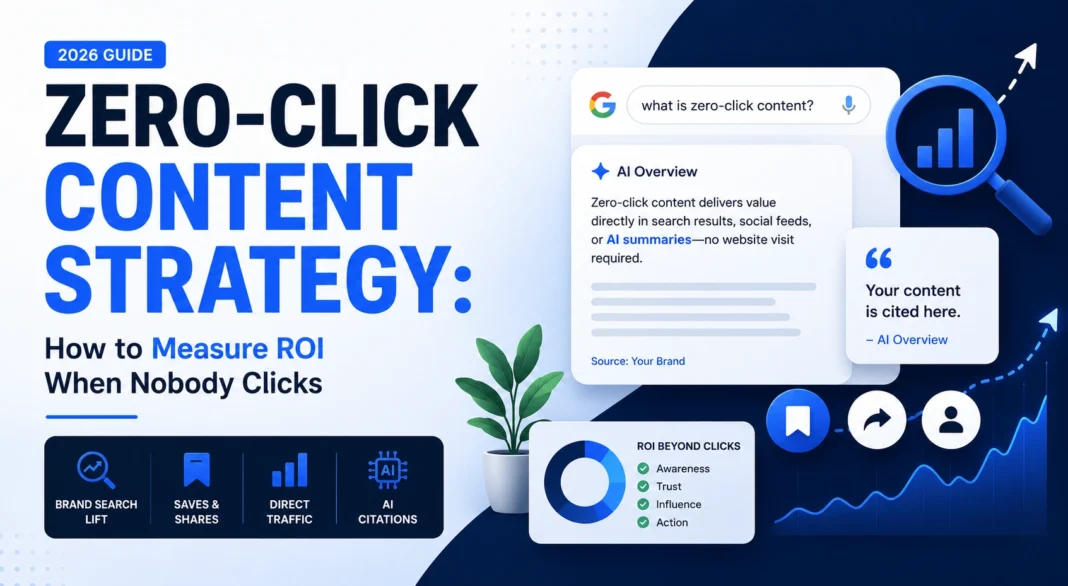
- New signals to track include branded search lift, saves/shares, direct traffic, newsletter signups, and AI citations.
- Trust and originality matter more than volume — generic content gets summarized and skipped; distinctive content gets remembered.
- Owned audiences (email, communities) are becoming your best hedge against zero-click erosion.
What Is Zero-Click Content, Really?
Zero-click content is any piece of content that answers a question, builds trust, or moves someone toward a decision — without requiring a click through to your website.
This happens in a few common ways:
- AI search summaries pull an answer from your article and show it directly in the search results.
- Social platforms keep users in-app by summarizing or excerpting your post in the feed.
- Voice assistants read out a short answer instead of sending someone to a browser.
None of this means your content failed. It means the value got delivered somewhere other than your own site. The problem is that most analytics tools still only count what happens on your domain.
Why This Is Happening Now
Search behavior has genuinely changed shape. People aren’t just typing keywords into Google anymore — they’re asking full questions inside AI chat interfaces, scrolling social platforms for recommendations, and treating search as one step in a longer discovery journey rather than the whole journey.
At the same time, AI-generated summaries are getting good enough to satisfy a lot of simple questions on the spot. If someone asks “what’s the difference between SEO and GEO,” a well-structured answer might appear right there — no click needed.
Old Metrics vs. New Metrics: A Quick Comparison
| Metric Type | Traditional Approach | Zero-Click Approach |
|---|---|---|
| Primary success signal | Pageviews, clicks | Brand search lift, citations, saves |
| Attribution | Last-click | Multi-touch, assisted influence |
| Content goal | Drive traffic | Drive recognition and action |
| Distribution | Search engine only | Search, social, AI summaries, email |
| Winning content | High-volume, keyword-stuffed | Original, opinionated, well-structured |
Neither column is “wrong” — but if you’re only measuring the left side, you’re missing most of the picture in 2026.
Step-by-Step: Building a Zero-Click Measurement System
You don’t need expensive tools to start tracking this. You need the right questions and a bit of discipline.
Step 1: Set Up Branded Search Tracking
If your content is working, more people should be searching your brand name or product name over time — even if they found you somewhere else first.
- Use Google Search Console to track branded query volume monthly.
- Watch for spikes after a piece of content goes out on social or gets picked up elsewhere.
Step 2: Track Direct Traffic Separately
Direct traffic (someone typing your URL or clicking a saved bookmark) often reflects delayed influence from content they saw earlier and didn’t click at the time.
- Segment “Direct” traffic in your analytics tool.
- Look for unexplained increases that line up with a content push.
Step 3: Count Saves, Shares, and Replies — Not Just Likes
A “like” is passive. A save, a forwarded message, or a thoughtful reply means someone found real value.
- Track saves and shares natively on each platform.
- Note replies or DMs that mention specific pieces of content — this is qualitative gold.
Step 4: Monitor AI Citations
Check whether your content is being referenced or summarized inside AI search tools.
- Periodically ask relevant questions inside AI search assistants and see if your brand or article gets referenced.
- If it does, that’s a visibility win even without a click.
Step 5: Grow and Track an Owned Audience
Email subscribers, newsletter signups, and community members are the one audience you don’t lose when a platform changes its algorithm.
- Add a clear, low-friction subscribe option to every piece of content.
- Track subscriber growth rate alongside content publishing frequency.
Requirements: Google Search Console access, analytics tool (GA4 or similar), a spreadsheet or dashboard tool, an email platform.
Best practice: Review these numbers monthly, not daily. Zero-click influence builds slowly and gets lost in day-to-day noise.
Troubleshooting tip: If branded search isn’t moving at all after several months of consistent publishing, the issue is usually distinctiveness — your content may be too similar to what’s already out there to be remembered.
Who Should Use a Zero-Click Strategy (and Who Shouldn’t)
Good fit for:
- Bloggers and content marketers publishing consistently across multiple channels
- B2B brands with longer consideration cycles where trust-building matters more than instant clicks
- Founders and creators building a personal brand alongside a business
Less urgent for:
- Pure transactional e-commerce pages where a direct click-to-purchase is the entire goal
- Very early-stage sites with no existing content library or distribution presence yet — get the basics of SEO and content quality right first
Common Mistakes to Avoid
- Only measuring pageviews. Fix: Add branded search and direct traffic to your monthly report.
- Ignoring social platform-native metrics. Fix: Track saves and shares directly in-platform, not just via link clicks.
- Writing generic, safe content. Fix: Add a real opinion, an original example, or a named author to every piece.
- Treating email as an afterthought. Fix: Make subscribing the easiest action on every page.
- Giving up too early. Fix: Zero-click influence compounds — expect to see meaningful shifts over 2–3 months, not 2–3 weeks.
Expert Tips
- Answer the exact question first, in the first two sentences. This is what gets pulled into AI summaries and featured snippets.
- Name a real author with real credentials. Content with a visible, credible voice behind it tends to earn more trust and more citations.
- Repurpose one strong article into five formats (short video, carousel, email, thread, infographic) instead of writing five separate weak ones.
- Track “content-influenced” leads by simply asking new customers where they first heard about you — don’t rely on analytics alone.
Future Trends: What’s Next for Zero-Click Content
- AI answer engines will keep growing as a discovery channel, meaning structured, citable content becomes even more valuable.
- Platforms will roll out better native analytics for saves, shares, and influence — expect less reliance on guesswork over time.
- First-party data and owned audiences will become the most valuable marketing asset a small brand can build, since they’re immune to algorithm and AI-summary changes.
- “Content-influenced revenue” will become a standard reporting metric, alongside — not instead of — traditional traffic numbers.
Conclusion
Zero-click content isn’t a threat to content marketing — it’s a sign that content is working in more places than your analytics dashboard can see. The brands that win from here won’t be the ones producing the most posts. They’ll be the ones building trust, tracking the right signals, and owning an audience that no algorithm can take away.
Start small: pick one new metric from this guide, track it for 60 days, and see what it tells you that pageviews never could.
FAQ
1. What does “zero-click content” mean? It’s content that delivers value or influences a decision without the person clicking through to your website — for example, an AI search summary or a social media caption.
2. Is zero-click content bad for my website traffic? It can reduce direct clicks, but it often increases brand awareness and trust, which shows up later as branded search and direct traffic.
3. How do I measure ROI if people aren’t clicking? Track branded search volume, direct traffic, saves/shares, AI citations, and newsletter signups instead of relying only on pageviews.
4. What is branded search lift? It’s the increase in people searching your brand or product name directly, often a sign that earlier content built awareness even without a click.
5. Does SEO still matter if zero-click search is growing? Yes. Good SEO structure is exactly what makes your content more likely to be pulled into AI summaries and featured snippets in the first place.
6. What tools can track zero-click performance? Google Search Console for branded search, GA4 for direct traffic, and native platform analytics (Instagram, LinkedIn, TikTok) for saves and shares.
7. How long does it take to see zero-click results? Most brands see measurable shifts in branded search or direct traffic within 2–3 months of consistent, distinctive publishing.
8. Should I stop tracking pageviews altogether? No. Pageviews still matter — just don’t treat them as the only measure of success.
9. What type of content performs best in a zero-click environment? Content with a clear, direct answer, an original opinion or example, and a credible named author tends to perform best.
10. How does email fit into a zero-click strategy? Email is an owned channel that isn’t affected by search or social algorithm changes, making it a reliable long-term measurement and retention tool.
11. What’s the difference between zero-click content and content marketing ROI? Zero-click content refers to how content is consumed; content marketing ROI is the broader measurement of whether that content drives business results.
12. Can small businesses benefit from a zero-click strategy? Yes — small businesses often benefit the most, since trust and word-of-mouth-style influence can outweigh raw traffic volume for a smaller audience.