Introduction
Here’s an uncomfortable question every marketing leader eventually has to answer: is our martech stack actually making us money, or are we just paying rent on a very expensive collection of software?
It’s not a rhetorical question. Global spending on marketing technology is racing toward $215 billion, yet most CMOs privately admit they can’t clearly prove what that spending is returning. Tools pile up, subscriptions renew automatically, and somewhere along the way, “let’s measure this properly” gets pushed to next quarter, every quarter.
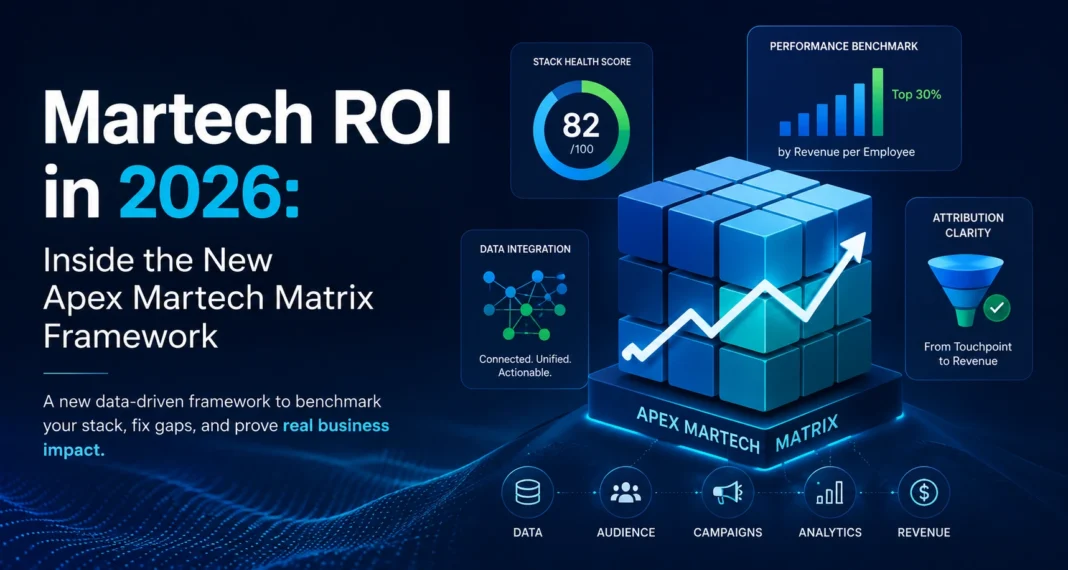
A new framework called the Apex Martech Matrix, built by the CMO Council in partnership with research firm MartechTribe, is trying to finally answer that question with real data instead of guesswork.
What you’ll learn:
- Why martech ROI has been so hard to measure
- What the Apex Martech Matrix actually does
- The two most common reasons stacks underperform
- Practical steps to start auditing your own stack this quarter
Key Takeaways
- The Apex Martech Matrix is a benchmarking framework built from data on 15,000 martech solutions and 1,600 real-world company stacks.
- It ranks the top-performing 30% of companies in each industry by revenue per employee, then studies what their stacks have in common.
- The two most common weaknesses found in underperforming stacks are fragmented data and unclear attribution.
- Speed to value, how fast a company turns a tool’s capability into a real business result, separates top performers from everyone else.
- There’s no single “best” stack. Performance depends on matching your tools to your industry, business model, and level of organizational maturity.
Why Martech ROI Has Always Been Hard to Prove
Most companies don’t buy their entire martech stack at once. It’s built up over years, one tool at a time, often by different teams solving different problems. The email tool was chosen by one manager. The analytics platform was chosen by another. Nobody sat down and asked how they’d all work together, or how success would be measured across the whole thing.
The result is a stack that technically works but resists being measured as a whole. You can see how many emails were opened. You can see how many ads were clicked. What’s much harder is connecting all of that to actual revenue in a way a finance team would trust.
What Is the Apex Martech Matrix?
Think of it like a report card, but instead of grading individual students, it grades entire companies based on how well their marketing technology choices line up with real business results.
The CMO Council and MartechTribe built the framework using nearly a decade of research, pulling data from a warehouse covering 15,000 different martech solutions and more than 1,600 real cross-industry technology stacks.
Rather than asking companies to self-report whether their tools “feel” effective, the framework ranks companies within each industry by a hard financial metric: revenue per employee, pulled from actual annual reports. It then identifies the top 30% of performers and studies what their technology choices, and their habits, have in common.
The Two Biggest Reasons Stacks Underperform
According to the research behind the framework, most underperforming stacks share two specific problems.
1. Data fragmentation. Customer and campaign data scattered across disconnected tools, so no single view of what’s actually working exists.
2. Attribution blindness. Even when data exists, companies often can’t clearly trace which marketing activities led to which business results, so decisions get made on gut feeling instead of evidence.
Neither of these is a technology problem you fix by buying one more tool. They’re structural problems, and that’s exactly why a benchmarking framework like this is useful: it forces you to look at the whole system instead of chasing the next shiny feature.
What Separates Top Performers
The single clearest pattern among high-performing companies isn’t which specific tools they use, it’s how quickly they turn a tool’s capability into a measurable result. The report calls this “speed to value,” and it shows up again and again as the defining trait of top performers across every industry studied.
In other words, it’s not about having the most advanced martech stack. It’s about having a stack, and a team, that can actually put new capabilities to work fast instead of letting them sit half-implemented for a year.
How to Start Auditing Your Own Stack
You don’t need the full framework in front of you to start applying its logic. Here’s a simple starting process:
Step 1: List every tool in your current stack. Include anything touching customer data, campaigns, or analytics, not just the “official” martech budget line.
Step 2: Map where customer data actually lives for each one. Note which tools talk to each other automatically and which ones require manual exports or workarounds.
Step 3: Pick one campaign and trace it end to end. Can you follow a single customer’s journey from first touch to final sale using your current data setup? If not, you’ve found your attribution gap.
Step 4: Time how long it took to adopt your last new tool. From purchase to real, measurable use. If it took more than a quarter, that’s a speed-to-value problem worth investigating.
Step 5: Compare your industry position. Look at what’s publicly known about top performers in your specific industry rather than benchmarking against martech in general. A software company and a retailer will have very different “ideal” stacks.
Comparison: High-Performing vs. Underperforming Stacks
| Trait | Underperforming Stack | High-Performing Stack |
|---|---|---|
| Data structure | Scattered across disconnected tools | Centralized or clearly connected |
| Attribution | Unclear or guessed | Traceable end to end |
| New tool adoption speed | Slow, often stalls mid-rollout | Fast, tied to a clear business goal |
| Stack design | Copied from industry trends | Matched to specific business model |
| Measurement | Activity-based (opens, clicks) | Outcome-based (revenue, retention) |
Common Mistakes to Avoid
- Benchmarking against the wrong companies. Comparing your B2B SaaS stack to a retail giant’s stack tells you very little useful information.
- Buying a new tool to fix a data problem. New software rarely fixes fragmented data; better integration and process usually will.
- Measuring activity instead of outcomes. Open rates and click rates are easy to track but don’t prove business impact on their own.
- Letting tools sit half-adopted. A powerful feature nobody uses well delivers zero ROI, no matter how good it looks in a demo.
- Treating the audit as a one-time event. Stacks change constantly. Revisit this process at least once a year.
Expert Tips
- Before your next renewal cycle, ask each tool owner one question: “What specific business outcome did this tool move last quarter?” If nobody has a confident answer, that’s your first audit target.
- Track “speed to value” internally as its own metric, not just adoption rate. The gap between buying a tool and actually using it well is where most martech budget quietly disappears.
- Resist stack envy. The right stack for a competitor in a different market is not automatically the right stack for you.
Benefits of Using a Benchmarking Framework
Main benefits: A shared language for talking about martech performance with finance and leadership, a way to prioritize which stack problems to fix first, and a defense against vanity-metric decision-making.
Who should use it: Marketing leaders and operations teams under pressure to justify technology spend, especially at mid-size to large organizations with several years of accumulated tools.
Who should be cautious: Very early-stage companies with minimal stack complexity may get more value from simply building good data habits first before applying a formal benchmarking exercise.
What’s Next for Martech ROI Measurement
Expect more industry-specific benchmarking to emerge, since a one-size-fits-all view of “good” martech performance is increasingly seen as unhelpful.
Expect finance teams to get more involved in martech decisions, pushing marketing toward the same rigor already expected of other business functions.
Expect “speed to value” to become a standard term in vendor pitches and internal reporting alike, as the real differentiator between stacks that pay off and stacks that don’t.
Conclusion
Martech ROI has been notoriously hard to prove, not because the data doesn’t exist, but because it’s usually scattered, disconnected, and measured by activity instead of outcome. The Apex Martech Matrix offers a rare thing in this space: an evidence-based way to see what actually separates top-performing stacks from expensive collections of underused software.
You don’t need the full research report to start. Map your stack, trace one customer journey end to end, and be honest about how fast your team actually adopts new tools. That’s the same logic the framework is built on, and it’s a habit worth building regardless of which benchmarking tool you use.
FAQ
What is the Apex Martech Matrix? It’s a benchmarking framework from the CMO Council and MartechTribe that uses real company data to identify which martech practices are linked to stronger business performance.
How does the Apex Martech Matrix measure performance? It ranks companies within each industry by revenue per employee, based on public annual reports, then studies the top 30% to identify common patterns in their martech stacks and practices.
What are the most common reasons martech stacks underperform? Data fragmentation, where customer information is scattered across disconnected tools, and attribution blindness, where companies can’t clearly trace marketing activity to business results.
What does “speed to value” mean in martech? It refers to how quickly a company turns a newly adopted marketing technology capability into a measurable business result, rather than how advanced the technology itself is.
Is there one ideal martech stack every company should copy? No. Performance is closely tied to matching a stack to a company’s specific industry, business model, and organizational maturity, not to copying a competitor’s setup.
How much is being spent on martech globally? Global martech spend is approaching $215 billion, according to the research behind the Apex Martech Matrix.
How can I audit my own martech stack without a formal framework? Start by mapping every tool touching customer data, tracing one campaign end to end to check attribution, and timing how long your team takes to fully adopt new tools.
Does buying more martech tools improve ROI? Not necessarily. Many underperformance issues come from fragmented data and slow adoption rather than a lack of tools.
Who created the Apex Martech Matrix? It was developed by the CMO Council in partnership with research and consulting firm MartechTribe.
How often should companies re-evaluate their martech stack? At least once a year, since tools, teams, and business priorities change frequently enough to shift what “good performance” looks like.