Introduction
Imagine your customer data platform could not just store information about your customers, but actually make decisions and take action on its own, all day, every day, without anyone clicking “launch campaign.”
That’s the idea behind the agentic CDP, and it just got a lot more real. Databricks, a company best known for data infrastructure, has entered the marketing technology space with a product called CustomerLake, and it’s built entirely around AI agents that manage customer relationships on their own.
If you’ve been hearing the term “agentic CDP” and wondering what it actually means in practice, or if you’re trying to figure out whether this changes anything for your own marketing stack, this article breaks it down in plain language.
What you’ll learn:
- What a CDP is, and what makes an “agentic” CDP different
- How Databricks CustomerLake works
- Why a data infrastructure company suddenly cares about marketing
- What this shift means for your own martech decisions
Key Takeaways
- A CDP (Customer Data Platform) collects and unifies customer data from every channel into one profile.
- An agentic CDP adds AI agents on top of that data, agents that analyze behavior, make decisions, and act without waiting for a human to press go.
- Databricks CustomerLake is built directly into its existing data platform, so companies don’t need to copy customer data into a separate system.
- Analysts expect most new CDP deployments going forward to be built into existing data platforms rather than sold as standalone products.
- This shift matters even if you’re not buying a new CDP right now, because it changes what you should look for in every future martech purchase.
What Is a CDP, in Plain English?
Picture a customer walking through a store, but the store is actually five different systems: your website, your email tool, your ad platform, your support desk, and your app. Each one sees a slice of that customer, but none of them sees the whole person.
A Customer Data Platform exists to fix that. It pulls information from all of those places and stitches it into one profile per customer. Instead of five partial pictures, you get one full one.
For years, that was the whole job: collect, store, and let marketers look at the profile to decide what to do next.
So What Makes a CDP “Agentic”?
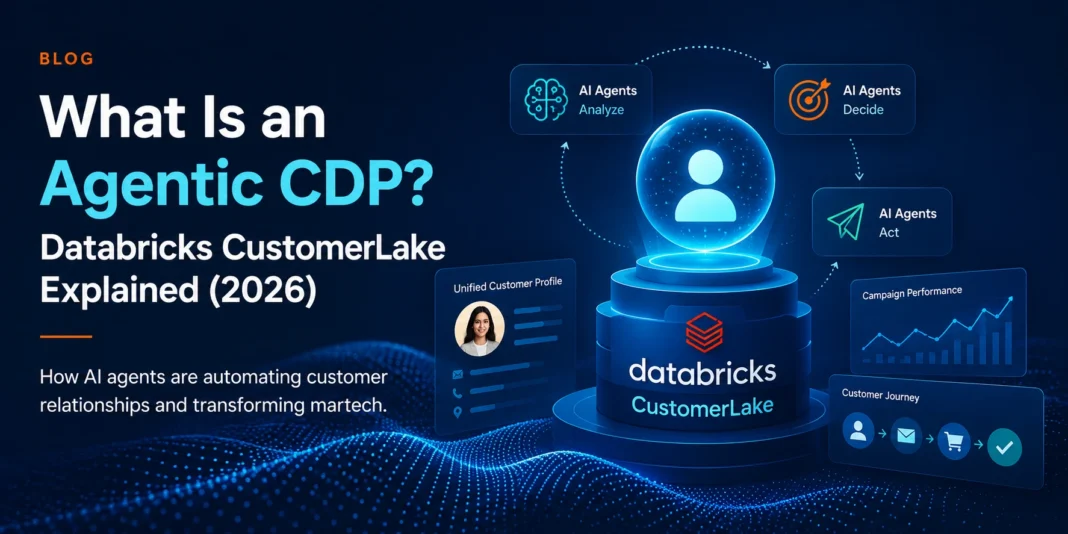
The word “agentic” simply means the system has agents, small AI programs that don’t just show you information, they act on it.
An old-school CDP might tell a marketer, “this customer looks like they’re about to cancel.” An agentic CDP goes further: it notices the signal, decides what to do about it, sends the retention offer, watches what happens, and adjusts the approach, all without a person building that workflow step by step.
Think of the difference between a smoke detector and a sprinkler system. One tells you there’s a problem. The other reacts to it.
How Databricks CustomerLake Works
Databricks built its reputation on data infrastructure, the behind-the-scenes systems that store and process huge amounts of company data. CustomerLake is its move into marketing, and the approach is different from a typical CDP.
Most CDPs are separate products. Your customer data has to be copied out of your company’s main data systems and into the CDP, which creates delays, extra cost, and security headaches.
CustomerLake skips that step. It’s built directly inside the same data platform companies already use to store their other business data, meaning customer information never has to leave home. The company describes the result as two kinds of agents working together: ones that keep customer profiles clean and up to date, and ones that build and run marketing campaigns on their own, continuously adjusting based on what’s working.
Databricks calls these self-running, self-adjusting campaigns “infinity campaigns,” a nod to the fact that they don’t really end, they just keep learning and optimizing.
Why Is a Data Company Suddenly a Martech Company?
This is the part worth paying attention to, even if you never buy CustomerLake specifically.
For the past twenty years, martech tools were built as separate apps that marketers logged into. The value was in the interface, the dashboards, the campaign builder.
That’s starting to flip. As AI agents take over more of the day-to-day decision-making, the real value moves underneath the interface, into whether the system can safely and instantly access the right customer data at the right moment. Companies that already own that data layer, like Databricks, suddenly have a natural advantage in marketing.
Analysts covering the space expect this pattern to spread. The prediction: within a few years, most new customer data platform purchases will be systems built into a company’s existing data infrastructure rather than bought as a separate standalone tool.
Comparison: Traditional CDP vs. Agentic CDP
| Feature | Traditional CDP | Agentic CDP |
|---|---|---|
| Main job | Collect and unify customer data | Collect data AND act on it automatically |
| Who makes decisions | A human marketer, using the data | AI agents, with human oversight |
| Data location | Often copied into a separate system | Frequently built into the existing data platform |
| Campaign style | One-time campaigns, manually launched | Continuous, self-adjusting campaigns |
| Setup complexity | Requires data integration work | Can plug directly into data already in place |
Benefits of an Agentic CDP
Main benefits:
- Faster reaction time, since agents can respond to customer behavior in real time instead of waiting for the next campaign cycle
- Less manual busywork for marketing teams, freeing them up for strategy instead of execution
- Cleaner data, since profile agents continuously fix and update records instead of letting them go stale
Who should consider it: Larger companies with a lot of customer data already sitting in a modern data platform, and marketing teams ready to hand over some routine decisions to automation.
Who should be cautious: Smaller teams without much customer data yet, or companies still cleaning up basic data quality problems. Agentic tools amplify whatever process you already have, good or bad.
Common Mistakes to Avoid
- Buying the hype before checking data readiness. Agents need clean, well-organized data to work with. Feeding a messy system into an agentic CDP just multiplies existing errors, faster.
- Assuming “agentic” means “no human needed.” Every serious agentic CDP still needs a marketer setting the goals and checking the results.
- Ignoring the data governance question. Ask exactly where customer data lives, who can access it, and what happens if the AI agent makes a bad call.
- Treating this as just another feature upgrade. It’s a structural shift in how CDPs are built. Evaluate it as an infrastructure decision, not a checkbox feature.
- Switching platforms without a rollback plan. Autonomous campaigns can run for a while before a problem is noticed. Always keep a way to pause and review.
Expert Tips
- Before evaluating any agentic CDP, audit how many separate places your customer data currently lives. That number tells you how much integration work you’re really signing up for.
- Ask any vendor a very specific question: “If your AI agent makes a bad decision at 2 a.m., how fast can I find out and stop it?” The answer tells you a lot about how mature the product really is.
- Don’t evaluate agentic CDPs only against other CDPs. Increasingly, the real competitor is your existing data warehouse provider extending into marketing.
What’s Next for Agentic CDPs
Expect more infrastructure companies, not just traditional martech vendors, to enter the CDP space over the next couple of years. The core skill required, safely managing huge amounts of live data, is the same skill needed to run marketing agents well.
Expect more vendors to launch their own version of “always-on” campaigns that adjust in real time rather than running in scheduled bursts.
Expect a growing conversation about guardrails: how much decision-making authority to give an AI agent, and how to keep a human in the loop for judgment calls that really matter.
Conclusion
The agentic CDP isn’t just a new feature bolted onto old customer data tools, it represents a real shift in where the value in martech lives. Databricks CustomerLake is one of the clearest examples yet: a data infrastructure company building marketing automation directly into the data layer, instead of asking companies to copy their data somewhere else.
Whether or not you ever buy CustomerLake, the underlying question is worth asking about every martech tool in your stack going forward: is this an app my team uses, or is it infrastructure my data lives in? That distinction is quickly becoming the most important one in marketing technology.
FAQ
What is an agentic CDP? An agentic CDP is a customer data platform that uses AI agents to not just collect and organize customer data, but also make decisions and take marketing actions automatically.
What is Databricks CustomerLake? CustomerLake is an agentic customer data platform from Databricks, built directly into its existing data infrastructure so customer data doesn’t need to be copied into a separate system.
How is an agentic CDP different from a regular CDP? A regular CDP mainly organizes and displays customer data for a human to act on. An agentic CDP adds AI agents that can act on that data directly, running and adjusting campaigns without manual setup each time.
Do I need to replace my current CDP with an agentic one? Not necessarily. It depends on how much of your marketing decision-making you’re ready to automate and how clean your existing customer data already is.
Is an agentic CDP safe for customer data? It can be, but it depends heavily on the vendor’s data governance and oversight controls. Always ask how data access is managed and how automated decisions can be reviewed or paused.
What are “infinity campaigns”? It’s the term Databricks uses for continuous, self-adjusting marketing campaigns run by AI agents, campaigns that don’t have a fixed end date because they keep optimizing based on results.
Why is a data company like Databricks building marketing tools? Because as marketing becomes more automated through AI agents, the company that already controls the underlying customer data has a natural advantage building the tools that act on it.
Will agentic CDPs replace marketing teams? No. They’re designed to handle repetitive execution and real-time decisions, but they still need marketers to set strategy, goals, and guardrails.
What should I look for when evaluating an agentic CDP? Data quality readiness, how easily it connects to data you already have, how transparent its decision-making is, and how easily a human can review or stop an automated action.
Are agentic CDPs only for large enterprises? Right now, yes, mostly. They tend to suit organizations with substantial, centralized customer data. Smaller teams may want to focus on data quality basics first.