Key Takeaways
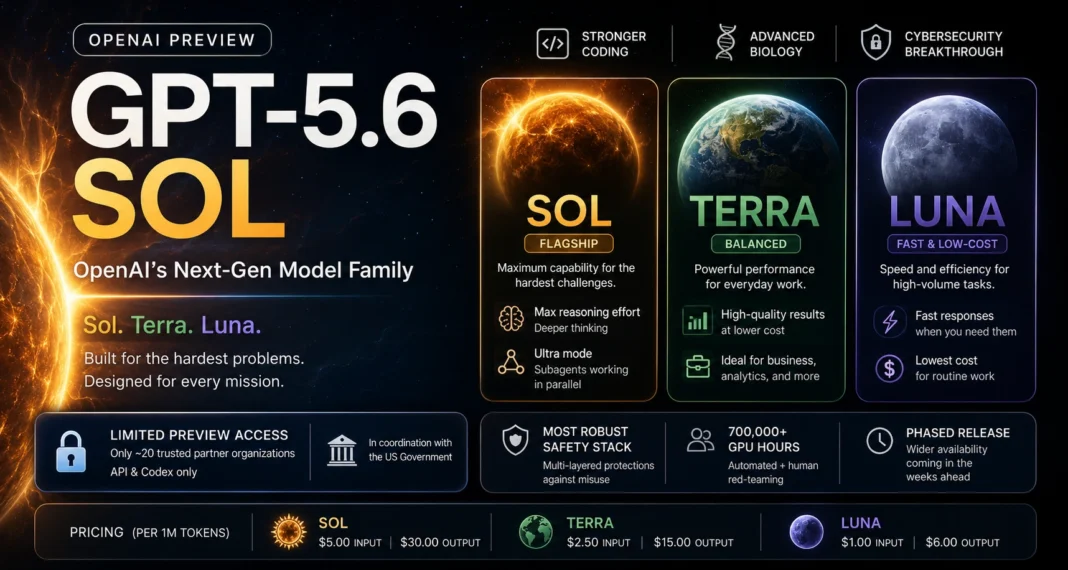
- On June 26, 2026, OpenAI began a limited preview of three new models: Sol (flagship), Terra (balanced, everyday work), and Luna (fast, low-cost).
- The GPT-5.6 family shows major gains in coding, biology research, and cybersecurity, including a new state-of-the-art score on Terminal-Bench 2.1.
- Two new modes ship with Sol: a
maxreasoning effort for deeper thinking, and anultramode that splits work across subagents. - Access is unusually restricted: only roughly 20 trusted partner organizations can use the models through the API and Codex, after OpenAI coordinated with the US government on a phased release tied to cyber-risk review.
- GPT-5.6 is not yet available in ChatGPT. A broader rollout is planned “in the coming weeks,” though no firm date has been announced.
- Pricing per million tokens: Sol at $5 input / $30 output, Terra at $2.50 / $15, Luna at $1 / $6.
Introduction
OpenAI just previewed its most capable model yet, and almost nobody outside a small list of partner companies can touch it.
That’s the strange part of the GPT-5.6 story. Normally, a flagship model launch means a same-day rollout to ChatGPT subscribers and open API access. This time, OpenAI built three new models, gave them a fresh naming system, posted strong benchmark results, and then said: only a pre-approved group gets in for now.
If you follow AI model releases, work in software, security, or biology research, or you’re just trying to figure out whether to wait for general availability, this guide breaks down everything currently known about GPT-5.6 Sol, Terra, and Luna, including the capability gains, the unusual access restrictions, and what it likely means for you.
What Is GPT-5.6, and Why Three Names Instead of One?
OpenAI’s announcement introduced a new naming convention. Instead of suffixes like “Instant” or “Thinking,” the GPT-5.6 generation ships as three durable capability tiers, each able to advance on its own schedule going forward.
- Sol — the flagship. Built for the hardest problems: long-horizon coding, security research, and complex multi-step reasoning. This is the model OpenAI leads with on every benchmark in the release, and the only tier with access to the new
maxandultramodes. - Terra — the balanced, everyday-work model. OpenAI positions it as roughly matching GPT-5.5’s performance while costing about half as much, aimed at high-volume business tasks like customer support, internal tooling, and document analysis.
- Luna — the fast, low-cost option. Intended for routine work such as summarization, drafting, and simple automation, where speed and price matter more than maximum reasoning depth.
The number (5.6) marks the generation. The name marks the tier. According to OpenAI, this should make it easier for developers to pick a model without constantly relearning what each version suffix actually means.
What’s New: Reasoning Modes and Subagents
Two features stand out as genuinely new mechanics rather than just performance bumps.
max reasoning effort gives Sol more time to think through a problem before answering. This sits above the existing reasoning-effort settings developers already use to trade off speed against depth.
ultra mode goes further. Instead of one model working through a task step by step, ultra mode splits the work across multiple subagents that can run pieces of a complex job in parallel, then combine the results. Early third-party benchmark write-ups show this isn’t just a marketing label — on Terminal-Bench 2.1, “Sol Ultra” scored meaningfully higher than plain Sol, which independent analysts pointed to as the clearest evidence yet that the subagent approach actually helps on real tasks.
Capability Gains: Coding, Biology, and Cybersecurity
OpenAI focused its capability claims on three areas.
Coding and Agentic Workflows
GPT-5.6 Sol set a new state-of-the-art score on Terminal-Bench 2.1, a benchmark that tests command-line workflows requiring planning, iteration across multiple steps, and coordinating tools — closer to how a developer actually works through a real task than a single isolated coding question.
Independent coverage comparing the field put Sol Ultra at roughly 92% on this benchmark, ahead of plain Sol, GPT-5.5, and several competing frontier models from other labs.
Biology and Scientific Research
On GeneBench v1, a benchmark for long-horizon genomics and quantitative biology analysis, GPT-5.6 Sol outperformed GPT-5.5 while using fewer tokens to do it — meaning better results at lower computational cost, which matters for labs running large batches of analyses.
Cybersecurity
This is where the release gets more complicated. OpenAI says GPT-5.6 Sol is its most capable model yet for security work, shifting what the company calls the “performance-efficiency frontier” for tasks like vulnerability research and exploit development. On an internal benchmark called ExploitBench, Sol reportedly performed competitively with OpenAI’s unreleased “Mythos Preview” model while using about a third of the output tokens. On ExploitGym, an external benchmark built by UC Berkeley researchers in collaboration with multiple frontier labs, all three GPT-5.6 tiers showed stronger cyber performance as their reasoning effort increased.
Importantly, OpenAI states the model did not cross what it calls the “Cyber Critical” threshold under its internal risk framework. In testing against Chromium and Firefox, the model could identify bugs and some of the building blocks of an exploit, but it did not autonomously assemble a complete, working exploit chain under the test conditions used.
Why Access Is So Restricted
This is the part of the launch that’s generated the most discussion. Rather than a typical staged rollout, GPT-5.6 Sol, Terra, and Luna are currently available only through the API and Codex, and only to a small number of pre-approved organizations — reportedly around 20.
According to OpenAI’s own announcement, this followed coordination with the US government ahead of launch. The company says that at the government’s request, it is starting with a limited preview for partners whose participation has been shared with officials, before expanding access more broadly. OpenAI explicitly states it does not believe government-gated access should become a permanent fixture of future model releases, framing the current arrangement as a short-term step tied to ongoing work on a cyber-related executive order and a repeatable review process for future launches.
Reporting on the release has tied this to a broader pattern: a separate executive order on AI benchmarking and pre-release assessment, and earlier action that reportedly restricted a rival lab’s access to some of its own models. Whatever the precise mechanics, the practical result for most developers and ChatGPT users right now is the same: there is no public waitlist, no self-serve signup, and access is determined by an existing OpenAI account relationship rather than by request.
GPT-5.6 is not currently available inside ChatGPT at all, even for paying subscribers. It’s API- and Codex-only during this preview phase.
Safety Stack: How OpenAI Is Trying to Contain Misuse
Because the cybersecurity gains are real, OpenAI paired this release with what it describes as its most robust safety stack to date, built in layers:
- Model-level training to refuse prohibited cyber assistance, including attempts to disguise intent or jailbreak the model.
- Real-time misuse classifiers that monitor cyber- and biology-related output as it’s generated. Higher-risk cases can trigger a pause while a separate, more powerful model reviews context before the response is released.
- Account-level review that looks across a user’s conversation history and risk signals, rather than judging a single message in isolation — useful for telling apart legitimate security research from a sustained attempt at misuse.
- Differentiated access, where the most sensitive capabilities are reserved for vetted accounts rather than exposed to everyone by default.
OpenAI also says it put more than 700,000 A100-equivalent GPU hours into automated red-teaming aimed specifically at finding “universal jailbreaks” — attacks that generalize across many prompts rather than working only in one narrow setting. That was paired with ongoing human expert red-teaming through third-party testers.
The company is upfront that this comes with friction: during the preview, legitimate users doing dual-use work like penetration testing or vulnerability research may occasionally get blocked or delayed while the system double-checks intent. OpenAI frames this as part of what the preview period is meant to surface and fix before wider release.
Pricing
GPT-5.6 pricing is set per million tokens:
| Model | Input (per 1M tokens) | Output (per 1M tokens) | Positioning |
|---|---|---|---|
| Sol | $5.00 | $30.00 | Flagship, hardest problems |
| Terra | $2.50 | $15.00 | Balanced, high-volume business use |
| Luna | $1.00 | $6.00 | Fastest, lowest cost |
Sol’s pricing matches GPT-5.5’s previous rate despite the capability jump. The family also introduces more predictable prompt caching: explicit cache breakpoints, a 30-minute minimum cache life, cache writes billed at 1.25x the uncached input rate, and cache reads still receiving a 90% discount.
OpenAI also announced GPT-5.6 Sol will run on Cerebras hardware at up to 750 tokens per second starting in July, initially for select customers, aimed at workloads where raw response speed matters as much as reasoning quality.
What This Means If You’re Not One of the ~20 Trusted Partners
For most developers and businesses, the honest answer right now is: wait. There’s no application form and no waitlist to join — access runs through existing OpenAI account relationships, and OpenAI has only said broader availability is coming “in the coming weeks” without committing to a date.
In the meantime, it’s worth treating the published benchmark numbers as directional rather than something you can verify on your own workload yet. Claims like “Terra is 2x cheaper than GPT-5.5 at similar performance” are based on OpenAI’s own evaluation suite; how that translates to your specific mix of tasks, prompt lengths, and tool use will vary.
If your work touches cybersecurity research, biosecurity-adjacent biology queries, or other dual-use areas, it’s also worth assuming the new safety classifiers will be stricter than what you’re used to from GPT-5.5, and budgeting time to test existing prompts against the new system once access opens up.
Frequently Asked Questions
What is GPT-5.6 Sol? GPT-5.6 Sol is OpenAI’s new flagship AI model, previewed on June 26, 2026, with major improvements in coding, biology research, and cybersecurity tasks, alongside a new “most robust safety stack to date.”
What’s the difference between Sol, Terra, and Luna? They’re capability tiers within the same generation. Sol is the most capable and most expensive, built for the hardest problems. Terra is a balanced, mid-cost model competitive with GPT-5.5. Luna is the fastest and cheapest, meant for routine, high-volume work.
Is GPT-5.6 available in ChatGPT? No. As of the preview launch, GPT-5.6 is only available through the API and Codex, and only to a limited group of trusted partner organizations. It is not in ChatGPT yet.
How do I get access to GPT-5.6 during the preview? There is no public waitlist or signup form. Access is limited to organizations with an existing OpenAI account representative relationship, and approval is granted on a case-by-case basis.
Why is the US government involved in this release? OpenAI says it previewed its plans and the models’ capabilities to the US government ahead of launch, and at the government’s request, began with a limited preview for vetted partners before a broader release, citing ongoing coordination on cyber-related AI policy.
What is the max reasoning effort? It’s a new setting available to Sol that allows the model to spend more time reasoning through a problem before responding, aimed at the hardest, most complex tasks.
What is ultra mode? Ultra mode uses multiple subagents to work on parts of a complex task in parallel, rather than relying on a single model thread, and is designed to speed up and improve results on long, multi-step work.
How much does GPT-5.6 cost? Per million tokens: Sol costs $5 input / $30 output, Terra costs $2.50 input / $15 output, and Luna costs $1 input / $6 output.
Did GPT-5.6 Sol pass OpenAI’s highest internal risk threshold for cybersecurity? No. OpenAI says Sol did not cross its “Cyber Critical” threshold. In tests against real browser codebases, it could find bugs and partial exploit components but did not autonomously build a complete, working exploit chain under the conditions tested.
What benchmarks did OpenAI use to show coding improvements? Terminal-Bench 2.1, which tests command-line workflows involving planning, iteration, and coordinating multiple tools — and is meant to reflect realistic developer workflows rather than isolated coding puzzles.
What is GeneBench v1? A benchmark for long-horizon genomics and quantitative biology analysis. GPT-5.6 Sol reportedly outperformed GPT-5.5 on it while using fewer tokens.
What is ExploitGym? An external cybersecurity benchmark built by UC Berkeley researchers in collaboration with several frontier AI labs, used to measure how models perform on exploit-related tasks as reasoning effort increases.
When will GPT-5.6 be generally available? OpenAI has said it plans to release the models more broadly to ChatGPT, Codex, and the API “in the coming weeks,” but has not given a specific date.
Does the new safety system block legitimate security research? OpenAI acknowledges that during the preview, legitimate dual-use work (like penetration testing or vulnerability research) may occasionally be slowed or blocked while automated systems check context, and says it’s using the preview period to reduce these false positives before wider release.
Is GPT-5.6 cheaper than GPT-5.5? It depends on the tier. Terra is positioned as roughly 2x cheaper than GPT-5.5 at similar performance. Sol is priced the same as GPT-5.5 despite higher capability. Luna is the cheapest of all three.
Sources
- OpenAI, “Previewing GPT-5.6 Sol: a next-generation model”, June 26, 2026.
- OpenAI Help Center, “A preview of GPT-5.6 Sol, Terra, and Luna”.
- VentureBeat, “OpenAI unveils GPT-5.6 Sol, Terra and Luna models — but only accessible to limited preview partners for now, per US Gov”.
- MacRumors, “OpenAI Launches GPT-5.6 Sol, Terra, and Luna in Limited Preview”.
- DataCamp, “GPT-5.6 Sol, Terra, and Luna: OpenAI’s Next-Gen Model Family”.
- Tech My Money, “OpenAI GPT-5.6 Sol Preview Shows Sol, Terra and Luna Tiers”.