Key Takeaways
- On May 19, 2026, Google rolled out what it calls its biggest Search overhaul in over 25 years.
- Gemini 3.5 Flash is now the default model powering AI Mode globally.
- The search box was redesigned to accept text, images, video, files, and Chrome tabs.
- Google launched “Information Agents” that scan the web continuously on a user’s behalf.
- Generative UI can now build custom dashboards, tables, and mini-apps directly inside search results, no click required.
- Personal Intelligence (which uses Gmail, Photos, and soon Calendar) expanded to nearly 200 countries.
- Google published its first official AI search optimization guide on May 15, 2026 — and its main message is that AEO/GEO are not separate disciplines from SEO.
Introduction
If you’ve felt like the ground keeps shifting under Google Search over the past two years, I/O 2026 confirmed it’s not just a feeling. On May 19, 2026, Google VP of Search Elizabeth Reid described it plainly at the keynote in Mountain View: Search is entering a new chapter where AI isn’t just a feature bolted onto results, it’s woven through the entire product.
For anyone running a website, doing SEO, or managing content strategy, this matters a lot. Rankings and clicks used to be the whole game. Now Google is actively building experiences where users never see a ranked list, never click a blue link, and get their answer as a custom-built mini app instead. So what exactly changed, and what should you actually do about it? Let’s break it down.
What Google Announced at I/O 2026
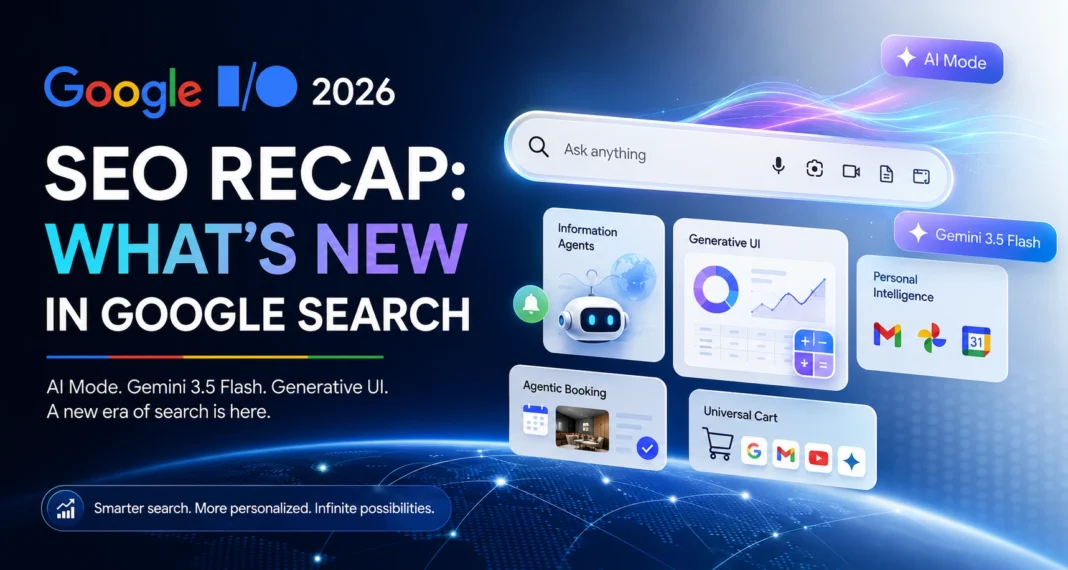
1. Gemini 3.5 Flash Becomes the Brain of AI Mode
Google replaced the AI model running AI Mode with Gemini 3.5 Flash, now the default worldwide. According to statements at the keynote, this model runs roughly four times faster than most frontier models, and even faster inside Google’s own infrastructure — fast enough to make the other features below technically possible at scale.
2. The Biggest Search Box Redesign in 25 Years
The search box itself got rebuilt. It’s now multimodal by default, accepting text, images, video, files, and even Chrome browser tabs from a single entry point. It expands dynamically for longer queries and offers AI-powered suggestions that go well beyond simple autocomplete, helping users articulate more complete questions.
Follow-up questions can now flow straight out of an AI Overview into full AI Mode without the user ever navigating away, meaning conversations extend and deepen without a single click to an outside website.
3. Information Agents: Background Search That Never Sleeps
This is arguably the most architecturally new idea from I/O 2026. Google introduced persistent background agents that operate continuously inside Search, monitoring the web on a person’s behalf. Describe what you’re looking for, an apartment that matches specific criteria, or a sneaker collab from a favorite athlete, and the agent keeps scanning and notifies you the moment something matches. These are rolling out first to Google AI Pro and Ultra subscribers.
4. Generative UI: Search Builds You an App, Not a List
Rather than returning a page of links or even a paragraph summary, Search can now assemble a custom interactive interface on the fly, think dashboards, comparison tables, calculators, or simulations, tailored to the exact question. A query about building a workout and meal plan, for example, could produce a working interactive tracker instead of a set of articles. This is powered by Google’s Antigravity platform and is expected to roll out to everyone, free, by summer 2026.
5. Personal Intelligence Expands to Nearly 200 Countries
Personal Intelligence lets AI Mode draw on a user’s own Gmail, Google Photos, and soon Calendar, when they choose to connect them. This means two people typing the identical query can get meaningfully different answers, since the response is shaped by their personal data. It launched earlier in 2026 as a US-only beta and is now expanding globally.
6. Agentic Booking and Universal Cart
Search is also taking on tasks, not just answering questions. Expanded agentic booking lets users describe specific criteria (like a private karaoke room for six that serves food late) and get bundled pricing, availability, and direct booking links. Alongside this, Google introduced Universal Cart, a shopping cart that spans Search, Gmail, YouTube, and the Gemini app, and automatically checks for better prices in the background after an item is added.
Why This Matters for SEO
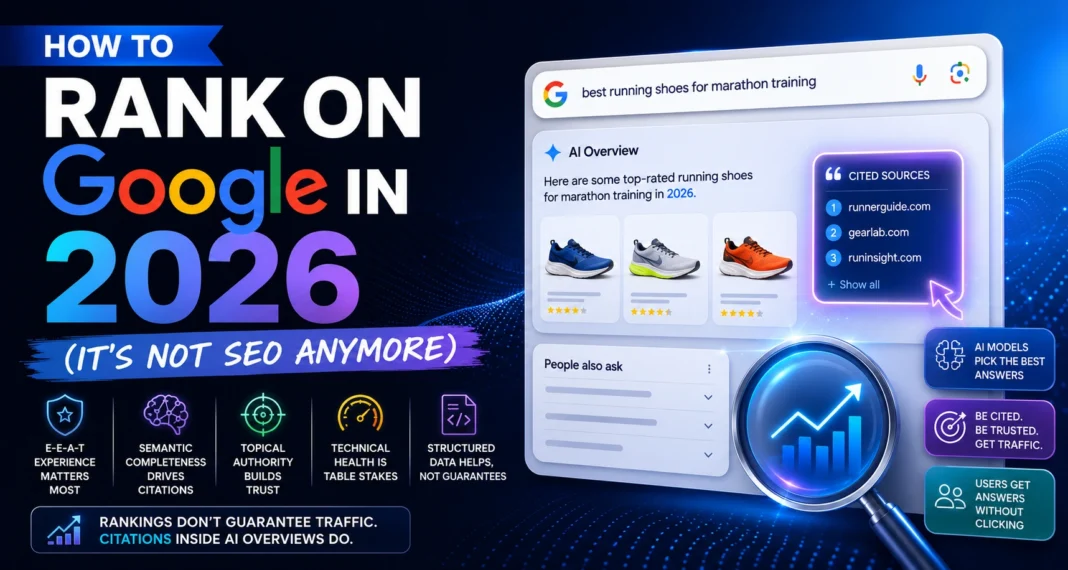
Here’s the uncomfortable stat at the center of all this: the overlap between top-10 Google rankings and AI Overview citations has collapsed from around 75% in mid-2025 to somewhere between 17% and 38% by early 2026, depending on which study you look at. Ranking #1 on Google no longer means you’ll be the one cited in the AI answer for that same query.
That’s a real structural shift. Google is now pulling from a wider pool of sources for AI answers, including Reddit threads, niche authority sites, and structured data feeds that might never crack a traditional top-ten list.
Google’s Own Guidance: SEO and GEO Aren’t Separate
Just four days before I/O, on May 15, 2026, Google’s Search Central team published its first official guide on optimizing for generative AI features in Search. The core message, straight from Google, is refreshingly direct: AEO and GEO are not a separate discipline. They’re SEO applied to an AI-powered surface, because AI Overviews and AI Mode are built on Google’s existing ranking and quality systems.
The guide flags five things that genuinely help:
- Unique, non-commodity content. Generic summaries an AI can already produce on its own earn no citation value. Original research, first-hand experience, and genuine expertise are what get pulled into an answer.
- Local and shopping data hygiene. Google Business Profiles and Merchant Center feeds directly shape what shows up for local and product queries.
- Structured, answer-ready content. Not stuffed with schema for schema’s sake, but genuinely organized so a machine can lift out a clear answer.
- Image and video optimization, since generative features increasingly pull from more than just text.
- Agent readiness. Since browser agents read your site by analyzing screenshots, the DOM, and the accessibility tree, broken booking flows or JavaScript-rendered pricing can make you invisible to an agent even if a human user has no trouble.
The guide also pushes back on some popular assumptions: it explicitly says structured data isn’t a magic requirement for AI visibility (though it’s still good general practice), and that there’s no special schema markup exclusively for AI features.
Common Mistakes to Avoid Right Now
- Chasing “AEO/GEO” as a brand-new discipline. Google itself says this is just SEO. Don’t pay for a completely separate strategy that ignores your existing technical foundation.
- Over-indexing on structured data alone. It helps with rich results, but it won’t single-handedly earn you an AI citation.
- Ignoring data hygiene. Outdated pricing, broken mobile booking flows, and JavaScript-only product specs can make agents skip your site entirely.
- Measuring success only by clicks and rankings. With Generative UI and Information Agents removing the click altogether, you need new signals: citation frequency, branded search growth, and AI referral traffic.
- Writing generic, summarizable content. If an AI can already produce your paragraph itself, it has no reason to cite you. Depth, original data, and a clear point of view are what earn a mention.
Expert Tips Not Commonly Discussed
- Pull your Search Console impression data and find which queries already trigger AI Overviews, then rebuild those specific pages to lead with a direct, extractable answer near the top.
- Treat your pricing, booking flows, and product specs as machine-readable assets, not just human-facing UI, since agents parse your DOM and accessibility tree, not just what looks nice.
- Watch for the “AI Overview Suspects” pattern in your own analytics: high ranking position, unusually low click-through rate, and healthy impression volume. That combination usually means you’re being summarized, not clicked.
What’s Next / Future Trends
Google says Generative UI, wider Information Agents access, and expanded agentic booking will all roll out broadly by summer 2026. AI Mode has already crossed one billion monthly users just a year after launch, and query volume is still climbing. Expect voice assistants to increasingly draw on the same generative answers, expect more core updates layered on top of this shift (Google’s May 2026 core update landed just two days after the AI guide), and expect the gap between “ranked” and “cited” to keep widening rather than closing.
Conclusion
Google I/O 2026 didn’t kill SEO, but it did retire the idea that ranking #1 is the finish line. Between Gemini 3.5 Flash, a rebuilt search box, background Information Agents, and Generative UI that can skip the click entirely, discovery now happens across a much wider surface than ten blue links. Google’s own guidance is reassuringly simple, though: keep doing real SEO well, unique content, technical health, structured and accessible data, and treat AI visibility as an extension of that work rather than a separate game to chase.
FAQ
1. Is AI Mode now the default Google Search experience? Not officially by name, but it’s functionally close. Standard searches already show AI Overviews, and follow-up questions now flow directly into full AI Mode.
2. What is Gemini 3.5 Flash? It’s Google’s newest AI model, now powering AI Mode globally. It’s built for speed, which is what makes features like background Information Agents possible at scale.
3. Do I need a separate AEO or GEO strategy? According to Google’s own May 2026 guide, no. AEO and GEO are described as SEO applied to an AI surface, not a separate discipline.
4. Does structured data guarantee AI citations? No. Google explicitly says structured data isn’t required for generative AI search and won’t by itself get you cited, though it still helps with traditional rich results.
5. What are Information Agents? Background AI features that continuously monitor the web for a user’s specific criteria (like apartment listings or product drops) and notify them when a match appears.
6. What is Generative UI in Search? A feature that builds a custom interactive interface, like a dashboard, table, or calculator, directly inside search results instead of returning links or a summary.
7. How much has Google’s AI changed click-through rates? Research cited around I/O 2026 suggests traditional link clicks drop noticeably when AI summaries appear, and clicking on citations within the summary itself is rare.
8. What is Personal Intelligence in Search? A feature that lets AI Mode draw on a user’s own Gmail, Photos, and soon Calendar (with permission) to personalize answers.
9. Will ranking #1 still matter in 2026? It still matters for traditional clicks, but it no longer guarantees you’ll be cited in an AI-generated answer for the same query.
10. What should I actually change in my SEO strategy after I/O 2026? Focus on unique, expert-led content, clean and accurate structured data for local/shopping, machine-readable pricing and booking flows, and track new metrics like citation frequency and branded search instead of relying only on rankings and clicks.