Key Takeaways
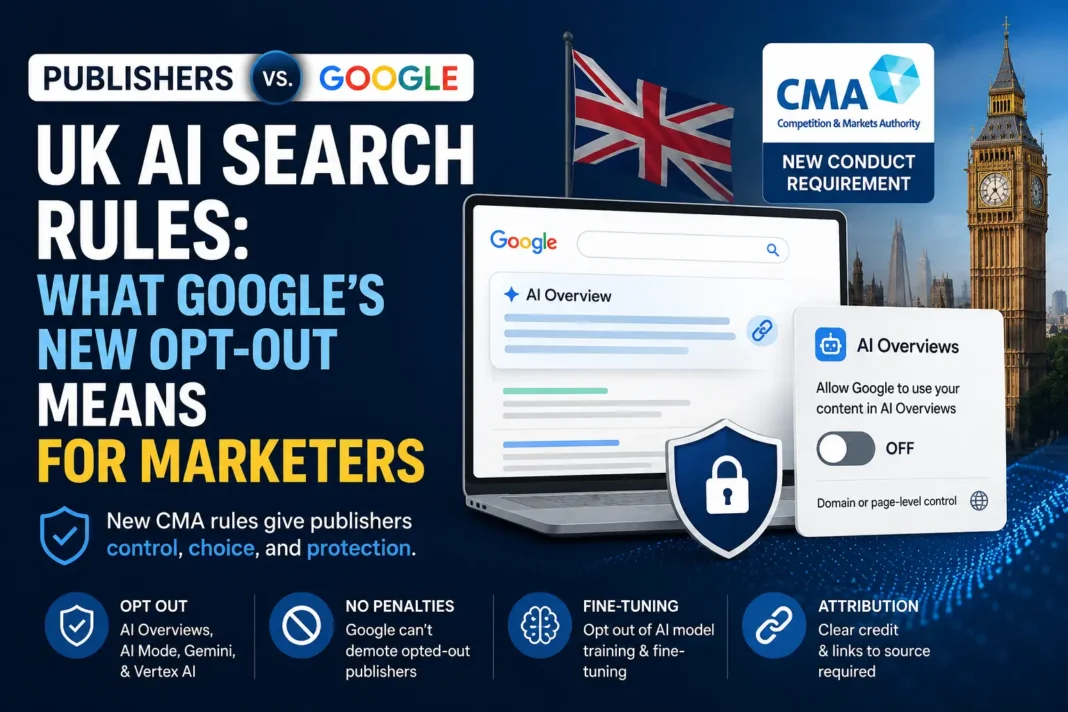
- On 3 June 2026, the UK’s Competition and Markets Authority (CMA) imposed a new conduct requirement on Google, calling it a world first.
- Publishers can now opt out of having their content power Google’s AI Overviews, AI Mode, Gemini, and Vertex AI — at the domain or page level.
- Google cannot punish opted-out publishers by demoting them in regular search results.
- A separate opt-out covers using publisher content to fine-tune AI models.
- Implementation rolls out in phases: core controls by around December 2026, page-level grounding controls by March 2027.
- The rule doesn’t force Google to pay publishers — that question is still open, with the CMA saying it will wait at least a year before deciding on licensing requirements.
- For marketers, this changes the calculus around AI Overviews visibility, structured data, and content protection strategy.
Why This Is Happening Now
For the last couple of years, AI Overviews have sat at the top of Google’s results, pulling answers straight from publisher content. Searchers got their answer without clicking through. Publishers got the traffic loss without the byline credit or the ad revenue.
Think of it like a chef who spends hours perfecting a recipe, only to watch someone else read it aloud to customers at the door — customers who never come inside to eat. The chef did the work. Someone else captured the value.
That imbalance is exactly what pushed the UK regulator to act. Google holds more than 90% of general search queries in the UK, which the CMA has described as a level of market control that ordinary competition law struggles to address. In October 2025, the CMA designated Google with “strategic market status” — a formal label that lets it impose specific, binding rules on Google’s search business without first proving wrongdoing in court.
The publisher conduct requirement announced on 3 June 2026 is the first rule to come out of that designation, and CMA chief executive Sarah Cardell has already signaled more is coming.
What the New Rules Actually Say
The Opt-Out Itself
Publishers can now block their content from feeding Google’s AI-generated summaries — AI Overviews, AI Mode, and the underlying Gemini and Vertex AI systems — without losing their ranking in standard search results. That separation matters. Previously, appearing in Google’s index at all meant implicitly accepting that your content could be scraped into an AI answer box.
Controls will sit inside Google Search Console, letting site owners make decisions at the whole-domain level or down to individual pages.
Protection From Retaliation
Google is barred from down-ranking or otherwise penalizing publishers who use the opt-out. That’s a meaningful guardrail given how dependent most publishers are on organic search traffic to survive.
A Separate Fine-Tuning Opt-Out
Beyond blocking content from live AI answers, publishers can also stop their content from being used to train or fine-tune Google’s AI models entirely. This is a broader, more permanent kind of control — it’s about keeping content out of the model’s “memory,” not just out of a single search result.
Attribution Requirements
Google must also make sure AI-generated answers clearly attribute and link back to the original source, giving readers a real path back to the publisher’s site.
Timeline
Google has roughly nine months from the June 2026 order to roll out full compliance, though the CMA wants meaningful tools available well before that. Reporting points to core publisher controls landing by December 2026, with the more granular page-level grounding controls following by March 2027.
What’s Still Unresolved
The rule gives publishers a lever, not a paycheck. The CMA has explicitly said it will wait at least a year before deciding whether to force Google into fair licensing negotiations with publishers. Trade bodies welcomed the opt-out but were quick to point out that controlling your content isn’t the same as recovering lost revenue.
There’s also a genuine trade-off built into the system. Opt out, and you protect your content but risk losing whatever visibility AI features still provide. Stay in, and you keep feeding a system that’s already been linked to a steep rise in “zero-click” searches — moments where the user gets their answer without ever visiting a website.
| Approach | What You Keep | What You Risk |
|---|---|---|
| Opt out of AI Overviews | Full control over your content, no AI summarization of your work | Possible loss of visibility as Google leans further into AI-driven search |
| Stay opted in | Continued exposure inside AI summaries, attribution and a link back | Continued zero-click traffic loss without direct compensation |
What This Means for Marketers and SEOs
This isn’t just a publisher-and-platform story. If you run content marketing, SEO, or digital PR for any brand, this changes how you should be thinking about visibility right now.
1. Audit your AI Overviews exposure. Use Search Console data to see how much of your traffic currently comes through AI-generated summaries versus traditional blue links. You can’t make a smart opt-in/opt-out call without knowing your starting point.
2. Reconsider your highest-value content. Evergreen guides, proprietary research, and anything with strong commercial intent (think product comparisons or “best of” lists) are prime candidates for protection, since these are the pages most likely to be summarized — and most likely to drive real conversions if a human actually visits.
3. Don’t assume opting out is automatically the right move. For many sites, especially those relying on broad informational queries, staying visible inside AI Overviews — with strong attribution — may still beat invisibility.
4. Watch your structured data and schema markup. Clear, accurate Article, FAQPage, and HowTo schema will matter even more once granular grounding controls roll out, since AI systems will lean on structured signals to decide what to surface and how to attribute it.
5. Expect more regulatory moves. The CMA has already said further action on Google’s search business is coming. Build flexibility into your content strategy rather than treating this as a one-time decision.
Common Mistakes to Avoid
- Opting everything out by default. Blanket opt-outs can tank visibility for content that actually benefits from AI exposure. Decide page by page.
- Ignoring attribution settings. If you stay opted in, check that your branding and links are showing up correctly in AI summaries once tools roll out.
- Waiting until December 2026 to plan. Controls are arriving in phases — start auditing your content and traffic sources now.
- Treating this as a UK-only issue. Other regulators are watching closely; similar rules may follow elsewhere.
- Confusing the AI Overviews opt-out with the fine-tuning opt-out. They’re separate switches with separate consequences — read the documentation carefully before flipping either.
Expert Tips
- Segment your content by commercial value before deciding on opt-out status — don’t apply one rule to your whole site.
- Track “AI Overview appearance rate” alongside traditional ranking metrics in your reporting from now on.
- Build a quarterly review cadence for these settings, since the rules and Google’s own AI rollout are both still moving.
What’s Next
The CMA has signaled that the fair-payment question is far from closed, and a decision on whether to mandate licensing negotiations could land within the next year. Other regulators — in the EU, and potentially in the US — are likely to study how this opt-out model performs before deciding whether to copy it. For marketers, the safest bet is to treat 2026 as a transition year: build the measurement habits and content governance now, so you’re not scrambling when the next phase of rules lands.
Conclusion
The UK has handed publishers a genuine, if partial, win: real control over whether their work powers Google’s AI answers, with protection against retaliation. It hasn’t solved the money problem, and it won’t be the last word from the CMA. For marketers, the job now is practical — know your AI exposure, make page-level calls instead of blanket ones, and keep an eye on the next round of regulatory action.
FAQ
What did the UK CMA announce about Google AI search? On 3 June 2026, the CMA imposed a new conduct requirement letting publishers opt out of having their content power Google’s AI Overviews and related AI features.
Can Google penalize publishers who opt out? No. The rule specifically bars Google from down-ranking opted-out publishers in standard search results.
Does the opt-out apply to Gemini and Vertex AI too? Yes. The conduct requirement covers AI Overviews, AI Mode, Gemini, and Vertex AI.
Is there a separate opt-out for AI model training? Yes. Publishers can also stop their content being used for fine-tuning Google’s AI models, independent of the AI Overviews opt-out.
When do these controls go live? Google has about nine months to comply, with core controls expected around December 2026 and page-level controls by March 2027.
Does this mean Google has to pay publishers now? Not yet. The CMA has said it will wait at least 12 months before deciding whether to require licensing payments.
Why did the CMA have the power to do this? Google was designated with “strategic market status” in October 2025 due to its dominant share of UK search, which allows the CMA to impose targeted conduct requirements.
Will opting out hurt my traffic? It depends on the page. Highly clicked-through content may benefit from opting out; broad informational content may lose visibility if removed from AI summaries.
Where do publishers manage these settings? Through Google Search Console, with controls available at the domain and page level.
Is this a global rule or UK-only? Currently UK-only, tied to the UK’s Digital Markets, Competition and Consumers Act 2024, though it may influence other regulators.
What’s the biggest risk for marketers right now? Making a blanket decision without first measuring how much current traffic comes through AI Overviews versus traditional search results.
Will Google have to attribute content in AI answers? Yes, the rule requires clear attribution and a link back to the original source in AI-generated search results.
Has Google responded to the ruling? Google has raised concerns that some requirements could have disproportionate effects on users, publishers, and its ability to invest in UK products, while saying it is reviewing the order.
Is more regulation coming? The CMA has said further action on Google’s search business will be announced in the coming weeks and months.
Should small businesses care about this? Yes — any business relying on organic search or AI-generated answers for visibility should understand how opt-out decisions by publishers and competitors could reshape the search landscape they compete in.