Key Takeaways
- Agentic AI differs from earlier marketing automation because agents pursue objectives (“reduce churn by 15%”) rather than just following fixed rules.
- Research from McKinsey suggests agentic AI could support up to two-thirds of current marketing activities, with organizations reporting 10–30% revenue growth from more personalized execution.
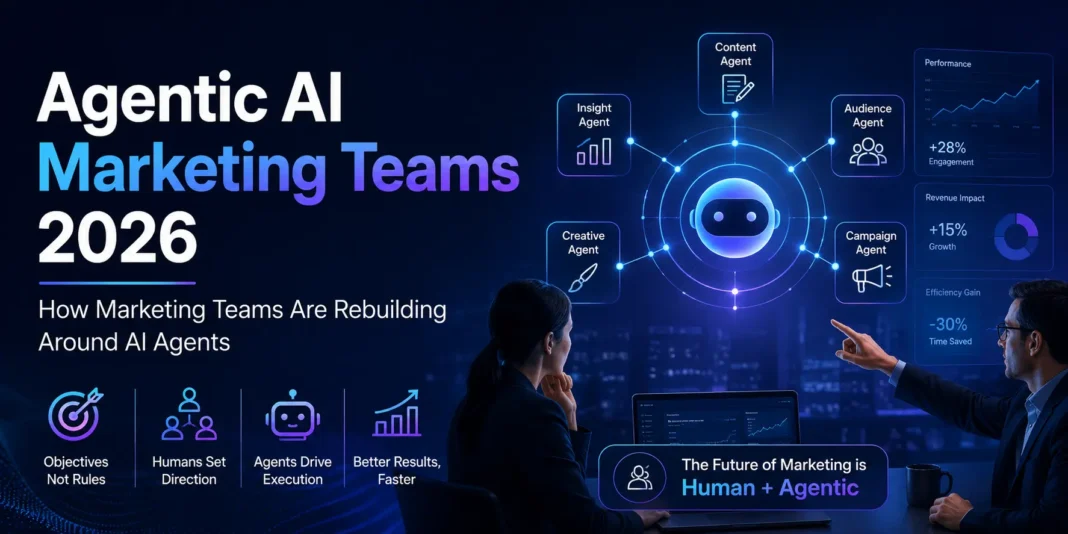
- The most effective model is a hybrid human-agent workforce: humans set objectives and guardrails, agents handle multi-step execution.
- Multi-agent orchestration — specialized agents working together rather than one all-purpose agent — is becoming the dominant architecture.
- System interoperability, not the underlying AI model, is usually the real bottleneck to adoption.
- Nearly 90% of CMOs are testing AI applications, but fewer than 10% have deployed end-to-end agentic workflows that generate measurable value — there’s a real gap between experimentation and execution.
- New roles are emerging: workflow architects, agent governance leads, and AI workforce managers who coordinate blended human-AI teams.
Why “Agentic” Is Different From Plain Automation
It helps to picture the difference with a simple analogy. Old-school marketing automation is like a vending machine: you press a button, it gives you exactly what’s programmed, every time, no matter what’s happening around it. Generative AI is more like a very fast intern: you ask it to write something, and it writes it, but it waits for your next instruction.
Agentic AI is closer to hiring a junior team member who actually owns a goal. You don’t tell it “send this email at 9am.” You tell it “increase engagement in this segment by 15%,” and it figures out which emails to send, when, to whom, and adjusts based on what’s working — without waiting for you to approve every step.
That shift, from instructions to objectives, is what’s driving organizations to rethink not just their tools but their team structure.
What’s Actually Changing Inside Marketing Teams
From Channel Silos to Workflow Pods
Traditional marketing teams were built around channels: a social team, an email team, a paid media team, each with its own handoffs and approval chains. Agentic systems work better across that structure than within it, because a single workflow — say, lead nurturing — touches multiple channels at once.
The emerging model for 2026 is a hybrid: marketers keep their channel expertise, but teams are reorganized into cross-functional pods built around outcomes like acquisition, retention, content supply chain, and insights, with agents coordinating the handoffs that used to require multiple people and multiple meetings.
Specialized Agents, Working as a Team
Rather than one general-purpose AI doing everything, organizations are building ecosystems of specialized agents: a brand consistency agent, a competitive intelligence agent, a customer lifecycle agent, each handling a narrow slice of the work and collaborating with the others. One large consumer brand reportedly identified close to 100 individual modular agents just within its content generation process — reusable building blocks that could plug into multiple workflows like creative development, sales collateral, and partner co-marketing.
The Marketer’s Role Shifts to Orchestration
The marketer doesn’t disappear from this picture — the job changes shape. Content creators move toward becoming brand voice strategists who set the rules agents must follow. Analysts become insight interpreters who decide what the data means rather than just pulling reports. The most in-demand skill stops being mastery of a specific tool and becomes the ability to ask the right questions and supervise a team of agents effectively.
New Governance Roles
As agents take on more execution, new oversight roles are appearing: people responsible for validating agent outputs, maintaining brand and regulatory compliance, managing the data quality agents depend on, and coordinating how agents interact with CRM, CMS, and analytics systems. Some organizations are formalizing this as an “AI workforce manager” role, responsible for assigning work between human staff and agents based on risk and context, and tuning agent performance over time.
Comparison: Traditional Automation vs. Agentic AI
| Feature | Traditional Automation | Agentic AI |
|---|---|---|
| Input | Fixed rules and triggers | High-level objectives |
| Adaptability | Static until manually updated | Learns and adjusts in real time |
| Scope | Single task or channel | Multi-step, often cross-channel |
| Human role | Operator pressing buttons | Strategist setting goals and guardrails |
| Failure mode | Predictable, rule-bound errors | Can optimize toward the wrong goal if data is poor |
The Real Bottleneck Isn’t the AI
One pattern shows up across nearly every report on this shift: the limiting factor is rarely the intelligence of the model. It’s whether the agent can actually plug into the company’s existing systems — data platforms, content repositories, CRM, and activation tools. Many marketing technology stacks were built for human operators clicking through dashboards, not for agents calling APIs in real time. That fragmentation is often called the “gen AI paradox”: the technology is everywhere, but it hasn’t yet shown up clearly on the bottom line for most companies.
Common Mistakes to Avoid
- Bolting agents onto old workflows instead of redesigning them. Agentic AI delivers the least value when it’s just automating a broken process faster.
- Skipping the data audit. Agents making autonomous decisions on bad CRM or analytics data will optimize confidently toward the wrong outcome.
- Deploying agents with no governance layer. Without brand guardrails and review checkpoints, autonomous agents can drift from brand voice or compliance requirements quickly.
- Treating this as a tools purchase rather than an operating-model change. Buying an “agent platform” without redesigning team roles and workflows rarely produces the promised gains.
- Trying to do everything at once. Most successful rollouts start with one high-value workflow, prove it out, and scale only once trust and performance are demonstrated.
Expert Tips
- Start your agentic rollout with a workflow that has clear, measurable outcomes — campaign reporting or lead scoring tend to be easier wins than full customer-journey orchestration.
- Build a “scorecard” that tracks both efficiency (time to launch, content throughput) and trust metrics (error rates, compliance flags), not just speed.
- Invest in unified data layers and consistent identity frameworks before scaling agent count — interoperability problems compound quickly once you have more than a handful of agents running.
- Keep a human checkpoint at key decision points even in mature deployments; full autonomy isn’t the goal, reliable collaboration is.
What’s Next: Future Trends
Expect multi-agent orchestration to become the default architecture rather than the exception, with specialized agents increasingly coordinated by a dedicated orchestrator layer. Natural language interfaces are likely to replace many traditional dashboards, letting marketers direct campaigns through conversation instead of configuration screens. As enterprise software embeds more task-specific agents by default, the distinction between “marketing software” and “marketing agents” will likely blur into a single category. At the same time, privacy-first targeting will keep pushing organizations toward first-party data, with agents increasingly responsible for finding patterns in that data that manual analysis would miss.
Conclusion
Agentic AI isn’t just a faster version of the automation marketing teams already use — it’s a different relationship between humans and software, where agents pursue goals rather than execute fixed instructions. The teams seeing real results in 2026 aren’t the ones with the most tools; they’re the ones that redesigned their workflows, fixed their data foundations, and built clear governance before scaling up. For most organizations, the work ahead is less about chasing the newest agent platform and more about becoming genuinely workflow-first instead of tool-first.
FAQ
What does “agentic AI” mean in marketing? It refers to AI systems that can plan and execute multi-step tasks autonomously toward a defined goal, rather than simply following fixed rules or generating content on request.
How is agentic AI different from marketing automation? Traditional automation follows static if-then rules until a human updates them. Agentic AI receives an objective and decides which actions to take, adapting as conditions change.
What revenue impact has agentic AI shown so far? Research from McKinsey points to organizations seeing 10–30% revenue growth from more personalized, agent-driven campaigns.
Do AI agents replace marketing teams? No. The dominant model is a hybrid human-agent workforce, where people set objectives and guardrails while agents handle execution, and people shift toward strategy and oversight roles.
What is multi-agent orchestration? It’s an architecture where several specialized agents — each handling a narrow task — collaborate on a larger workflow, coordinated by an orchestrator agent, rather than relying on one general-purpose system.
What’s the biggest barrier to adopting agentic AI in marketing? System interoperability — connecting agents reliably to existing CRM, CMS, and analytics platforms — is more often the limiting factor than the capability of the AI model itself.
What new job roles are emerging because of agentic AI? Roles like workflow architect, AI workforce manager, and agent governance lead are appearing to coordinate and oversee blended human-AI teams.
How many companies have actually deployed agentic workflows successfully? Reports suggest nearly 90% of CMOs are experimenting with AI, but fewer than 10% have deployed full end-to-end agentic workflows that generate measurable business value.
Where should a marketing team start with agentic AI? With one high-value, measurable workflow — such as campaign reporting or lead scoring — before scaling to more complex, cross-channel orchestration.
What governance is needed for AI agents in marketing? Clear brand guardrails, data quality checks, compliance review, and human checkpoints at key decision points are essential to prevent agents from drifting off-brand or making poor autonomous decisions.
Will agentic AI change how marketing teams are structured? Yes — many organizations are shifting from channel-based silos toward cross-functional workflow pods built around outcomes like acquisition, retention, and content supply chain.
Is agentic AI only for large enterprises? No. Low-code and no-code agent-building platforms are making it accessible to smaller teams, though governance and data quality remain just as important regardless of company size.