Key Takeaways
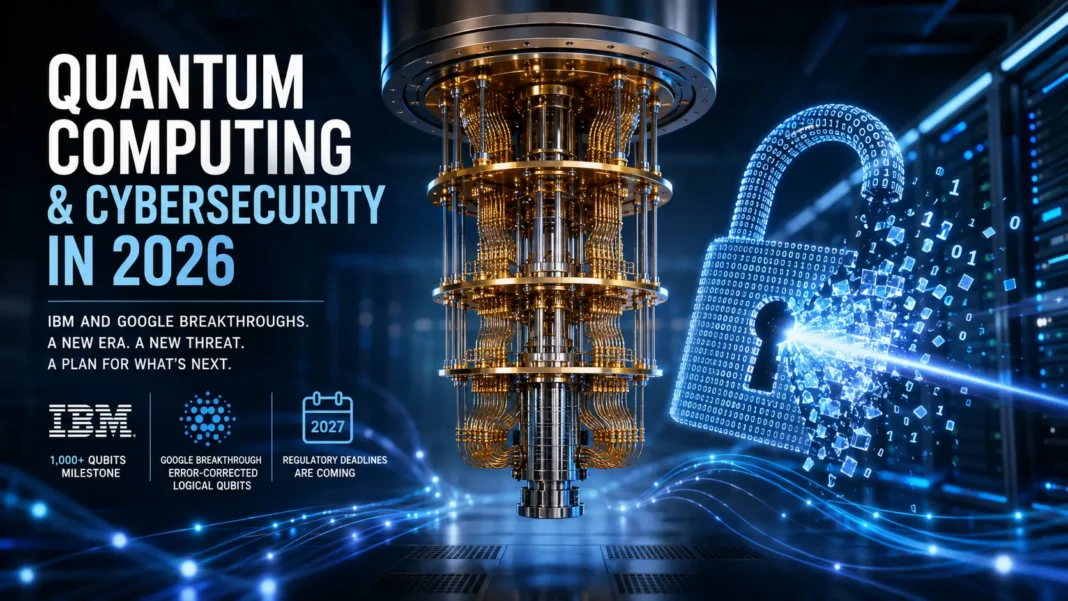
- IBM and Google have both crossed major milestones in 2026 — IBM with processors topping 1,000+ qubits, Google with error-corrected “logical qubits” that hold their quantum state far longer than before.
- These aren’t lab toys anymore. Quantum computers are starting to solve real problems faster than classical supercomputers can.
- The flip side: today’s encryption — the stuff protecting your bank details, your company’s data, your private messages — is vulnerable to powerful enough quantum computers.
- Governments are already moving. US federal agencies have a 2027 deadline to switch to “post-quantum cryptography.” Big browsers and phone makers are quietly doing the same.
- You don’t need a quantum computer to start preparing. You need an inventory of where you use vulnerable encryption, and a plan to swap it out.
Introduction
Imagine a lock that’s been unbreakable for forty years. Banks trust it. Governments trust it. Your phone trusts it every time you check your email. Now imagine someone invents a key that opens that lock in seconds — not next year, but possibly within the next decade.
That’s the quiet panic spreading through cybersecurity teams in 2026. It’s not science fiction anymore. IBM and Google have both announced real, measurable progress on quantum computers — machines that calculate using the strange rules of quantum physics instead of regular 1s and 0s. And one of the first things these machines will be good at is breaking the encryption that protects almost everything online.
This isn’t a “someday” problem. It’s a “start now” problem. In this article, we’ll explain what actually happened with IBM and Google’s quantum computers in 2026, why it matters for your business even if you’ve never touched a quantum chip, and what steps real companies are taking to protect themselves.
What you’ll learn:
- What IBM’s and Google’s 2026 quantum milestones actually mean, in plain English
- Why quantum computers threaten current encryption
- What “post-quantum cryptography” is and why it’s suddenly everywhere
- A simple action plan for getting your organization quantum-ready
- Common mistakes companies make when thinking about this threat
What Actually Happened in 2026? (Explained Like You’re 10)
Think of a regular computer like a light switch — it’s either on or off, a 1 or a 0. A quantum computer is more like a dimmer switch that’s spinning so fast it’s kind of on and off at the same time. That weirdness, called superposition, lets a quantum computer test many possibilities at once instead of one at a time.
For years, quantum computers were impressive in theory but useless in practice. They made too many mistakes — physicists call this “noise” — to do anything meaningful.
In 2026, that changed in two important ways:
IBM scaled up. IBM’s newest quantum processors have crossed the 1,000-qubit mark, a major jump from the hundreds-of-qubits machines of just a couple years ago. More qubits means more raw computing potential, similar to adding more cores to a regular computer chip.
Google got more reliable. Google’s approach has focused less on raw qubit count and more on accuracy. Their newer systems group several “noisy” physical qubits together to form one stable “logical qubit” that holds its quantum state far longer than before — a breakthrough known as error correction. Google has also demonstrated specific calculations that run dramatically faster on its quantum hardware than on the world’s best classical supercomputers, for certain narrow types of problems.
Put simply: machines that used to be fragile science experiments are starting to look like real computers you could eventually build a business around.
Expert Tip
Don’t get distracted by qubit counts alone. A machine with fewer, more stable qubits can sometimes outperform one with more, noisier qubits. When evaluating vendor claims, ask about error rates and coherence time, not just the headline number.
Why This Is a Cybersecurity Story, Not Just a Tech Story
Most of the encryption protecting the internet today — the kind that secures your banking app, your company’s VPN, your encrypted emails — relies on math problems that are extremely hard for regular computers to solve. Factoring huge numbers, for example, would take a classical computer longer than the age of the universe.
A sufficiently powerful quantum computer, running a known method called Shor’s algorithm, could theoretically solve that same problem in hours or minutes.
We’re not there yet. Today’s quantum machines aren’t strong enough to break real-world encryption. But two things make this urgent anyway:
- “Harvest now, decrypt later.” Attackers — including nation-states — can record encrypted data today and simply wait until quantum computers are strong enough to unlock it. If your data needs to stay secret for 10+ years (health records, trade secrets, government files), it’s already at risk.
- Migration takes years. Replacing the cryptography baked into every app, device, and protocol across a large organization isn’t a weekend project. It’s a multi-year undertaking, which is exactly why regulators are pushing companies to start now.
Common Mistake
Treating this as “future IT’s problem.” The migration timeline is long enough that delaying by even a year or two can mean missing regulatory deadlines or scrambling under pressure later.
What Is Post-Quantum Cryptography?
Post-quantum cryptography (PQC) is a new generation of encryption methods designed to resist attacks from quantum computers, while still running on the regular computers and phones we use today.
These new methods rely on different kinds of math problems — like complex lattice structures — that, as far as we currently know, stay hard even for quantum machines.
Standards bodies finalized the first official PQC algorithms a couple of years ago, and 2026 is the year adoption is visibly accelerating:
- Major browsers and operating systems are beginning to default to quantum-safe encryption for secure web connections.
- Government agencies in several countries face hard deadlines — many around 2027 — to complete their transition for sensitive systems.
- Cloud providers now offer “quantum-safe” key exchange and encryption services as a standard option, not a special request.
Comparison: Classical Encryption vs. Post-Quantum Cryptography
| Feature | Classical Encryption (RSA/ECC) | Post-Quantum Cryptography |
|---|---|---|
| Based on | Factoring large numbers, elliptic curves | Lattice-based, hash-based, code-based math |
| Vulnerable to quantum attack | Yes (via Shor’s algorithm) | No (currently believed resistant) |
| Maturity | Decades of real-world use | Newly standardized, early rollout |
| Performance | Well-optimized, lightweight | Often larger keys/signatures, improving fast |
| Who’s adopting it now | Being phased out for sensitive data | Browsers, OS vendors, cloud providers, governments |
A Step-by-Step Tutorial: Getting Your Organization Quantum-Ready
You don’t need a PhD in physics to start. Here’s a practical, staged approach security teams are using in 2026.
Step 1: Build a cryptographic inventory. List every place your organization uses encryption — websites, internal apps, VPNs, databases, IoT devices, partner integrations. Most companies are shocked at how scattered this is.
Step 2: Prioritize by data sensitivity and lifespan. Rank systems by how long the data needs to stay confidential. A 10-year trade secret needs attention sooner than a password reset email that expires in an hour.
Step 3: Identify “crypto-agile” gaps. Crypto-agility means how easily a system’s encryption can be swapped without rebuilding the whole thing. Older, hardcoded systems are higher risk and need earlier attention.
Step 4: Pilot post-quantum algorithms in low-risk environments. Test PQC libraries (many are open-source and supported by major cloud providers) in non-critical systems first, to catch performance issues like larger key sizes.
Step 5: Work with vendors and partners. Ask software and cloud vendors directly about their PQC roadmap. Your security is only as strong as the weakest link in your supply chain.
Step 6: Train your team. Most engineers have never worked with lattice-based cryptography. Budget time for learning, not just tooling.
Best practice: Treat this like the Y2K migration or the move from SHA-1 to SHA-2 — a slow-moving but unavoidable industry-wide transition. The companies that start early avoid the panic later.
Troubleshooting tip: If PQC algorithms are slowing down your systems, check whether you’re using “hybrid” implementations (classical + post-quantum combined) — these are heavier but offer a safer migration path than switching cold.
Benefits of Acting Now
Main benefits:
- Avoids a last-minute scramble as deadlines approach
- Protects long-lifespan data from “harvest now, decrypt later” attacks
- Builds genuine trust with customers and partners in regulated industries
- Positions your security team as forward-thinking rather than reactive
Real-world applications: Healthcare providers protecting patient records, financial institutions securing transaction systems, governments protecting classified communications, and any company holding intellectual property with long-term value.
Who should prioritize this now: Regulated industries (finance, healthcare, government, defense), companies with long-lifespan sensitive data, and any organization subject to compliance frameworks that reference quantum readiness.
Who can wait a bit longer: Small businesses with short-lived, low-sensitivity data — though even they should at least start the inventory step, since it’s cheap and prevents surprises.
Common Mistakes to Avoid
- Assuming “we’ll deal with it when quantum computers are actually a threat.” By then, your migration window is gone.
- Only updating external-facing systems. Internal systems and legacy infrastructure are often the most vulnerable and the hardest to fix later.
- Ignoring vendor and supply-chain risk. Your own systems can be quantum-safe while a partner’s aren’t, leaving a gap attackers can exploit.
- Treating this purely as an IT task. It needs executive sponsorship and budget, since it touches nearly every system in the company.
- Skipping the inventory step. You cannot protect what you haven’t mapped. Teams that jump straight to “buying a PQC solution” often miss major exposure points.
Expert Tips Not Commonly Discussed
- Watch your backups and archives, not just live systems. Encrypted backups from years ago may need re-encryption once your active systems migrate.
- Hybrid cryptography is your friend during transition. Running classical and post-quantum encryption side-by-side reduces risk if a new algorithm is later found to have a flaw.
- Quantum readiness is becoming a procurement criterion. Expect RFPs and vendor contracts to start including quantum-safe requirements within the next two years.
Future Trends: What’s Next
- Fault-tolerant quantum computing — machines reliable enough for sustained, error-free calculations — is expected to mature significantly before the end of the decade, narrowing the gap between “impressive demo” and “everyday business tool.”
- Quantum key distribution (QKD) networks, which use quantum physics to detect eavesdropping on communication lines, are expanding beyond research labs into pilot deployments for critical infrastructure.
- AI and quantum computing are converging, with early experiments suggesting quantum hardware could eventually speed up parts of machine learning training.
- Regulatory pressure will intensify, with more countries following the lead of early movers and setting hard migration deadlines for critical sectors.
Conclusion
Quantum computing went from a physics curiosity to a boardroom topic faster than almost anyone expected. IBM and Google’s 2026 breakthroughs prove the technology is advancing on two fronts at once: scale and reliability. That combination is what eventually breaks today’s encryption — not next month, but soon enough that “later” is already a risky bet.
The good news is that this is a manageable problem if you start now. Build your cryptographic inventory, prioritize your most sensitive and long-lived data, pilot post-quantum algorithms, and push your vendors for their roadmaps. The organizations that treat this as a multi-year project starting today will be the ones that aren’t scrambling when quantum computers finally cross the threshold that matters.
FAQ Section
1. What is quantum computing in simple terms? It’s a type of computer that uses quantum physics to process multiple possibilities at once, instead of one at a time like regular computers.
2. Can quantum computers break encryption today? Not yet. Current quantum computers aren’t powerful or stable enough to break widely used encryption, but progress is accelerating.
3. What is post-quantum cryptography? It’s a new set of encryption methods designed to stay secure even against attacks from powerful quantum computers.
4. Why are IBM and Google’s 2026 announcements significant? IBM crossed major qubit-count milestones, while Google achieved meaningful error correction, making quantum computers more stable and useful for real problems.
5. What does “harvest now, decrypt later” mean? It refers to attackers collecting encrypted data today, planning to decrypt it once quantum computers become powerful enough.
6. When do companies need to switch to quantum-safe encryption? Many regulators have set deadlines around 2027 for critical sectors, but a full migration can take years, so starting now is recommended.
7. Is post-quantum cryptography slower than current encryption? Some post-quantum algorithms use larger keys and can be slightly slower, though performance is improving with newer implementations.
8. Do small businesses need to worry about quantum computing? Small businesses with short-lived, low-sensitivity data have more time, but should still start a basic cryptographic inventory.
9. What industries are most at risk? Finance, healthcare, government, and defense, due to long-lived sensitive data and strict compliance requirements.
10. What is a logical qubit? It’s a stable, error-corrected unit made from multiple physical qubits working together, which holds quantum information longer and more reliably.
11. What is quantum key distribution (QKD)? A method of securely exchanging encryption keys using quantum physics, which can detect if someone is eavesdropping on the exchange.
12. How can a company start preparing for quantum threats? Start with a cryptographic inventory, prioritize sensitive long-lived data, and pilot post-quantum algorithms in low-risk systems.
13. Will quantum computers replace regular computers? No. Quantum computers excel at specific types of problems and are expected to work alongside classical computers, not replace them.
14. What is Shor’s algorithm? A quantum algorithm capable of factoring large numbers efficiently, which is the mathematical basis of much of today’s encryption.
15. Are browsers already using post-quantum cryptography? Yes, several major browsers and operating systems have begun defaulting to quantum-safe encryption for secure connections in 2026.