Key Takeaways
- Google published a new Search Central document on June 5, 2026, titled “Google Search’s guidance on using third-party SEO tools, services, and advice,” and simultaneously updated its older “Do you need an SEO?” page.
- The core message: third-party tools don’t have access to Google’s internal ranking data and can’t guarantee performance, regardless of what their marketing implies.
- Google explicitly named AEO and GEO (“answer engine optimization” and “generative engine optimization”) tools as a category to evaluate with the same care as traditional SEO services.
- Google does not endorse any third-party tool or service, and warns site owners to be wary of any vendor implying otherwise.
- Google continues to recommend Search Console as the one tool that provides data directly from Google Search itself, rather than a third-party approximation.
If you’ve ever sat through a sales call where a vendor claimed their tool’s “Google-approved methodology” would guarantee a ranking boost, Google just handed you a documentation page to push back with. On June 5, 2026, Google Search Central quietly added a new guidance document specifically about third-party SEO tools, services, and advice, and it doesn’t pull punches.
What the New Guidance Actually Says
The document’s stated purpose is straightforward: highlight important considerations when evaluating third-party SEO tools and advice, while simplifying some of the older documentation and removing outdated examples. But the actual content goes further than a simple update.
Google states plainly that some third-party services provide data that users misinterpret as somehow coming from Google itself, and clarifies that third-party tools don’t have access to Google’s internal ranking data, full stop. Any predictions those tools make are their own, not Google’s, and like predictions generally, Google notes, they may simply not happen.
The guidance lists specific categories of third-party services worth evaluating carefully: sitemap tools, indexing tools, content generation services, ranking advice services, and tools promising improvements for AEO or GEO. That last category is the newest addition, and it’s a meaningful one. Google explicitly grouped “answer engine optimization” and “generative engine optimization” tools, services built around the relatively new idea of optimizing for AI-generated answers rather than traditional rankings, into the same skeptical evaluation framework as older, more established SEO tool categories.
The “Google Doesn’t Endorse Anyone” Message
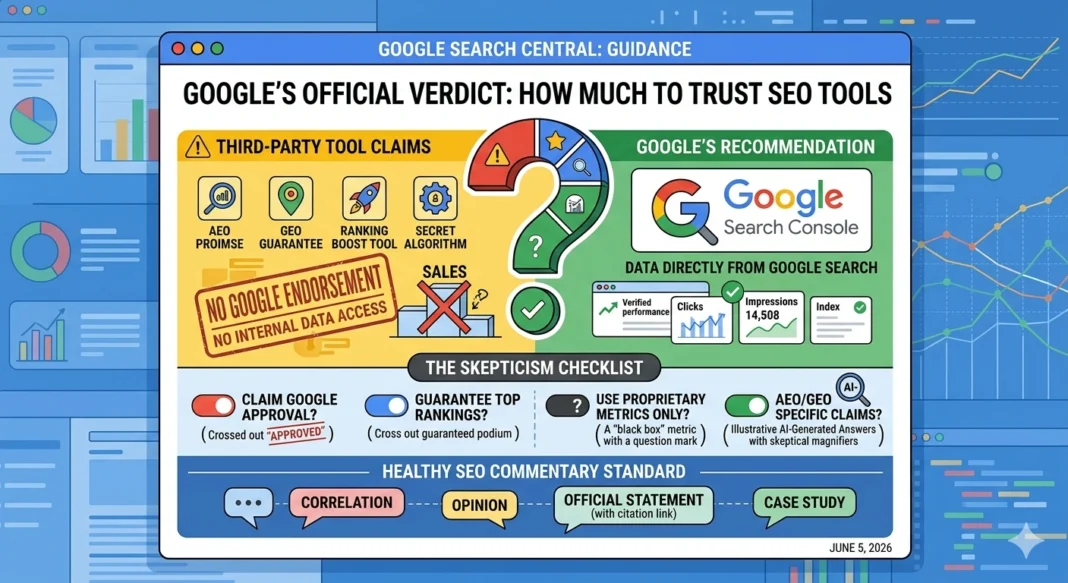
One line in the guidance is doing most of the heavy lifting: Google doesn’t evaluate third-party services, so be wary of such claims and those making them. This isn’t subtle. Google is directly telling site owners that any tool, service, or agency implying Google-sanctioned legitimacy, “Google-approved,” “Google-certified,” “follows Google’s secret algorithm,” anything in that family, should be treated with suspicion, because that endorsement simply does not exist.
The guidance extends this same skepticism to commentary, not just paid tools and services. It explicitly covers advice on blogs, newsletters, podcasts, YouTube channels, X threads, LinkedIn posts, conference slides, and SEO communities generally. Google acknowledges plenty of this advice is genuinely helpful, while some of it misinterprets or overstates what Google actually says or how its ranking systems work.
Google’s own suggested standard for “healthy” SEO commentary is worth internalizing if you create content in this space yourself: claims should be clearly labeled as official statement, observed test, correlation, opinion, case study, old guidance, new guidance, Google-specific, non-Google-specific, high-risk, or low-risk. A headline claiming “Google wants X” should link to actual Google documentation. A claim about AI Overviews specifically should distinguish what’s official Google guidance from what’s outside measurement or speculation. A case study, however compelling, shouldn’t be presented as proof of a universal ranking rule.
Why AEO and GEO Tools Got Called Out Specifically
The explicit inclusion of AEO and GEO tooling in this guidance isn’t incidental timing. As AI-generated answers have taken up more of the search experience, a fast-growing category of tools and services has emerged promising visibility improvements specifically inside AI Overviews, AI Mode, and similar generative answer surfaces, often using language that implies a level of certainty or Google insider knowledge that doesn’t actually exist.
By naming AEO and GEO tools directly in this guidance, Google is effectively pre-empting a category of marketing claims before it gets too entrenched, the same way it has historically had to push back on traditional SEO tools that overstated their relationship to Google’s actual ranking systems. The message is consistent across both categories: no third-party tool, regardless of what it’s optimizing for, has access to Google’s actual internal systems, and any claim suggesting otherwise should be treated skeptically.
The Updated “Do You Need an SEO?” Page
Google didn’t just add a new document; it revised an existing one. The “Do you need an SEO?” page, longstanding guidance aimed at businesses deciding whether to hire outside SEO help, got updated alongside the new third-party tools document, with fresh advice specifically on evaluating an SEO provider’s recommendations and tools.
One piece of longstanding advice in that document hasn’t changed: an SEO who guarantees you a top ranking position is a clear reason to walk away from that relationship. That warning predates this update by years, but it now sits alongside more detailed, more current guidance about evaluating the broader landscape of tools and claims an agency or consultant might bring to the table.
What This Means If You’re Evaluating an SEO Agency or Tool
If you’re a business owner currently vetting SEO providers, this guidance gives you a genuinely useful, official checklist to measure any pitch against. A few direct, practical questions worth asking any vendor now:
Does this tool or service claim any kind of Google approval, certification, or insider access? If so, that claim itself is now something you can point to as contradicting Google’s own stated position.
Does the vendor’s data come from something you can independently verify, like Google Search Console, or does it come from a proprietary metric you have to take on faith? Google’s own recommendation is explicit here: whether or not you use a third-party tool, you should also be using Search Console, since it’s the one source providing data directly from Google Search itself.
If the pitch involves AEO or GEO promises specifically, apply the same scrutiny you’d apply to a traditional ranking guarantee. The newness of generative-AI-focused optimization doesn’t exempt a vendor from the same “no guaranteed outcomes” reality that’s always applied to traditional SEO.
What This Means If You Work in SEO or Create SEO Content
If you write about SEO, run an agency, or build SEO tools yourself, this guidance is effectively Google publishing a style guide for how it wants the entire industry’s public claims to be framed. Labeling your claims clearly, as opinion, as correlation observed in your own data, as official Google guidance with a direct citation, isn’t just good practice anymore; it’s now the explicit standard Google has put in writing.
For tool builders specifically, particularly anyone building AEO or GEO-focused products, this is a clear signal to be precise in your marketing language. Implying Google approval or guaranteed visibility improvements in AI-generated answers, even unintentionally through loose marketing copy, now runs directly counter to documentation Google itself has published and will likely point clients toward if they have doubts about a vendor’s claims.
Common Mistakes to Avoid
- Trusting any vendor claim of “Google-approved” or “Google-certified” status. Google explicitly states it does not evaluate or endorse third-party services; any such claim should be treated with suspicion.
- Relying entirely on third-party tool data without cross-referencing Search Console. Google specifically recommends using Search Console because it’s the only source providing data directly from Google Search itself.
- Treating AEO or GEO tool promises as a newer, less scrutinized category. Google has explicitly extended the same skepticism it applies to traditional SEO tools to these AI-answer-focused services.
- Hiring or trusting any provider who guarantees a top ranking position. This remains one of Google’s clearest, longest-standing warning signs in its hiring guidance.
- Sharing or repeating SEO claims online without labeling their source or certainty level. Google’s own healthy-commentary standard calls for clearly distinguishing official statements from opinion, correlation, or case study.
Expert Tips
If you’re an agency or consultant, consider proactively referencing this Google guidance in your own client communications and proposals. Demonstrating that your claims are appropriately labeled, backed by Search Console data where possible, and free of any implied Google endorsement, builds exactly the kind of credibility this guidance is implicitly rewarding.
For anyone evaluating a new AEO or GEO tool specifically, ask the vendor directly how they measure AI answer visibility and whether that measurement is independently verifiable or a proprietary internal metric. Given how new this measurement space is, a vendor with a transparent, explainable methodology is a meaningfully better sign than one offering a single opaque “AI visibility score.”
What’s Next
Expect this guidance to become a recurring reference point in industry discussions, the kind of document SEO commentators link to whenever a tool or agency oversells its capabilities. Google has a track record of revisiting and expanding documentation like this over time rather than publishing it once and leaving it static, so further updates, particularly around AEO and GEO terminology as that space matures, seem likely.
It’s also worth watching whether this guidance shapes how AEO and GEO tools market themselves going forward. If enough buyers start asking the kinds of questions this document implicitly encourages, certifiable data sources, clearly labeled claims, no implied endorsement, vendors in this space may need to adjust their messaging fairly quickly to keep up.
Conclusion
Google’s new guidance on third-party SEO tools, services, and advice draws a clear, official line: no third-party tool has access to Google’s internal ranking data, none are endorsed by Google, and any claim suggesting otherwise should be treated skeptically. The guidance explicitly extends this standard to the newer category of AEO and GEO tools, not just traditional SEO services, and pairs it with an updated “Do you need an SEO?” page offering fresher advice on vetting providers. For business owners evaluating who to trust with their SEO, and for professionals working in the space, this document is now the clearest official benchmark available for separating credible claims from marketing overreach.
FAQ
What is Google’s new third-party SEO tools guidance?
It’s an official Search Central document, published June 5, 2026, that explains how to evaluate third-party SEO tools, services, and advice, including a warning that none of them have access to Google’s internal ranking data.
Does Google endorse any SEO tools or services?
No. Google explicitly states it does not evaluate third-party services and advises being wary of any vendor claiming Google approval, certification, or endorsement.
Are AEO and GEO tools covered by this guidance?
Yes. Google explicitly named AEO (“answer engine optimization”) and GEO (“generative engine optimization”) tools as a category that should be evaluated with the same scrutiny as traditional SEO tools.
Can a third-party SEO tool guarantee my rankings will improve?
No tool can guarantee that, and Google’s guidance states directly that using a service or tool doesn’t guarantee ranking success.
What tool does Google recommend instead of third-party SEO tools?
Google recommends using Google Search Console, since it provides data directly from Google Search itself, regardless of whether you also use third-party tools.
Did Google update any other documentation alongside this new guidance?
Yes. Google also updated its existing “Do you need an SEO?” page with fresh advice on evaluating an SEO provider’s recommendations and tools.
What’s one longstanding red flag Google warns about when hiring an SEO?
An SEO or agency that guarantees a top ranking position is a clear warning sign, according to Google’s hiring guidance.
Does this guidance apply to SEO advice on blogs and social media, not just paid tools?
Yes. Google’s guidance explicitly covers advice found on blogs, newsletters, podcasts, YouTube, X, LinkedIn, conference slides, and SEO communities generally.
How does Google define “healthy” SEO commentary?
Claims should be clearly labeled, such as official statement, observed test, correlation, opinion, or case study, and headlines claiming “Google wants X” should link to actual Google documentation.
Why did Google publish this guidance now?
Google stated the goal was to highlight important considerations when evaluating third-party SEO tools and advice, and to simplify and update older documentation, with the AEO and GEO additions reflecting the growing market for AI-answer-focused optimization tools.