Most people who switch from Google to an AI search engine describe the same initial feeling: relief. The ads disappear. The SEO-bloated articles stop being the first thing you see. You ask a question and get an answer, often a good one, with sources listed beside it. Then, a few days in, the cracks appear. The AI misses something time-sensitive. A citation leads to a page that does not actually say what the summary claimed. You reach for Google again.
This comparison ran both platforms as a primary search tool for five working days across five categories: current news, technical research, product comparisons, local queries, and fact-checking. The goal was a practical verdict, not a benchmark leaderboard.
How Each Platform Works in 2026
Google operates at 8.5 billion queries per day and has introduced AI Overviews across nearly half of all searches. An AI Overview appears above the organic results, synthesizes an answer from multiple indexed sources, and often ends the search without the user ever clicking a link. Google’s AI Mode, the full conversational search experience, ends in zero clicks to external websites in around 93 percent of sessions. Google now also displays ads in roughly 25 percent of AI-generated answers, a figure that has climbed sharply in the past year.
Perplexity operates at 1.2 billion monthly queries and describes itself as an answer engine rather than a search engine. It synthesizes responses from multiple sources, displays numbered citations inline, and presents the sourcing prominently. The free tier uses Perplexity’s own model. The Pro tier at $20 per month lets users choose between GPT-4o, Claude 3.7 Sonnet, Gemini 2.0 Flash, and Perplexity’s in-house model depending on the task. In March 2026, a class action lawsuit was filed alleging that Perplexity shared user chat data with Meta and Google through tracking pixels, which is worth monitoring if privacy matters to how you search.
Current News: Google Wins
For breaking news, Google’s freshness advantage was clear. Searching for a story that had appeared in the last four hours returned accurate, current headlines from major publications. Perplexity occasionally returned slightly older synthesis that missed the most recent developments, particularly on fast-moving stories where new information was arriving hourly.
Google’s AI Overviews on news topics tended to summarize the established story accurately. The sourcing, however, was less transparent than Perplexity’s numbered citations. On Google, it was often unclear exactly which source a claim came from. On Perplexity, every claim could be traced to a numbered reference within a few seconds.
The ad injection on Google became noticeable on news-adjacent commercial queries. Searching for anything with a purchase intent, including travel coverage, insurance news, and product announcements, returned sponsored placements woven into the AI response. Perplexity’s free tier showed no ads during the test period.
Technical Research: Perplexity Wins
On complex, multi-part technical queries, Perplexity produced more thorough and better-cited answers than Google’s AI Overviews. Testing questions about API documentation, software architecture decisions, and developer tool comparisons returned Perplexity responses that synthesized from five or more sources, showed the reasoning behind claims, and surfaced less obviously ranked content from developer blogs and documentation.
Google’s AI Overviews on technical topics tended toward shorter answers that directed users to click through to a single authoritative source. That approach is sometimes preferable, but on genuinely complex research tasks where the answer requires synthesizing from multiple perspectives, Perplexity produced more complete first-pass answers.
Independent accuracy benchmarks published in early 2026 found that Google’s AI Overviews carry error rates around 18 percent on complex informational queries. Perplexity’s multi-source verification approach achieved 90 to 97 percent accuracy on factual queries in the same research. The citation model makes errors easier to catch because each claim is traceable.
Product Comparisons: Even
Both platforms handled product comparison queries competently, with some differences in depth. Perplexity’s Pro Search mode, available on the paid tier, retrieved more recent review data and synthesized it more thoroughly than the free tier. Google’s AI Overviews on product comparisons were accurate but often shorter and less specific about why one option was better than another.
For shopping queries with local inventory or price-checking intent, Google’s integration with Maps, Shopping, and real-time availability data gave it a clear advantage. Perplexity could tell you the general features and typical price range of a product; Google could tell you which store three kilometers away had it in stock at the lowest price.
Local Queries: Google Wins
This was not close. Google’s integration of Maps, local business data, ratings, hours, menus, and booking into AI responses creates something Perplexity cannot replicate. Searching for a restaurant, a plumber, a class, or a local event returned Google results with actionable local information and direct links to book or call. Perplexity’s responses to the same local queries were generic and required clicking through to find any specific local information.
Anyone who primarily searches for things in the physical world, finding places, booking services, checking local hours, will find Google significantly more useful.
Fact-Checking: Perplexity Wins
On questions designed to test accuracy and sourcing, Perplexity’s transparent citation model was the clearer winner. When a claim seemed questionable, tracing it to the numbered source and checking the original took 15 seconds. On Google, the same process required more effort, particularly when an AI Overview presented information without clear attribution.
Perplexity’s model selection on the Pro tier adds another dimension here. Switching to Claude Sonnet or GPT-4o for a sensitive factual query produced noticeably more careful, caveated answers on topics where certainty was legitimately limited.
The Honest Verdict
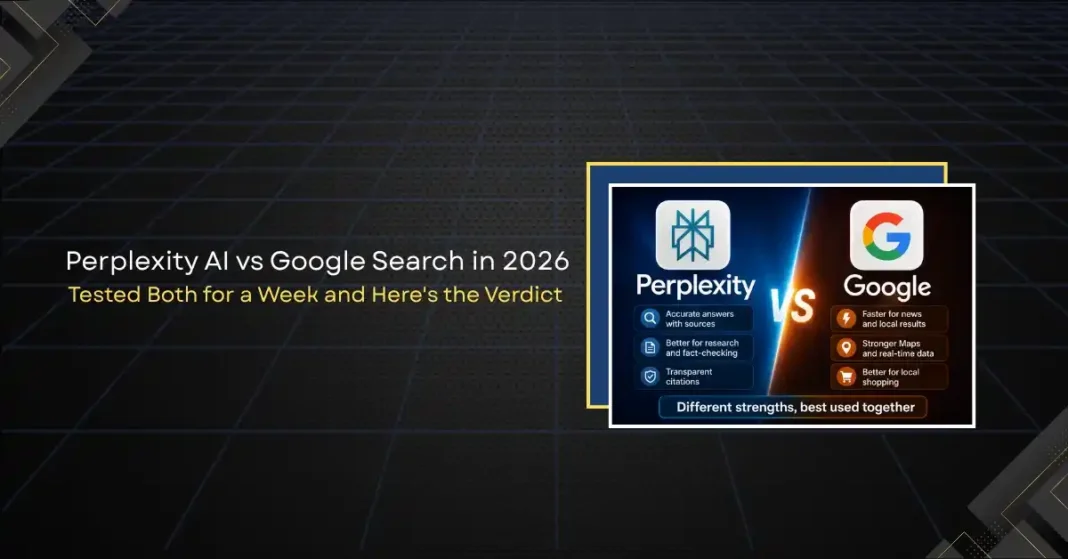
Google is better for news, local queries, and anything involving the physical world. Its real-time freshness, Maps integration, and 25-year index make it irreplaceable for those use cases. The growing ad load in AI responses is a real drawback but does not undermine its factual performance.
Perplexity is better for deep research, technical questions, and anything where seeing the sources matters. The citation model is genuinely superior. The Pro tier’s model selection adds flexibility that Google’s unified interface cannot match.
The most useful conclusion is that these tools are becoming specialized rather than one replacing the other. Using both depending on the query type is not a failure to pick a winner. It reflects what these tools are actually good at.