On May 18, 2026, Decart announced a $300 million funding round at a valuation of nearly $4 billion. The round was led by Radical Ventures. Nvidia was among the new investors. That combination prompted an obvious question: why would a company that sells AI chips invest in a startup whose main product makes it easier to use chips other than Nvidia’s?
The answer is more revealing about the current state of AI infrastructure than it might appear. It says something about where chip economics are heading, what the real constraint on AI deployment has become, and why even dominant hardware companies have to engage with the possibility that their dominance is not permanent.
What Decart Actually Builds
Decart was founded in late 2023 by Dean Leitersdorf and Moshe Shalev, both veterans of Israel’s Unit 8200 intelligence unit. The company now builds three products. DOS is the Decart Optimization Stack, software that compresses the process of adapting an AI model to run on different chip architectures. Lucy is a world model for real-time interactive video. Oasis is a world model for physical AI and robotics applications.
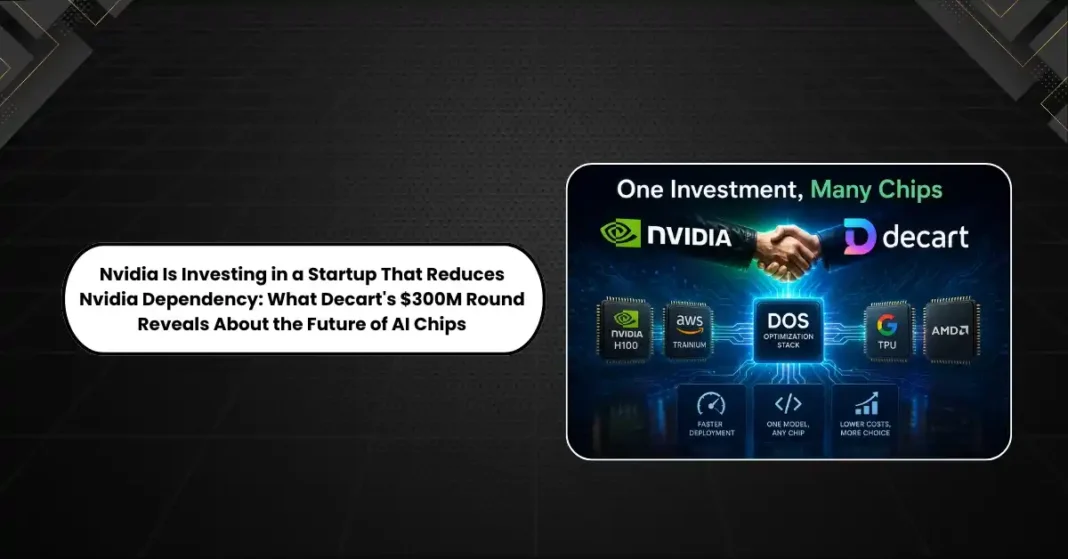
The DOS product is the one that generated the Nvidia paradox question. Typically, deploying a neural network on a new chip architecture requires writing custom optimization libraries specific to that hardware. The process can take months and requires specialized engineers. DOS compresses that workflow to a few weeks by abstracting the optimization layer across chip types. The same model runs on Nvidia H100s, Amazon Trainium chips, Google TPUs, or AMD hardware without starting the optimization from scratch for each one.
DOS 2.0, announced alongside the funding round, enables AI agents to process over 1,600 tokens per second. That is eight times the industry average according to Decart. Amazon is currently Decart’s largest customer, using DOS across Twitch, retail operations, and AWS cloud services. Lucy2, Decart’s video model, already runs on Amazon Trainium3 chips.
The Nvidia Investment Logic
Nvidia has committed over $40 billion in AI equity investments in 2026 alone, according to TNW’s tracking. The pattern is consistent: Nvidia takes an equity stake, the portfolio company signs a long-term GPU commitment, and GPU revenue flows back to Nvidia as a return on the same equity. It is a capital recycling mechanism that keeps GPU demand anchored even as companies explore hardware diversification.
For Decart specifically, investing alongside a product that enables chip-switching follows a counterintuitive logic. Nvidia’s GPU dominance is bottlenecked not by hardware supply in 2026 but by software optimization capacity. Every AI developer who cannot get their model optimized for non-Nvidia hardware stays on Nvidia by default. Decart’s technology removes a friction point that keeps some developers on Nvidia not by preference but by switching cost.
If Decart makes multi-chip deployment easier, it also makes the decision to use Nvidia hardware more active and deliberate. Companies currently locked into Nvidia because optimization elsewhere is too expensive will be able to compare their options. Some will choose to stay on Nvidia. Some will switch. For Nvidia, the equity stake buys visibility into this transition and positions it as a partner in the broader AI infrastructure economy rather than a hardware vendor that depends on lock-in.
There is also the forward-looking bet. Nvidia’s investment in Decart is partly a hedge against a world where its GPU market share declines. A stake in the software layer that runs AI on any chip means Nvidia participates in the value created regardless of which hardware wins in five years.
What the Investor List Reveals
The angel and institutional investor roster is worth reading carefully. Andrej Karpathy, the OpenAI co-founder and former Tesla AI head, is on the cap table. Michael Eisner, the former Disney CEO, is an investor. The Yamauchi family, which founded Nintendo, participated. Adobe Ventures, Toyota Ventures, and eBay Ventures joined institutional backers.
The breadth of the investor base reflects the range of industries Decart’s technology touches. Real-time interactive video, which Lucy produces, is relevant to gaming, entertainment, advertising, and e-commerce. Oasis, the physical AI world model, targets robotics and autonomous systems, which explains Toyota Ventures. Adobe’s participation reflects interest in AI-generated visual media. The Yamauchi family’s presence connects the gaming dimension of world models to Japanese gaming capital.
The total funding now exceeds $450 million across four rounds in less than three years. Decart raised $21 million at seed in August 2024, $32 million at Series A in December 2024, $100 million at Series B at a $3.1 billion valuation in August 2025, and $300 million at Series C in May 2026. Each round roughly tripled the valuation. That pace reflects the market’s view that optimization infrastructure is a foundational layer of AI, not a niche tooling product.
What This Means for the AI Chip Market
The broader implication of Decart’s rise is that the constraint in AI deployment is shifting from hardware access to optimization capacity. In 2023 and 2024, the bottleneck was getting Nvidia chips. In 2026, the bottleneck is increasingly whether those chips are being used efficiently and whether AI teams can move across hardware types as cost and availability shift.
Alternative AI chips from Amazon (Trainium), Google (TPU), AMD, Intel, and emerging startups are technically capable but have historically required significant engineering investment to access. DOS reduces that investment. As the software layer for hardware-agnostic AI deployment matures, the hardware market becomes more competitive. Chip manufacturers that have relied on developer inertia as part of their moat will face more active comparison shopping.
Nvidia’s response, buying into the company doing the disrupting, is a historically recognizable move. Intel’s failure to make this kind of investment in GPU software when it should have is a cautionary tale Nvidia’s leadership almost certainly knows well.
What Comes Next for Decart
The upcoming product launches include new versions of all three product lines. DOS will continue improving cross-chip optimization performance. Lucy is heading toward real-time interactive video capable of running at production quality for gaming applications. Oasis targets physical AI simulation for robotics, a market where real-time world models can substitute for expensive physical testing.
The partnership with AWS creates a distribution path that few two-year-old AI startups have: direct access to AWS enterprise customers across media, commerce, advertising, and physical AI. If DOS becomes the standard optimization layer for Trainium-based deployments, Decart’s revenue base scales with AWS’s AI infrastructure growth.
The $4 billion valuation on $450 million in total funding is aggressive but not unusual for infrastructure companies with confirmed enterprise customers and strong revenue signals. The next milestone question is whether Decart can establish DOS as the default cross-chip optimization layer before better-funded competitors build credible alternatives. The $300 million round buys the time and talent to make that case.