Something fundamental changed in Google Search over the past year, and a lot of SEO advice has not caught up to it.
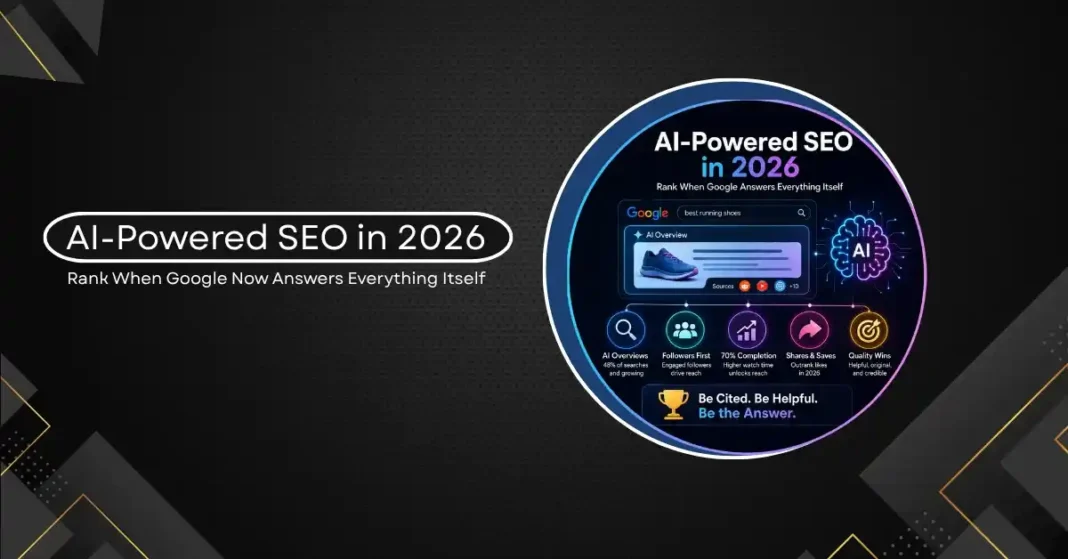
AI Overviews now appear on 48 percent of all Google queries, up from 34.5 percent in December 2025. That 58 percent increase happened in three months. When an AI Overview appears above the organic results for a keyword you rank number one for, your click-through rate drops by approximately 18 percent on that query. For informational content, some sites have seen traffic declines of 30 to 40 percent on their previously strongest pages.
The old SEO goal was to rank in position one. That goal has not disappeared, but it is no longer sufficient on its own. In 2026, visibility in AI-generated answers is a separate objective that requires a different approach.
Here is what has changed, what it means, and what actually works.
Understanding What Google Is Now Serving
Google is currently operating three different search experiences for the same query: classic Search with organic results, AI Overviews that appear above organic results, and AI Mode, a fully conversational search experience powered by Gemini that replaces the traditional results page entirely.
Each one ranks content differently. Each one affects your traffic differently.
Classic Search is still how the majority of searches end up, but its share is shrinking. For transactional queries (someone looking to buy something, find a service, or navigate to a specific site), traditional results still dominate. For informational queries (how-to, what-is, why, explanatory content), AI Overviews and AI Mode are increasingly handling the answer without sending traffic anywhere.
AI Overviews appear automatically for select queries and cite sources, which can drive traffic. But the data shows that organic click-through rates fall significantly when an AI Overview is present, from roughly 5 percent in a clean result to around 2.4 percent when an AI Overview covers the query. For high-volume informational content, this is a material traffic hit.
AI Mode, Google’s fully conversational search experience, is the most disruptive. It has no traditional organic results. You either get cited in the AI-generated answer, or you get nothing. Sites cited in AI Mode results see 35 percent more organic clicks than those appearing only in traditional results below an overview. Sites that do not appear in AI Mode responses get nothing at all from those queries.
The strategic implication: being cited in AI answers is now a distinct objective from ranking in traditional results, and the two do not always overlap. Ahrefs data shows the citation overlap between AI Overviews and the traditional top-10 results has dropped from 76 percent in mid-2025 to somewhere between 17 and 54 percent in early 2026. Ranking number one no longer guarantees AI Overview inclusion.
What Gets Cited in AI Answers
Understanding what Google’s AI cites is important because it is different from what ranks well in traditional search.
Structure and clarity matter more than length. Google’s AI systems summarize and synthesize content. Pages that are clearly organized, with direct answers close to the top, are easier to include in a synthesized response than pages that bury the answer in five paragraphs of introduction.
The average AI Overview now contains 13.34 cited sources, up from 6.82 in 2024. This means the citation pool is wider than it used to be, which is both an opportunity and a clarification: Google’s AI is not just pulling from the obvious authority sites. It is pulling from a broad range of sources if they provide relevant, clearly structured answers.
Reddit holds 21 percent of citations in Google AI Overviews. YouTube has become the most-cited source across AI answers broadly. Community and video platforms are now directly competing with traditional editorial content for AI citation share. If you are not thinking about Reddit presence and YouTube content as part of your SEO strategy, you are working with a narrower set of options than the citation data suggests is optimal.
Ranking number one does not guarantee citation, but high organic traffic still correlates with AI Overview inclusion. The correlation is weaker than it was a year ago, but it is not gone. Pages that rank well in traditional search still have a meaningful advantage in AI citation rates compared to pages that do not rank at all.
Answer Engine Optimization
The clearest strategic framework for SEO in 2026 is a three-layer approach: traditional SEO for crawlability and organic rankings, Answer Engine Optimization (AEO) for featured snippets and direct answer formats, and Generative Engine Optimization (GEO) for citation in AI-generated responses on Google, ChatGPT, and Perplexity.
AEO is about structuring your content so Google can directly extract an answer. This means leading each section with the answer to a clear question, using FAQ formats with genuine questions real users ask, writing in plain language rather than jargon, and organizing content around specific questions rather than broad topics.
Practical AEO technique: before writing any piece of content, identify the specific questions it should answer. Write those questions as headings or sub-headings. Lead each section with the direct answer in one or two sentences, then expand with supporting detail. This structure serves both featured snippets and AI Overview citation.
GEO is newer and less codified, but several patterns have emerged. Factual accuracy is essential. Google’s AI systems are increasingly good at detecting claims that conflict with high-authority sources. Content with errors or misleading claims is not cited. Original data and research get cited at higher rates than rephrased summaries of other people’s research. If you can produce original survey data, proprietary analysis, or firsthand reporting, that content earns citations at rates that generic content does not match.
Structured data markup still matters. Schema that clearly identifies what type of content a page contains, whether that is a FAQ, a how-to guide, a product review, or a news article, helps Google’s systems categorize and potentially cite it correctly.
The Content Quality Threshold Has Risen
The content that is losing ground in AI-era search shares a profile: generic summaries of information that is widely available elsewhere, thin how-to content that covers a topic but does not demonstrate expertise, and SEO-optimized articles written primarily for keyword density rather than genuine usefulness.
The content that is gaining ground: long-form original research, firsthand experience and expertise (reviews written by people who have actually used the product, guides written by practitioners who have done the work), content that synthesizes multiple perspectives rather than just summarizing one, and content that answers specific narrow questions rather than broad general topics.
The “helpful content” direction Google has been pushing for several years is now being enforced not just by human reviewers but by the AI systems that decide what to summarize. Content that a Gemini model would read and find genuinely informative gets cited. Content that reads like keyword padding does not.
This means the volume-based content strategy, producing hundreds of thin articles targeting long-tail keywords, is actively harmful in 2026. Those pages are not getting cited in AI answers. They are not getting featured snippets. They are taking up crawl budget and diluting site authority without driving traffic.
Technical SEO Still Matters
One thing that has not changed: crawlability, page speed, and site structure still determine whether Google can access and use your content at all.
Core Web Vitals remain a ranking signal. Pages that load slowly, shift layout while loading, or take too long to become interactive are penalized both in traditional rankings and in AI citation eligibility. The fastest sites in any given niche have a baseline advantage that content quality alone cannot overcome.
Structured data markup is worth implementing or auditing if you have not done so recently. Schema for articles, FAQs, how-to guides, local business information, and products all provide signals that help both traditional ranking and AI surface categorization.
Internal linking structure affects how AI systems understand the relationship between pages on your site. A clear site architecture where related content links to related content helps Google’s systems develop an accurate picture of what your site is authoritative about. An ad hoc link structure makes it harder.
One nuance specific to AI systems: blocking AI training bots does not protect you from AI citation. Studies show that roughly 75 percent of sites blocking OpenAI or Google AI bots still appear in AI citations. The bots used for training are different from the bots used for live retrieval. If you are blocking crawlers in an attempt to stay out of AI systems, you may be achieving the opposite of what you intended.
Local and Transactional Search Still Behaves Traditionally
The traffic collapse from AI Overviews is concentrated in informational content. Transactional queries, “plumber near me,” “buy running shoes size 10,” “book hotel in Barcelona,” are still handled primarily through traditional organic results and paid ads.
If your business depends on local or transactional search rather than informational traffic, the impact of AI Overviews is significantly smaller than the averages suggest. The disruption is real but category-specific.
For local businesses, the most important SEO action in 2026 is maintaining a current, complete Google Business Profile. AI Mode’s local answers pull directly from Business Profile data. Outdated hours, missing photos, or unanswered reviews all reduce the quality of the information available to AI systems and can affect whether you appear in AI-generated local recommendations.
What to Do Now
Start by looking at where your traffic is actually coming from in 2026 versus 2024. Segment by query type in Google Search Console. If informational queries are losing clicks while transactional queries hold steady, you are seeing the signature pattern of AI Overview impact.
For the informational content that is losing traffic, the decision is whether to restructure it for AI citation (clear structure, direct answers, original insight) or to redirect that effort toward transactional content where traditional SEO still delivers.
For new content, the framework is: pick specific narrow questions rather than broad topics, lead with direct answers, include original data or firsthand expertise wherever possible, structure for skimmability, and target queries where there is genuine purchase intent rather than pure curiosity.
The brands that will dominate search in 2026 and beyond are not necessarily the ones with the highest traditional rankings. They are the ones that AI systems choose to cite, quote, and recommend when users ask questions in their category. Building that citability is the new SEO objective. The inputs that drive it (genuine expertise, original research, clear structure, factual accuracy) are more demanding than keyword optimization. They are also more defensible.
Search traffic is harder to earn than it was two years ago. The sites earning it are doing work that AI cannot easily replicate.