The internet as it currently exists is built on classical physics. Data travels as bits, zeros and ones, over fiber optic cables and wireless networks. Quantum networking operates on entirely different principles, using quantum mechanical phenomena like entanglement and superposition to transmit information in ways that classical systems cannot replicate. In 2026, quantum networking has moved from laboratory curiosity to commercial infrastructure, with significant funding flowing into startups building the foundation of what researchers call the quantum internet.
What Quantum Networking Actually Is
A quantum network transmits information using qubits rather than classical bits. Qubits can exist in multiple states simultaneously, and two qubits can be entangled in a way that links their states regardless of the physical distance between them. This property underpins Quantum Key Distribution, or QKD, the most commercially mature application of quantum networking. QKD generates encryption keys using quantum mechanics, with a fundamental security guarantee: any attempt to intercept the key disturbs the quantum state and is therefore detectable. The keys cannot be secretly copied the way classical encryption keys can be compromised.
The commercial case for this technology is tied to a specific threat called harvest now, decrypt later. Nation-state actors and sophisticated criminal organizations are collecting encrypted data today with the intention of decrypting it once quantum computers powerful enough to break current encryption become available. Financial institutions, government agencies, and critical infrastructure operators are the primary buyers of quantum-secured communication in 2026, investing in QKD infrastructure now to protect data that needs to stay confidential for decades.
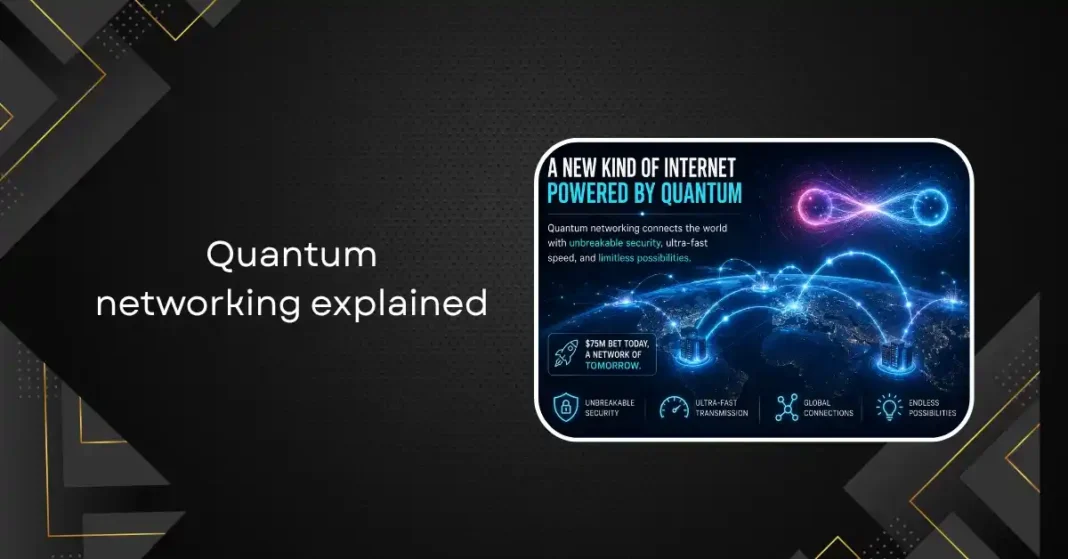
The $75M Bet and the Startup Race
The quantum networking startup space has seen a surge in investment. Photonic, a Canadian quantum networking company, raised CA$375 million total, including a CA$180 million Series B in January 2026 led by Inovia Capital, BCI, and Microsoft. The company’s focus on silicon photonics for quantum network components reflects the broader shift toward deployment-ready hardware rather than theoretical architecture. Qunnect launched ABQ-Net in Albuquerque in February 2026, the first open-access entanglement-based quantum network in the United States. The network serves as a proving ground for quantum startups to validate products on live infrastructure without bearing the full development cost.
IonQ, the Maryland-based quantum computing company that generated $130 million in revenue in 2025, announced a major breakthrough this year: successfully linking two remote quantum systems using photonic interconnects. The company’s collaboration with the Air Force Research Laboratory marked a foundational step toward multi-processor quantum computing at scale. DARPA has taken note, and IonQ’s stock reflected the market’s reaction to this progress. The state of Maryland has now secured more than $500 million in quantum-related investments since launching its quantum initiative.
The Infrastructure Being Built
China has already built a 2,000-kilometer quantum communication network connecting Beijing and Shanghai, the largest in the world. Europe is constructing the European Quantum Communication Infrastructure, known as EuroQCI, linking multiple countries with an investment of approximately one billion euros over ten years. In the US, the Department of Energy is developing a nationwide quantum internet prototype. EPB in Chattanooga, Tennessee, partnered with IonQ to build the nation’s first quantum computing and networking hub, expected to be operational in 2026, with projections that the initiative could generate up to $1.1 billion in community benefit over the next decade.
How Quantum Networking Differs from Classical
The technical barriers are different from those facing quantum computing. A quantum key distribution link between two cities requires entangled photon sources, fiber optic cables, single-photon detectors, and classical communication channels for coordination. It does not require error correction, million-qubit processors, or cryogenic cooling in most implementations. This means quantum networks face a lower technical barrier to commercial deployment than general-purpose quantum computers. The challenge is extending range, since photon loss in fiber limits practical QKD distances without quantum repeaters, and building quantum repeaters remains a significant engineering problem.
What This Means for the Future of the Internet
The quantum internet, in its full vision, would connect quantum computers across data-center boundaries using entanglement rather than classical cables. That future is decades away. But the near-term version, quantum-secured communication links for high-value data, is being deployed today. Financial institutions are projected to pour $1 billion into quantum-safe security solutions by 2026. The harvest-now-decrypt-later threat is driving decisions that most public reporting has not caught up with yet. The $75 million scale of recent startup investments in this space is not speculative capital chasing a distant horizon. It is infrastructure money going into the foundation of a security system that organizations with long data-retention obligations are choosing to build now.