Third-party cookies are gone. The question every marketer now faces is what replaces them. The answer is not a technological workaround. It is a strategic repositioning from data rented from third parties toward data owned and earned directly from your audience. First-party data strategy in 2026 is not a niche consideration for large enterprises. It is the foundation of any marketing operation that intends to survive the next algorithmic update, privacy regulation, or platform policy change.
Why This Moment Is Different
67% of US adults have turned off cookies or website tracking to protect their privacy, and that number grows each year. GDPR cumulative fines exceeded six billion euros by late 2025. By January 2026, more than 19 US states had enacted comprehensive data privacy laws. Even setting the regulatory environment aside, browser-level enforcement has made client-side tracking unreliable. Safari’s Intelligent Tracking Prevention deletes first-party cookies in as little as 24 hours. Ad blockers suppress client-side tags. The infrastructure that marketers relied on for behavioral targeting is not just legally constrained. It is technically broken in the environments where most users actually browse.
The strategic response is already visible in the data. 71% of brands, agencies, and publishers were growing or planning to grow their first-party datasets in 2026, nearly twice the rate recorded in 2022 when the comparable figure was 41%. Organizations with mature first-party data programs achieve 2.9 times higher revenue growth than those still depending primarily on third-party sources.
What First-Party Data Actually Means
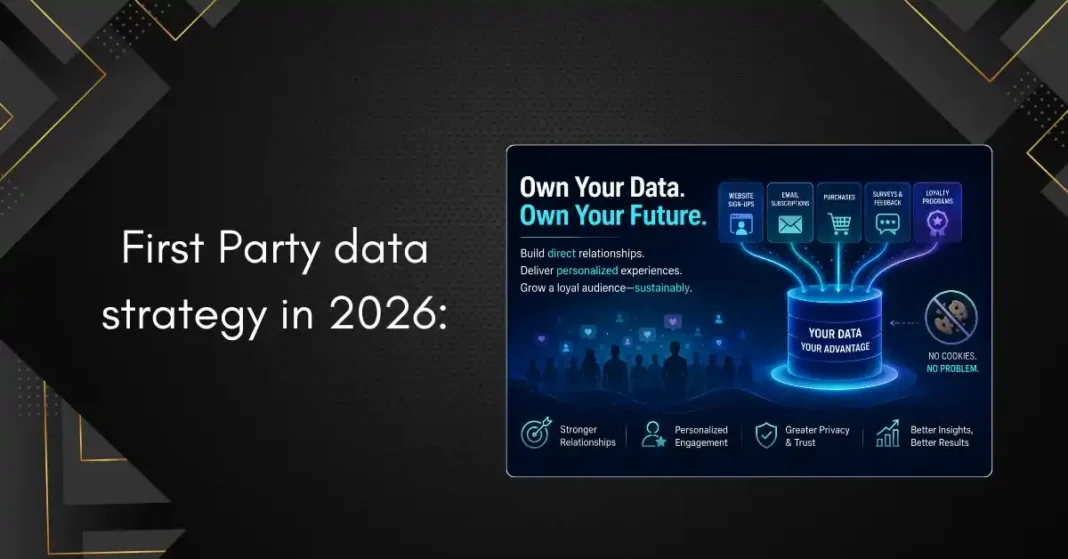
First-party data is information collected directly from your own audience through their interactions with you. Website behavior, app usage, purchase history, customer support interactions, email engagement, and CRM records all qualify. The key distinctions are consent and ownership. You collected it with the individual’s knowledge, you hold it yourself, and no platform change can take it from you. This is the asset that email lists represent. It is why the businesses that built owned audiences during the social media gold rush outperformed those who relied on algorithmic reach they never controlled.
The Four Pillars of a First-Party Data Strategy
Server-side tracking is the most important technical investment a marketer can make in 2026. Traditional client-side tagging fires JavaScript in the user’s browser. Ad blockers, ITP, and privacy settings suppress it. Server-side tracking moves measurement from the browser to your own server, eliminating all three failure modes. Google Tag Manager’s server-side container is the dominant implementation approach and compatible with most downstream advertising and analytics platforms.
Identity resolution connects data points across devices, channels, and touchpoints into unified customer profiles. Deterministic resolution uses exact identifiers like email addresses or phone numbers to link records with 100% accuracy. Probabilistic matching fills gaps where exact identifiers are unavailable, with 60 to 85% accuracy depending on signal quality. Customer Data Platforms like Segment, mParticle, and Bloomreach handle this at scale, normalizing data from website, email, CRM, point-of-sale, and app sources into a single profile.
Zero-party data is information customers share intentionally and proactively through quizzes, surveys, preference centers, and interactive content. A skincare brand that adds a skin-type quiz to its website and builds an email list from the responses owns something a third-party audience segment can never replicate: explicit stated preferences from identified customers. This is the most accurate and legally defensible data available.
Consent management creates the legal and trust foundation for everything else. Platforms like Cookiebot, OneTrust, and Usercentrics handle the technical requirements of GDPR, CCPA, and state-level equivalents. But the more important function is strategic: treating consent as a value exchange rather than a compliance checkbox. Users who understand what their data is used for and why are more likely to share it willingly.
Contextual Advertising: The Rehabilitated Approach
Contextual advertising, placing ads based on the content of the page a user is currently viewing rather than their behavioral history, fell out of favor when behavioral targeting became sophisticated. The cookieless transition has rehabilitated it completely. Research from DoubleVerify and IAS published in 2025 shows contextual signals delivering targeting accuracy that approaches behavioral methods in many categories. For brands without large first-party datasets, contextual is the most practical near-term replacement.
Building the Owned Audience
The strategic objective of first-party data in 2026 is not compliance. It is a fundamental restructuring of the brand-consumer relationship. Every email address collected, every preference center completed, every loyalty program enrollment is an asset the brand owns outright. No algorithm controls its distribution. No platform policy change can restrict access to it. Building this asset requires genuine value exchange: content worth subscribing to, experiences worth sharing data for, and communications personalized enough that the recipient considers them relevant rather than intrusive. The brands that make this shift systematically are building a moat. The brands still looking for a cookie replacement are missing the point of the question.