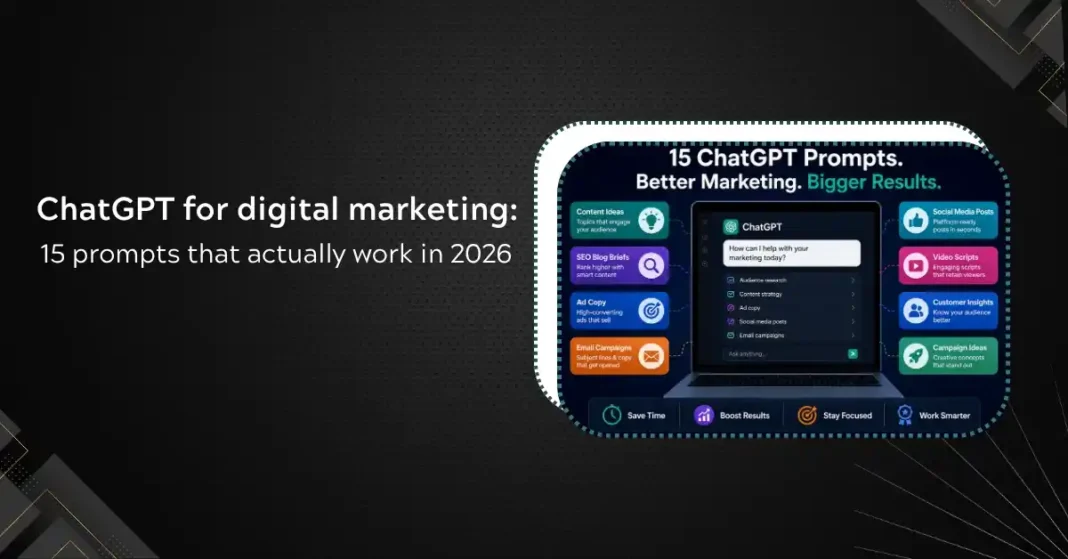
Most marketers using ChatGPT in 2026 are getting a fraction of the value the tool is capable of delivering. They write vague prompts, get generic output, and conclude that AI is not that useful for real marketing work. The problem is almost never the tool. It is the prompt. A well-constructed prompt with the right context, constraints, and format instructions will produce output that a junior copywriter would need three or four drafts to match. A vague prompt produces filler. This guide covers fifteen prompts that have been refined through actual marketing use, along with the reasoning behind each one so you understand how to adapt them for your specific situation.
The Foundation: How to Write a Prompt That Works
Before getting to the specific prompts, it helps to understand the structure that makes most of them work. A strong marketing prompt has four components: role (who ChatGPT should be), context (what you are working on and who the audience is), task (specifically what you want produced), and constraints (tone, format, length, what to avoid). Most weak prompts skip the context and constraints. Most strong prompts include all four.
In 2026, ChatGPT’s memory features and custom GPT configurations mean you can store persistent context rather than re-explaining your brand on every session. If you are using ChatGPT regularly for marketing, spend twenty minutes setting up a custom GPT or a memory context that includes your brand voice, key audience characteristics, and the type of content you produce. Every prompt you run after that starts from an informed baseline rather than a blank slate.
Prompt 1: Audience Research Synthesis
Prompt: ‘You are a market researcher. I am building a content strategy for [product/service] targeting [audience description]. Based on what you know about this audience, identify their top five pain points related to [problem area], the language they use to describe these problems, the objections they typically have to purchasing [product category], and three questions they are likely searching for answers to right now. Format each section as a numbered list with a one-sentence explanation for each item.’
Why it works: This prompt gives ChatGPT a clear role, a specific audience, and a structured output format. The instruction to capture the language they use is the detail most marketers skip, but it is what makes the resulting copy feel native to the audience rather than written at them. Use the output as a brief for content and ad copy rather than publishing it directly.
Prompt 2: SEO Content Brief
Prompt: ‘Create an SEO content brief for an article targeting the keyword [keyword]. The target audience is [audience description]. Include: the primary intent behind this search, three to five related secondary keywords to work into the piece naturally, a recommended article structure with H2 and H3 headings, key points each section should cover, and any factual claims or statistics that should be included or researched. The article should position [brand/product] as authoritative on this topic without being overly promotional.’
Why it works: This turns ChatGPT into a content strategist before you write a word. The brief it produces gives a human writer or a second AI pass a clear framework that reduces wasted drafts. The instruction to avoid being overly promotional is important: without it, the default output often drifts toward sales copy rather than authoritative content that actually ranks.
Prompt 3: Email Subject Line Testing
Prompt: ‘Write ten email subject lines for a campaign promoting [offer]. The audience is [description] and the email content covers [brief summary]. Write two subject lines using urgency, two using curiosity, two using a direct benefit statement, two using a question, and two using social proof or authority. Keep all lines under fifty characters. After the list, identify which two you would test first against each other and explain your reasoning in two sentences.’
Why it works: The constraint to produce subject lines across different psychological triggers forces variety. Most marketers default to one type (usually urgency or benefit) and test within that category. Testing across fundamentally different approaches produces more information about what your audience responds to. The instruction to recommend two for testing adds a decision layer that makes the output immediately actionable.
Prompt 4: Ad Copy Variants
Prompt: ‘Write three variants of Google Search ad copy for [product/service] targeting the keyword [keyword]. Each variant should have a different angle: one leading with the primary benefit, one leading with a pain point the audience has, and one leading with social proof (number of customers, rating, or similar). For each variant write a headline of thirty characters, a second headline of thirty characters, and a description of ninety characters. Follow Google’s ad policies and avoid superlatives like “best” without evidence to support them.’
Why it works: Specific character counts and the constraint to match Google’s actual format mean the output is ready to paste rather than needing adjustment. Most ad copy prompts produce text that sounds good but does not fit the format. Specifying the angle for each variant ensures you are testing different strategic approaches, not just different wording for the same message.
Prompt 5: Social Media Content Calendar
Prompt: ‘Create a two-week social media content plan for [brand] on [platform]. The brand voice is [two or three adjectives]. The audience is [description]. The content mix should be approximately forty percent educational, thirty percent engagement-driving, and thirty percent promotional. For each of the fourteen days, suggest a content idea with a one-sentence description and a sample opening line for the post. Avoid generic motivational content and focus on topics specific to [industry/niche].’
Why it works: The content mix ratio prevents the output from defaulting to either all promotional content (which is what most brands default to without prompting) or all educational content (which ChatGPT left to its own judgment often over-indexes on). Specifying the industry and explicitly excluding generic motivational content are the two instructions that do the most work in this prompt.
Prompt 6: Landing Page Copy
Prompt: ‘Write landing page copy for [product/service]. The primary CTA is [action]. The audience is [description] who struggles with [pain point]. The copy should follow this structure: headline that addresses the pain point, subheadline that introduces the solution, three benefit sections (each with a short header and two sentences), a social proof section with placeholder text for [testimonials/stats], an objection handling section that addresses the top three concerns [list them], and a CTA with urgency. Keep the tone [tone descriptor]. Avoid the words leverage, robust, and seamless.’
Why it works: The explicit structure turns a potentially sprawling task into a series of focused sections. Including the specific words to avoid prevents the most common AI copywriting clichés. The objection handling section, which most landing page prompts miss, often produces the highest-converting copy because it directly addresses the hesitations that keep visitors from converting.
Prompt 7: Competitor Gap Analysis
Prompt: ‘I am going to describe two competitors and my own product. Based on the information, identify three messaging gaps in the market that none of the three are fully exploiting, and suggest how my product could own each gap in its content and positioning. Competitor A is [description]. Competitor B is [description]. My product is [description]. Focus on gaps that are relevant to [audience], not theoretical ones.’
Why it works: This uses ChatGPT’s pattern recognition for competitive analysis rather than copywriting. The instruction to focus on gaps relevant to the audience, not theoretical ones, is the constraint that prevents the output from identifying technically valid but commercially uninteresting positioning opportunities.
Prompt 8: Repurposing Long-Form Content
Prompt: ‘Here is a blog post: [paste full text]. Repurpose this content into: a LinkedIn post of two hundred words that leads with the most counterintuitive insight from the article, three Twitter/X posts under two hundred eighty characters each covering the top three takeaways, and an email newsletter section of one hundred fifty words that frames the content as advice for the reader rather than a summary. For each format, adapt the tone appropriately: professional for LinkedIn, direct for Twitter, conversational for email.’
Why it works: Specifying the angle for each format (counterintuitive for LinkedIn, direct for Twitter, conversational for email) prevents all three outputs from sounding like the same thing in different lengths. The instruction to adapt tone rather than just truncate is the difference between repurposed content that feels platform-native and content that feels like it was designed for somewhere else.
Prompt 9: YouTube Video Script Outline
Prompt: ‘Create a video script outline for a YouTube video about [topic]. Target length is eight to ten minutes. The audience is [description] who wants to [goal]. The video should open with a hook that is a specific story or surprising statistic rather than an introduction, cover five key points in the body, include two moments designed for audience engagement (asking a question or directing to a comment), and close with a clear CTA to [desired action]. For each section note the approximate time allocation.’
Why it works: The instruction to open with a hook rather than an introduction forces an output that matches what actually retains viewers. Most scripts ChatGPT generates without this constraint start with ‘In today’s video…’ which kills watch time in the first fifteen seconds. The engagement moment instruction ensures the script is written for YouTube’s algorithm, not just for the viewer.
Prompt 10: Customer Persona Development
Prompt: ‘Build a detailed customer persona for [product/service] based on this information about our existing customer base: [provide any data you have on demographics, behavior, purchase patterns]. Fill in gaps with realistic assumptions and flag them clearly. Include: demographic profile, primary goals related to [product area], daily frustrations that our product addresses, how they discover new products in our category, the objections they have before purchasing, and the words or phrases they use to describe success in this area. Format as a profile card with labeled sections.’
Why it works: The instruction to flag assumptions separately is critical. Without it, ChatGPT blends real data inputs with invented details and the output looks authoritative whether it is based on your data or entirely made up. Flagging assumptions makes the output honest and useful as a starting point for research rather than a finished document.
Prompts 11 to 15: Quick-Use Templates
Prompt 11 (Cold Outreach): ‘Write a cold email to [role] at [type of company] introducing [product/service]. The email should be under one hundred fifty words, lead with a specific problem their company likely faces rather than information about us, mention one concrete result we achieved for a similar company (use [example]), and end with a low-commitment CTA. No subject line needed.’
Prompt 12 (Product Description): ‘Write a product description for [product] targeted at [audience]. Lead with the primary benefit, include three specific features with their customer-facing outcomes (not technical specs), and end with a sentence that addresses the most common objection to buying this type of product. Tone: [adjectives]. Length: eighty to one hundred words.’
Prompt 13 (FAQ Content): ‘Based on this information about [product/service]: [paste description], generate ten frequently asked questions that a skeptical potential customer would ask before purchasing, along with honest, persuasive answers of fifty to seventy-five words each. Include at least two questions about price or value and one about what happens if the customer is not satisfied.’
Prompt 14 (Press Release): ‘Write a press release about [announcement]. Journalists reading this cover [industry]. The release should follow standard AP style, lead with the most newsworthy element rather than background on the company, include one quote from [name, title] that says something genuinely interesting rather than generic, and end with a boilerplate company description of fifty words. Keep the total under four hundred words.’
Prompt 15 (Campaign Concept): ‘We are launching a campaign for [product/service] targeting [audience]. The campaign goal is [awareness/leads/sales]. Generate three campaign concepts, each with a different strategic angle. For each concept provide: a one-sentence positioning statement, a campaign name, the key message, the format it would work best in (video, social, email, etc.), and the reason why this audience would respond to this approach. Rank them by which you think is most likely to cut through in a crowded market and explain why.’
Making These Prompts Work for Your Brand
The prompts above are starting points, not finished templates. The ones that will work best for your specific brand are the ones you adapt with your actual audience characteristics, your specific brand voice, and the real competitive context you operate in. Generic prompts produce generic output regardless of how well-structured they are.
The single highest-leverage investment you can make in your ChatGPT marketing workflow in 2026 is spending one hour writing a comprehensive brand brief: your audience, your voice, your core differentiators, your main product benefits, and the specific words that are on-brand and off-brand for you. Paste that brief at the start of every session or build it into a custom GPT, and the quality improvement across every prompt you run will be immediate and consistent.