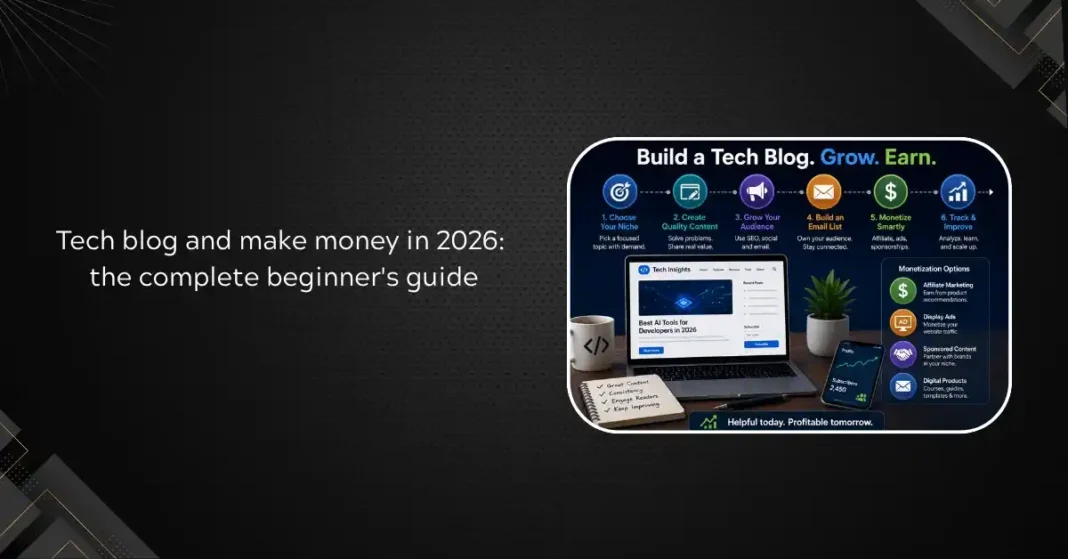
Starting a tech blog in 2026 is easier than it has ever been. The technical barriers to publishing are minimal, the tools for content creation have never been more capable, and the demand for clear, reliable information about technology is growing faster than the supply of quality writers. At the same time, building a blog that actually generates income requires more than it did five years ago. AI-generated content has flooded search engines with thin articles, Google’s AI Overviews have reduced clicks on informational content, and attention is fragmented across more channels than ever. This guide does not promise fast results. It does lay out the approach that is working for new tech blogs that are building real audiences and monetizing them in 2026.
Choosing Your Niche: The Most Important Decision You Will Make
The biggest mistake new tech bloggers make is going too broad. ‘Tech news’ is not a niche. It is a category that established players with large newsrooms, SEO budgets, and brand recognition already dominate. A new blog competing in that space will not rank, will not be discovered through social, and will not build a loyal readership. A niche is not just about topic. It is about audience and angle.
Good niche selection in 2026 sits at the intersection of three criteria: a specific audience whose needs are not being fully met, a topic area where you have genuine knowledge or can develop it, and a level of search and social demand that is sufficient to support monetization but not so saturated that established players have already owned every angle.
Some niche areas showing consistent growth for tech blogs in 2026 include: AI tools for specific professions (healthcare, legal, finance, education), small business technology stacks and automation, cybersecurity for non-technical audiences, home networking and smart home technology, and productivity technology for remote workers. Each of these has a specific, identifiable audience, real search demand, and enough technical complexity that quality content consistently outperforms generic overviews.
Before committing to a niche, test your interest and knowledge depth. Can you write twenty articles on this topic without running out of things to say? Can you see yourself staying current in this area for two to three years? If the honest answer to either question is no, the niche will eventually become a grind that produces declining quality content.
Setting Up Your Blog: Technical Decisions That Matter
WordPress hosted on your own domain through a provider like Kinsta, WP Engine, or SiteGround remains the best starting point for most tech blogs in 2026. It is not the fastest to set up, but it gives you full control over your site, no platform dependency risk, and the ability to implement any monetization strategy without restrictions.
The domain name matters more than most beginners think. Choose something that is easy to spell, memorable, and either contains your niche keyword or is a distinctive brand name that can grow beyond your initial niche. Avoid hyphens and numbers. Buy your domain from a registrar like Namecheap or Google Domains and keep it separate from your hosting provider so you do not lose access to your domain if you change hosts.
Speed and Core Web Vitals have been significant Google ranking factors for several years and remain so in 2026. Start with a fast, lightweight WordPress theme (Kadence, GeneratePress, and Blocksy are all good options), use a caching plugin like WP Rocket, serve images in WebP format, and use a content delivery network. If this sounds technical, many managed WordPress hosts handle most of it automatically. Getting these basics right from the start is far easier than fixing them after publishing one hundred articles.
Email list building should start from day one. Install a form plugin or email marketing integration before you publish your first article. The email list you build over time is the only audience asset you fully own. Social platform algorithms change, search rankings shift, but an email list of people who have explicitly asked to hear from you is yours regardless of what happens to other channels.
Creating Content That Ranks and Retains Readers in 2026
The content strategy that works for new tech blogs in 2026 is different from what worked in 2020. Google’s AI Overviews now handle a large percentage of informational queries directly, reducing clicks to websites for simple definitional or factual questions. The articles that still generate organic traffic are the ones that require genuine depth: comparative reviews, detailed how-to guides, expert opinions, original research, and content that synthesizes multiple sources in a way that AI Overviews cannot fully replicate.
Focus your early content on three types of articles. The first type is comparison and review content: ‘Tool A vs Tool B’, ‘Best X for Y use case’, ‘Is X worth it in 2026’. This type of content has high purchase intent, converts well for affiliate monetization, and earns clicks even when AI Overviews appear because readers want a human perspective rather than a synthesized summary before making a purchase decision.
The second type is specific how-to content that goes several levels deeper than generic tutorials. Not ‘How to use Google Analytics’ but ‘How to track revenue from organic search traffic in Google Analytics 4 when you use Shopify.’ The specificity signals expertise and ensures the article is genuinely useful to someone with that exact need rather than anyone who has ever heard of Google Analytics.
The third type is original perspective content: your tested experience with a tool, your honest assessment of a trend, your framework for thinking about a technical decision. This content is the hardest to write but the most durable. It cannot be AI-generated in a way that feels authentic, it earns links from other writers who want to cite a genuine perspective, and it builds the reader relationship that turns a visitor into a subscriber.
For article length, the rule in 2026 is: long enough to fully answer the question, short enough that nothing is filler. The average high-ranking article in most tech niches is between one thousand five hundred and three thousand words. Some topics genuinely require more; many topics that get padded to hit a word count would be better at half the length. Serve the reader, not the word count.
Using AI in Your Content Workflow Without Getting Penalized
AI tools are now a standard part of the content workflow for most professional bloggers. The distinction that matters in 2026 is not whether you use AI but how. Google and other search engines have gotten significantly better at identifying content that is purely AI-generated without human expertise, editing, and perspective, and they consistently rank it below content that demonstrates genuine knowledge and experience.
The approach that works is using AI as a writing assistant rather than a content factory. AI can help with outlines, first drafts of sections you will heavily edit, research synthesis, headline variants, and structural suggestions. The expertise, the specific examples from your own testing and experience, the opinions, and the voice should be yours. An article that reads like a knowledgeable person wrote it, supported by AI tools, outperforms pure AI output consistently across most tech niches.
First-hand experience signals in tech content matter more in 2026 than they did before AI content became widespread. Mentioning that you tested a specific tool for six months, sharing a screenshot of your own results, referencing a specific edge case you encountered, and writing in a voice that has an identifiable perspective all signal to readers and algorithms that a real person with real experience wrote the content.
Monetization Models That Work in 2026
Affiliate marketing remains the most accessible monetization model for new tech blogs. Technology products, software, and SaaS tools typically pay higher commissions than other affiliate categories, ranging from twenty to forty percent of subscription revenue in many cases. Programs like Amazon Associates (for hardware and physical tech products), ShareASale, Impact, and direct brand affiliate programs are accessible even to small blogs.
The most important rule for affiliate monetization in 2026 is to only promote products you have actually used and would genuinely recommend. Google has become much better at identifying affiliate content that promotes everything equally regardless of quality, and the reader trust you damage by promoting a product that disappoints is far more costly than the short-term commission revenue.
Display advertising through Google AdSense is available immediately but earns very little for new blogs. The more valuable display advertising networks, Mediavine and Raptive (formerly AdThrive), require minimum traffic thresholds of fifty thousand sessions per month (Mediavine) and one hundred thousand monthly page views (Raptive). Getting to those thresholds takes most new tech blogs twelve to twenty-four months of consistent publishing. Once you are eligible, display advertising can add two thousand to five thousand dollars per month to revenue at those traffic levels in a tech niche.
Sponsored content and brand partnerships become available once you have established credibility in a specific niche, typically around the six to twelve month mark for blogs that are growing consistently. Tech companies regularly pay bloggers with relevant audiences for reviews, tutorials, and product coverage. A blog with five thousand monthly readers who are all actively buying software tools in your niche is more attractive to sponsors than a blog with fifty thousand readers with no defined interest.
Growing Your Audience Beyond SEO
Relying entirely on SEO for audience growth is more risky in 2026 than it was three years ago. Algorithm updates, the expansion of AI Overviews, and the increasing competition for every keyword mean that traffic from search can shift significantly without warning. The most sustainable blog businesses have diversified traffic sources.
LinkedIn is the most effective social platform for tech blog distribution in 2026, particularly for content aimed at business and professional audiences. Sharing articles as post summaries rather than just link drops, engaging genuinely in comments, and building a following around your expertise in the niche creates a reader base that is not dependent on Google.
A newsletter is the other essential channel. Starting a weekly or bi-weekly email that shares new articles alongside original insights not published on the blog gives readers a reason to subscribe to both. The email list compounds over time: readers who stay subscribed after six months are highly engaged and reliably drive traffic to every new article you publish, regardless of how it performs in search.
Realistic Timelines and Income Expectations
A realistic timeline for a new tech blog in 2026: months one to three involve publishing fifteen to twenty quality articles, setting up your email list, establishing social presence on one or two platforms, and seeing minimal revenue. Months four to eight involve growing to fifty or more articles, starting to see early organic traffic, growing your email list to a few hundred subscribers, and potentially earning a few hundred dollars per month from affiliate commissions. Months nine to eighteen involve a growth phase where SEO traffic compounds, email subscribers grow past one thousand, and monthly revenue from affiliates, and possibly early sponsorships, reaches between one thousand and three thousand dollars.
Full-time income from a tech blog, defined as four thousand dollars or more per month, typically takes two to three years of consistent work for most new bloggers. Some reach it faster with aggressive content volume and SEO strategy, combined with strong affiliate programs. Some take longer if the niche is more competitive or the content development is slower. The blogs that fail are almost never the ones that grew too slowly. They are the ones that stopped publishing consistently before the compounding effects of content and SEO had time to materialize.