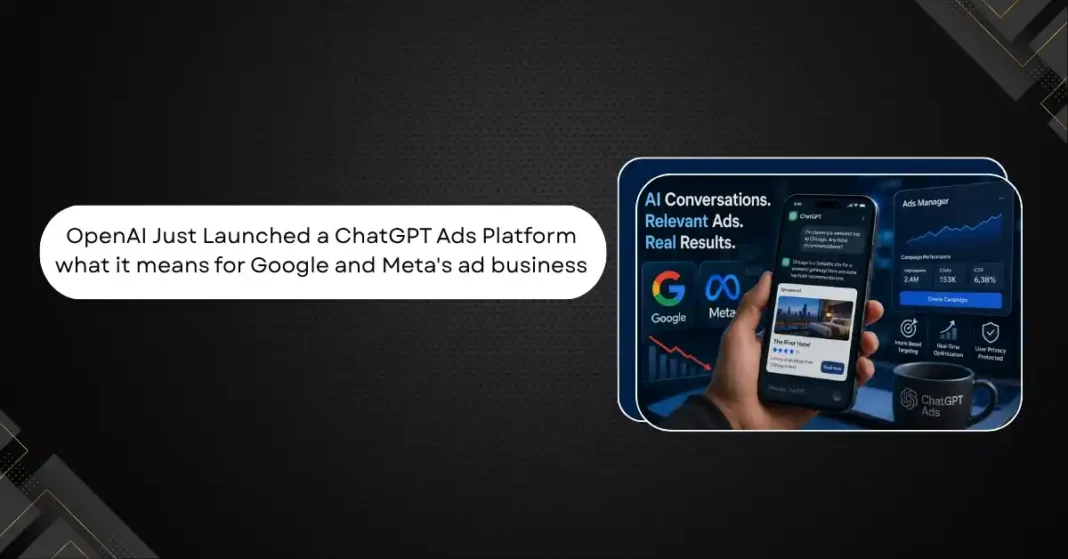
OpenAI confirmed on January 16, 2026 that it would begin testing ads inside ChatGPT for United States users on its free and Go tiers. What started as a beta test became something considerably more significant by May 2026: OpenAI launched a self-serve Ads Manager, added cost-per-click bidding to its existing CPM model, and opened the platform to advertisers of all sizes. With 800 million weekly active users, over 600 brands already on the platform including Target, Ford, and Adobe, and projected ad revenue of 2.5 billion dollars by end of 2026, ChatGPT advertising is no longer an experiment. It is a third major digital advertising platform.
How ChatGPT Ads Work
ChatGPT ads appear at the bottom of AI responses when a sponsored product or service is relevant to the conversation. They are clearly labelled as sponsored content and are separated visually from the AI-generated answer. OpenAI has stated that ads do not influence the chatbot’s answers, and the company has documented its position that sponsored content and AI responses operate independently.
The targeting mechanism is unlike any that exists on Google or Meta. Rather than matching ads to keywords typed into a search box or to demographic interest profiles derived from behaviour data, ChatGPT combines the intent signal of the user’s current question with the full conversational context of the session and the accumulated memory of previous interactions. If a user discussed wedding planning three weeks ago and is now asking about travel, the system understands the combined context and can surface relevant ads at a level of precision that pure keyword targeting cannot achieve.
The Self-Serve Ads Manager
On May 5, 2026, OpenAI launched a self-serve campaign management dashboard that allows advertisers to launch, monitor, and optimise ChatGPT ad placements in real time without routing requests through OpenAI or an agency. Early users describe it as functionally similar to Google Ads in its interface and capabilities. The tool provides real-time campaign data including impressions, clicks, and optimisation controls, ending the era when all performance data had to come through OpenAI as intermediary.
The May 2026 launch also eliminated the minimum spend requirement, which had dropped from 250,000 dollars to 50,000 dollars in April, entirely. OpenAI’s Head of Advertiser Partnerships confirmed the threshold removal, democratising access to the platform in the same way that Google Ads and Meta Ads did when they dropped minimum spends in their early years. Small businesses and startups can now advertise on ChatGPT without the budget constraints that previously excluded them.
The Business Case for ChatGPT Advertising
The pilot programme crossed 100 million dollars in annualised revenue within six weeks of formal launch on February 9, 2026. OpenAI has told investors it expects 2.5 billion dollars in ad revenue by the end of 2026, with a stated long-term target of 102 billion dollars by 2030. Current CPM pricing stands at approximately 60 dollars, above Meta’s typical rates and in line with premium streaming inventory. Ads run on free and Go tier users only; paid subscriptions remain ad-free.
The advertising infrastructure is assembling rapidly. Criteo handles commerce-media distribution, connecting approximately 17,000 advertisers to ChatGPT inventory. Smartly is building conversational and interactive ad formats. David Dugan, former VP of global clients and agencies at Meta, joined OpenAI in late March to lead global ad solutions, a hire that signals a permanent sales organisation rather than an experiment.
What This Means for Google
Google generates over 200 billion dollars annually from advertising, approximately 80 percent of its total revenue. Its dominance in search advertising is built on the principle that users come to Google with intent, and advertisers pay to appear when that intent is expressed. ChatGPT presents a structural challenge to that model because it intercepts intent at an even earlier stage, before the user has formulated a search query, in the context of a conversational exchange that provides richer information than a keyword.
Google has responded by accelerating its own AI advertising capabilities. At Google Marketing Live 2026, the company announced Gemini-powered ad formats, Ask Advisor, Universal Cart, and an agentic commerce framework. Google AI Overviews now appear on 48 percent of search queries, incorporating sponsored content in a way that keeps advertising revenue within Google’s ecosystem even as users shift toward AI-generated answers.
The long-term risk for Google is that users who find their questions fully answered by ChatGPT simply stop performing searches. Google is already seeing click-through rates on organic search results decline as AI Overviews answer questions directly. If users migrate from search to conversational AI as their primary interface with information, Google’s advertising model faces structural erosion, not a sudden collapse but a gradual shift that could take a decade to play out fully.
What This Means for Meta
Meta’s advertising model is built on attention and social context. Users browse Facebook and Instagram in a passive mode, and Meta matches ads to detailed interest and behaviour profiles. The engagement model is fundamentally different from ChatGPT’s intent-based targeting. A user asking ChatGPT for product recommendations is in active decision-making mode; a user scrolling Instagram is in passive content consumption mode.
ChatGPT advertising is potentially more competitive with Google than with Meta in its primary mode. However, as ChatGPT becomes a more central part of users’ daily digital behaviour, it inevitably competes for attention and advertising budgets that previously went to social platforms. Meta is also investing heavily in AI through its Llama models and AI features across its apps, which may create its own AI-native advertising opportunities.
The Privacy Question
OpenAI has been explicit that advertisers do not receive any user data. Chats, names, email addresses, IP addresses, and precise locations remain inside ChatGPT and are not shared with advertising partners. The targeting relies on contextual signals within the session rather than on a persistent profile shared with external parties. This is a meaningful difference from Meta’s advertising model, which is built on extensive personal data sharing.
However, the privacy picture is more complex than OpenAI’s statement suggests. ChatGPT’s memory feature means the AI accumulates context about users across sessions, and that accumulated context informs ad targeting even if the raw data is not shared externally. The targeting is effectively powered by a highly accurate personal profile that exists inside OpenAI’s systems, even if it is never transmitted to advertisers.
Frequently Asked Questions
When did ChatGPT ads launch?
OpenAI began testing ads in ChatGPT on February 9, 2026, for US users on the free and Go tiers. The self-serve Ads Manager launched on May 5, 2026, opening the platform to advertisers of all sizes without minimum spend requirements.
Do ChatGPT ads appear for paid subscribers?
No. Ads currently appear only for users on the free tier and the ChatGPT Go tier, which costs 8 dollars per month. Plus, Team, and Enterprise subscribers maintain ad-free experiences.
How much does it cost to advertise on ChatGPT?
The minimum spend requirement was eliminated in May 2026. CPM pricing is approximately 60 dollars per thousand impressions. CPC bidding is also available following the May 2026 platform update. Specific cost-per-click rates depend on category, competition, and campaign settings.
Does ChatGPT share user data with advertisers?
OpenAI states that advertisers do not receive user data including chats, names, email addresses, IP addresses, or precise locations. Targeting is based on contextual signals within the conversation rather than personal data shared externally.
How does ChatGPT advertising compare to Google Ads?
Both target users with commercial intent, but ChatGPT captures that intent within a conversational context that is richer and more personal than a search query. Google Ads match keywords; ChatGPT ads match conversational context including the history of the entire session. ChatGPT CPMs at 60 dollars are higher than typical Google search CPMs of around 38 dollars, reflecting the premium value of the deeper intent signal.