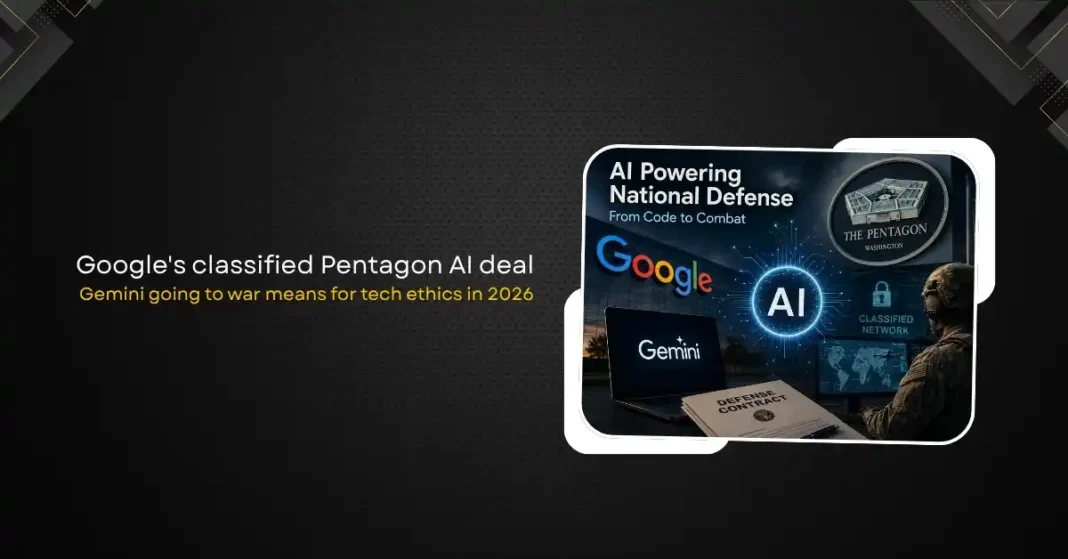
On April 28, 2026, Google signed an agreement with the United States Department of Defense allowing the Pentagon to use its Gemini AI models on classified military networks. The deal, first reported by The Information, permits the government to use Google’s AI for “any lawful government purpose.” It is an amendment to an existing 200 million dollar contract under which Gemini was already deployed on unclassified Pentagon systems through the GenAI.mil platform. The extension to classified networks changes the nature of the relationship fundamentally, and it has ignited a debate about the ethical limits of Big Tech’s role in military operations that will define the AI industry for years.
What the Google-Pentagon Deal Actually Involves
Google had already signed a 200 million dollar contract with the Defense Department prior to the April 2026 amendment. Under that contract, Gemini AI was deployed to the Pentagon’s unclassified systems and became the AI powering GenAI.mil, a platform that provides Gemini chatbot access to the Pentagon’s three-million-strong workforce. In March 2026, Google deployed Gemini AI agents to those unclassified systems. The April 28 amendment extends that access to classified networks used for sensitive operations.
The contract language permits the Pentagon to use Google’s AI for any lawful government purpose. It includes provisions stating that the technology is not intended for domestic mass surveillance or autonomous weapons without proper human oversight, but those provisions are not enforceable vetoes. Unlike OpenAI’s agreement with the Pentagon, Google’s deal reportedly does not give the company the right to control or veto how the government uses the technology.
The Context: Google’s Trajectory from Maven to Gemini
Google’s relationship with military AI has a contentious history that makes the April 2026 deal more significant than a simple business contract. The company’s trajectory follows a pattern that its own employees have described as systematic, and understanding that pattern is essential to understanding the current moment.
In 2018, Google faced a revolt from its own employees over Project Maven, a Defense Department contract involving AI analysis of drone footage. Thousands of employees signed a letter opposing the work, and Google ultimately declined to renew the contract. Separately, the company introduced AI principles pledging not to pursue weapons or surveillance technology.
In February 2025, Google removed the passage from its AI principles that excluded weapons and surveillance, citing global competition for AI leadership. In December 2022, Google won a share of the Pentagon’s 9 billion dollar Joint Warfighting Cloud Capability contract. In December 2025, GenAI.mil launched, powered by Gemini. In March 2026, Gemini agents were deployed to unclassified Pentagon systems. In April 2026, that access was extended to classified networks.
Each step was individually defensible. The trajectory is not, according to critics within and outside the company.
The Drone Swarm Exit: The Other Half of the Story
On February 11, 2026, Google notified the Pentagon that it would not continue participating in a 100 million dollar prize challenge to develop technology allowing military commanders to direct autonomous drone swarms using voice commands. Officially, Google cited a lack of resourcing. According to records reviewed by Bloomberg, the decision followed an internal ethics review.
The juxtaposition of Google exiting a drone swarm contest on ethics grounds in February while signing a classified AI deal with the Pentagon in April is the detail that employees and critics find most difficult to reconcile. The same Gemini infrastructure serving hundreds of millions of consumer users is now accessible on classified military networks where no external monitoring is possible.
Employee Backlash and Unionisation
An employee letter opposing the Pentagon deal was delivered to Google leadership on the same day the contract was signed, April 28, 2026. The letter received significant coverage and has not changed Google’s position. In the United Kingdom, Google DeepMind workers voted to begin organising with the Communication Workers Union, explicitly citing opposition to military AI contracts as a primary motivation. The union drive includes in-person protests and research strikes where employees abstain from work on core products including Gemini.
One Google DeepMind employee told Fortune: the hope is that collective organisation will help the company “grow a spine when it comes to standing up to what they have preached and publicly endorsed as our values and principles for the last two decades.” Google has described itself as “proud to be part of a broad consortium of leading AI labs and technology and cloud companies providing AI services and infrastructure in support of national security.”
Why Big Tech Is Embracing Defense Contracts
Google’s deal does not exist in isolation. The Pentagon signed similar agreements in March 2026 with OpenAI and Elon Musk’s xAI, and later Amazon, Microsoft, and Nvidia. Defense Secretary Pete Hegseth has made adopting AI a top priority for the armed forces, and the administration has positioned AI as central to national security strategy.
For Google, the business logic is straightforward. The company aims to add 6 billion dollars in government contract value by 2027, and defense contracts represent a category where long-term, high-value agreements are the norm rather than the exception. Cloud computing for military applications is a rapidly growing market, and companies that establish relationships now are positioned to capture a disproportionate share of that growth.
What This Means for Tech Ethics in 2026
The Google-Pentagon deal represents a broader collapse of the tech industry’s previous resistance to military AI applications. In 2018, employee opposition was sufficient to force Google out of Project Maven. In 2026, the same company is providing AI for classified military operations, and the employee opposition has not changed the outcome.
The question that remains unanswered is where the line is. The contract prohibits domestic mass surveillance and autonomous weapons without human oversight, but those provisions are non-enforceable from Google’s side. The company cannot veto government use of its technology once deployed on classified networks, and the classified nature of those networks means external accountability is structurally impossible.
For the broader tech industry, the implication is that the commercial pressure to participate in government AI contracts is now stronger than the ethical pressure to resist them. The era of tech companies using AI ethics as a genuine constraint on business decisions is ending. The question for 2026 and beyond is not whether AI companies will serve military customers but what limits, if any, will be placed on how that service is provided.
Frequently Asked Questions
What did Google agree to in the Pentagon AI deal?
Google agreed to extend its existing Gemini deployment from unclassified Pentagon systems to classified military networks. The contract permits the Pentagon to use Google’s AI for any lawful government purpose, with provisions against domestic mass surveillance and autonomous weapons, though Google does not have veto rights over government use.
How is this different from Project Maven in 2018?
Project Maven involved Google providing AI analysis for drone footage on a specific, publicly disclosed program. The 2026 deal extends AI access to classified networks across a much broader scope of military operations, with less transparency about specific applications and no external accountability mechanism.
Can Google employees refuse to work on Pentagon projects?
Individual employees can raise concerns through internal channels and may have some discretion over which projects they personally contribute to. Organised resistance, as seen with the DeepMind unionisation effort, may provide more collective leverage but has not changed the company’s direction in this case.
Are other AI companies also working with the Pentagon?
Yes. OpenAI, xAI, Amazon, Microsoft, and Nvidia all signed agreements with the Pentagon around the same period in 2026. The Google deal is notable for its scope and for the company’s history of employee resistance, but the broader trend of AI labs serving military customers is industry-wide.
What is GenAI.mil?
GenAI.mil is the Pentagon’s AI platform, powered by Google’s Gemini, that provides conversational AI access to the Department of Defense’s three-million-person workforce for unclassified work. It launched in December 2025 and formed the foundation of the broader Gemini deployment that was extended to classified networks in April 2026.