Windows 12 is coming, but not when most people expected. Despite years of speculation and a rapidly evolving AI computing landscape that would seem to demand a new operating system, Microsoft has repeatedly deferred a formal Windows 12 announcement. The current consensus among industry analysts, leaked roadmaps, and developer programme activity is that Windows 12 will arrive in late 2027. Here is what we know, what is rumoured, and why Microsoft is taking its time.
Is Windows 12 Officially Announced?
As of May 2026, Microsoft has not officially confirmed the existence of Windows 12. The company has not announced a product name, release date, hardware requirements, or feature set. What Microsoft has confirmed is a continuing focus on Windows 11, with annual feature updates and the ongoing trickling of new capabilities into the platform. The most recent confirmed update is Windows 11 version 26H2, and internal development logs suggest a version called 26H1 is targeted at Qualcomm Snapdragon X2 processors.
Industry insiders and Microsoft-adjacent sources have referred to the next major Windows version using the internal codename “Hudson Valley Next.” Leaked roadmaps suggest deep AI integration as the core system component, but Microsoft has not confirmed any of these details officially.
Why Has Windows 12 Been Delayed?
The AI Hardware Problem
Windows 12 is expected to require Neural Processing Units, dedicated AI chips that are now standard in new laptops but remain absent from hundreds of millions of existing PCs. A new operating system built around AI features that only work with hardware most users do not yet own creates the same problem that TPM 2.0 requirements created for Windows 11: huge numbers of otherwise capable machines cannot run the new OS. Microsoft saw what happened when Windows 10 users could not upgrade to Windows 11, and it does not want to repeat that situation.
The Windows 11 Adoption Problem
Windows 11 has approximately 34 percent market share against Windows 10’s 63 percent. The majority of Windows users have not yet moved to the most recent version of the operating system. Launching Windows 12 into that environment would add confusion, fragment the user base further, and place additional pressure on enterprise IT departments already managing a slow Windows 11 migration. Microsoft’s strategy of feeding Windows 12 features into Windows 11 updates ensures the ecosystem is stable and hardware is ready before a new version becomes official.
The “Ship When Ready” Philosophy
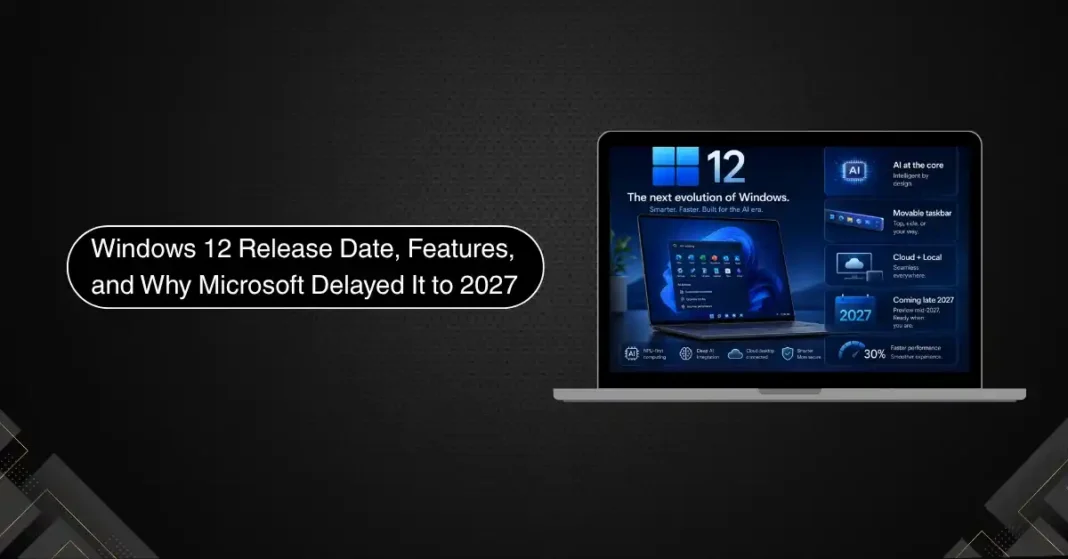
Microsoft’s March 2026 “Quality Reset” memo confirmed a shift in strategy. Rather than rushing a new operating system to market, the company is prioritising fixing the performance and bloat issues that have accumulated in Windows 11. Features currently in testing include a movable taskbar that can be repositioned to the top or sides of the screen, a 30 percent improvement in File Explorer launch speed, a new update system that reduces forced reboots, and a streamlined Start menu. These improvements will likely ship in Windows 11 updates before becoming foundation features of Windows 12.
Expected Windows 12 Features
Deep AI Integration
Windows 12 is expected to make AI a first-class system component rather than a feature bolt-on. Natural language search across the entire operating system, voice-driven task automation, AI agents that can take actions on behalf of users across apps and settings, and on-device AI processing for privacy-sensitive tasks are all part of the expected feature set. The difference from Windows 11’s Copilot implementation is architectural: rather than a sidebar that opens a web-based chatbot, AI would be integrated into the OS shell itself, understanding context from the entire desktop environment.
NPU-First Computing
Windows 12 is expected to build around NPU capabilities in a way that Windows 11 has only partially done through the Copilot Plus requirements. By 2027, the installed base of NPU-equipped machines will be substantially larger than in 2026, making it feasible to require the chip for core features without leaving the majority of users behind. AI features that currently require a cloud connection may be able to run entirely on-device in Windows 12 for qualifying hardware.
Movable Taskbar
One of the most requested Windows features in years, the ability to move the taskbar to the top or sides of the screen, is confirmed to be in testing and is expected to arrive in Windows 12 if not in a Windows 11 update first. Microsoft removed taskbar repositioning in Windows 11, and its absence generated significant negative feedback from power users.
Cloud Desktop Integration
Windows 12 is expected to offer deeper integration between local computing and cloud-hosted Windows instances, potentially allowing users to access their full Windows environment from any device, including non-Windows hardware, while maintaining the local app experience on capable machines.
What Is the Expected Release Timeline?
The most widely cited estimate, based on Microsoft’s historical six-year release cycle and the current trajectory of Windows 11 updates, is a late 2027 general availability launch. The pattern from Windows 11’s own development suggests: 2026 sees accelerated internal development while Windows 11 feature work slows, mid-2027 sees a public preview through the Windows Insider Canary channel, and October 2027 sees general availability, consistent with Microsoft’s longstanding preference for autumn operating system launches.
Windows 11 version 25H2 is supported until October 2027, which aligns with this timeline. A successor release would logically launch as Windows 11 support for its current major version winds down.
What Should You Do Now?
If your PC supports Windows 11, upgrading now is the sensible choice. Windows 11 continues to receive meaningful improvements, and the Copilot Plus features available on NPU-equipped machines are a genuine preview of where Windows is headed. Waiting for Windows 12 on an unsupported machine is not a viable strategy.
If your PC cannot run Windows 11, Windows 10 support has already ended, meaning you are running an OS without security patches. The right decision is a hardware refresh rather than waiting for a future operating system that will likely have even stricter hardware requirements.
If you are planning a new PC purchase for 2026 or 2027, prioritise NPU-equipped machines. Intel, AMD, and Qualcomm all offer chips with capable NPUs in their current product lines. A machine without an NPU is likely to struggle with Windows 12 features at launch.
Frequently Asked Questions
When will Windows 12 be released?
Microsoft has not confirmed a Windows 12 release date. Based on historical release patterns and the current Windows 11 support timeline, late 2027 is the most widely cited estimate. A public preview through the Windows Insider programme is expected in mid-2027.
Is Windows 12 free to upgrade from Windows 11?
Microsoft has not announced pricing for Windows 12. Both Windows 10 and Windows 11 were free upgrades for compatible hardware. Based on precedent, Windows 12 is likely to be a free upgrade for Windows 11 users on qualifying machines, though hardware requirements may exclude older PCs.
Will Windows 12 require an NPU?
Windows 12 is expected to require a Neural Processing Unit for its AI-intensive features. Whether an NPU will be required to install the OS at all or only to access specific features has not been confirmed. The Windows 11 Copilot Plus model, where NPU requirements apply to a specific feature tier rather than the base OS, is a likely template.
What is the Windows 12 codename?
Industry sources have referred to Windows 12 internally as “Hudson Valley Next,” though Microsoft has not confirmed this codename publicly. The company confirmed the codename for Windows 11 only after the product was announced.
Should I buy a new PC now or wait for Windows 12?
If you need a new PC today, buy one now. Windows 11 is a capable and well-supported operating system, and machines purchased today with NPUs will be well-positioned for Windows 12 when it arrives. Waiting until 2027 for hardware is not practical for most users who need a working computer in the meantime.