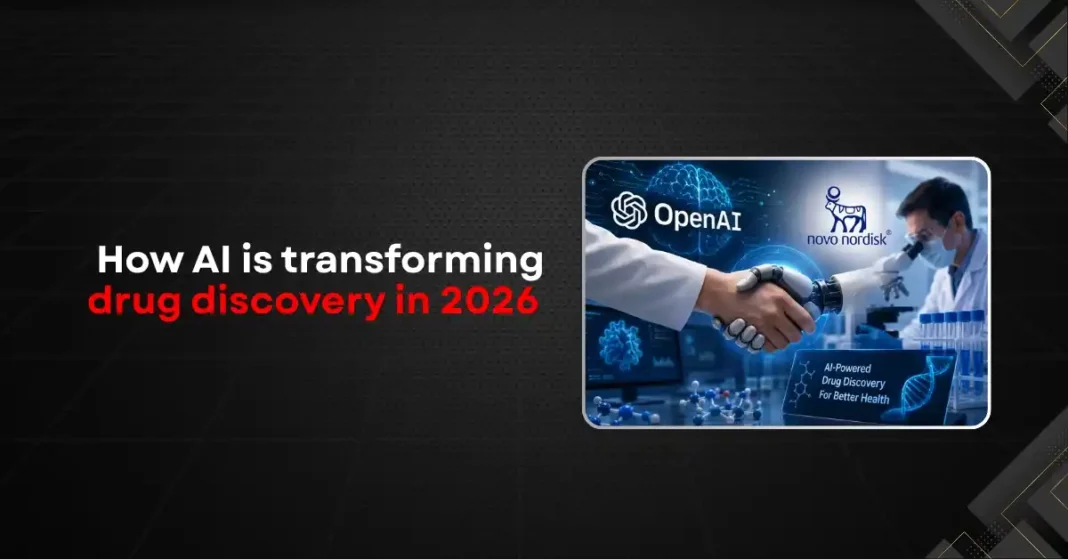
Novo Nordisk and OpenAI have announced a multi-year deal that puts OpenAI’s frontier models inside Novo’s drug discovery pipeline. The headline is the size and scope of the agreement, but the more interesting story is what this kind of partnership says about where pharmaceutical research is heading in 2026. AI has been promising to transform drug discovery for at least a decade. Most of those promises went nowhere. This one might be different.
Novo Nordisk is best known for Ozempic and Wegovy, the GLP-1 drugs that have reshaped global treatment of diabetes and obesity. Behind those headlines, the company has been investing heavily in AI-driven research, partnering with multiple AI labs, and building out its own internal machine learning teams. The OpenAI deal is the most prominent piece of that strategy.
Here’s what the deal actually involves, how AI is changing pharmaceutical research today, what’s hype and what’s real, and what it means for patients, smaller drug companies, and the wider biotech industry.
What the Deal Actually Covers
The agreement, reportedly worth several hundred million dollars over multiple years, gives Novo Nordisk access to OpenAI’s frontier models and a custom partnership with OpenAI’s research team. The custom work focuses on three areas: target identification, molecule design, and clinical trial optimisation.
Target identification is the process of finding the biological mechanism that a new drug should act on. Today this involves combing through huge amounts of research, experimental data, and clinical observations to spot which proteins, pathways, or cell types are involved in a disease. AI can read and synthesise that literature faster than humans, and it can spot patterns in experimental data that human researchers miss.
Molecule design is where AI tries to predict which chemical structures will bind to a target effectively, with low toxicity and good drug-like properties. This is the part of drug discovery that has been most transformed by AI in the last few years. Models like AlphaFold and its successors have made huge strides in predicting protein structures and interactions.
Clinical trial optimisation is newer. AI is being used to choose better patient populations, predict trial outcomes, and identify which trials are most likely to succeed. Novo Nordisk has been particularly interested in this area because the failure rate of clinical trials is one of the biggest cost drivers in the industry.
How AI Has Actually Changed Drug Discovery
Five years ago, AI in drug discovery was mostly hype. Companies promised that AI would compress decade-long discovery timelines into months and slash R&D budgets. The reality has been more modest but more useful.
Where AI has made a real difference is in the early stages of discovery. Reading and summarising scientific literature, predicting protein structures, screening candidate molecules, and prioritising experiments are all areas where AI saves significant time. A research team that used to spend weeks reviewing literature can now get a structured summary in hours and focus their attention on the most promising leads.
AI has been less transformative in the late stages of discovery, where wet lab experiments, animal studies, and human trials are still needed. The model can predict whether a molecule will work, but it cannot verify the prediction without running the experiment. The wet lab bottleneck is real and not going away.
What 2026 looks different is the scale and quality of the models. Frontier models like GPT-5 and the unreleased Claude Mythos handle scientific reasoning, protein structure prediction, and chemical synthesis planning at levels that were not possible even two years ago. The combination of better models, better data, and better experimental tooling is what makes deals like the Novo Nordisk one feel meaningful instead of speculative.
Why Novo Nordisk Is Betting Big
Novo Nordisk is in an unusual position. Ozempic and Wegovy are generating record revenue, but the patents won’t last forever. The company needs the next generation of drugs ready before its current cash cows lose market exclusivity. That’s a five to seven year window, which is short by pharmaceutical standards.
AI gives Novo a way to compress its discovery timelines and increase the number of candidate drugs in its pipeline. If the company can run twice as many discovery projects with the same headcount, the odds of at least one of them producing a blockbuster drug improve significantly.
There is also a strategic dimension. Pfizer, Roche, Merck, and other large pharma companies have all signed AI partnerships, including with OpenAI, Google DeepMind, and Anthropic. Novo Nordisk does not want to fall behind on the technology that is increasingly seen as a competitive advantage in the industry.
The other reason is data. Novo Nordisk has accumulated huge amounts of clinical data, biomarker data, and real-world evidence over its operating history. AI lets the company extract more value from that data than traditional analysis would. Combining proprietary data with frontier models is the kind of advantage that’s hard for smaller competitors to replicate.
What’s Hype and What’s Real
Hype, when it comes to AI drug discovery, usually shows up in three forms. The first is the timeline compression promise. Claims that AI will reduce a 15-year drug development cycle to two or three years are not credible. Wet lab experiments, animal studies, and human trials all have minimum durations that no algorithm can speed up.
The second is the success rate promise. Some AI-first biotech companies have claimed that AI-designed drugs have higher clinical trial success rates than traditional ones. The data so far is mixed, partly because there aren’t enough AI-designed drugs in late-stage trials yet to draw firm conclusions.
The third is the cost promise. AI saves money in some parts of discovery, especially early-stage screening and literature review, but the savings are often offset by the cost of running and licensing frontier models, hiring AI talent, and integrating AI into existing research workflows.
What’s real is that AI is now a standard part of major pharmaceutical R&D pipelines. The question is no longer whether to use AI, but how to integrate it effectively. Companies that get this right will outpace competitors that don’t. Companies that throw money at AI without changing their research culture will not see the gains they hoped for.
What This Means for Patients
For patients, the impact of AI in drug discovery will show up indirectly and slowly. The first benefit is more drug candidates entering trials. If AI can help drug companies test more hypotheses faster, more potential treatments reach patients, even if the overall success rate doesn’t change much.
The second is better targeting of treatments to patients. AI is being used to identify which patients are most likely to respond to a given drug, which can improve outcomes and reduce side effects. For chronic conditions like diabetes, obesity, and certain cancers, this kind of precision medicine is already starting to make a difference.
The third is faster development of treatments for rare diseases. Diseases that affect small populations have historically been neglected because the economics don’t support traditional drug discovery. AI changes the economics by lowering the cost of discovery, which makes it more feasible to develop drugs for smaller patient groups.
What patients should not expect is dramatically cheaper drugs. Drug prices are set by a combination of patent protection, regulatory approval costs, and market dynamics, none of which AI changes significantly. AI may help bring more drugs to market, but those drugs will still be priced based on standard pharmaceutical economics.
The Competitive Landscape
OpenAI is one of several AI companies courting pharmaceutical partnerships. Google DeepMind, through its Isomorphic Labs subsidiary, has signed deals with Eli Lilly and Novartis. Anthropic has partnered with smaller biotech companies. Microsoft, through its Azure AI investments, has done deals with multiple pharmaceutical giants.
Each AI company brings different strengths. Google DeepMind has AlphaFold and a deep history in protein structure prediction. OpenAI brings frontier model capability and a broader range of scientific reasoning. Anthropic has been positioning itself around safety and reliability, which matters for regulated industries.
On the pharmaceutical side, the competitive landscape is also shifting. Companies that move fastest to integrate AI into their pipelines are gaining an edge. Companies that are slow to adapt face the risk of being outpaced by smaller, more agile AI-first biotech firms.
AI-first biotech companies, including Recursion, Insitro, and several newer entrants, are betting on a different model where the AI is central to the company rather than a tool used by traditional researchers. These companies have raised significant funding but have yet to prove their model with a major drug approval. The next five years will tell us which approach works better.
Risks and Open Questions
AI in drug discovery raises specific risks worth flagging. The first is overreliance on model predictions. If researchers trust an AI’s prediction of molecule efficacy without sufficient experimental verification, time and money can be wasted chasing dead ends. The discipline of treating AI outputs as hypotheses to test, not conclusions to act on, is hard to maintain when models become very good.
The second is data quality. AI is only as good as the data it’s trained on, and pharmaceutical data is often messy, inconsistent, and biased toward certain populations or conditions. Models trained on biased data make biased predictions, which can have real consequences for patient outcomes.
The third is regulatory uncertainty. The FDA, EMA, and other regulators are still figuring out how to evaluate drugs that were discovered or designed with AI. The questions about what constitutes adequate evidence, how to audit AI-driven decisions, and how to handle IP for AI-generated molecules are all unresolved.
The fourth is concentration risk. If frontier AI models become essential to drug discovery, and only a handful of companies can afford to build and run them, the pharmaceutical industry becomes dependent on a small number of AI suppliers. That dependency is uncomfortable for an industry that is normally careful about its supply chains.
Frequently Asked Questions
Will AI-discovered drugs be available to patients soon?
Some AI-discovered drugs are already in clinical trials, but most are still in early or mid-stage testing. Expect the first major AI-discovered drug approvals in the next three to five years, with broader adoption following that.
Is the OpenAI Novo Nordisk deal the first of its kind?
No. AI partnerships in pharma have been growing for years. What makes this one notable is the scale, the involvement of OpenAI’s frontier models, and the focus on a company with proven commercial success in metabolic disease.
Will AI replace pharmaceutical researchers?
No, but it will change what researchers spend their time on. The boring, repetitive parts of literature review, data analysis, and screening become much faster. The creative, judgment-driven parts of research, including study design and interpretation, are still firmly human work.
Are AI-designed drugs safer than traditional ones?
There is no evidence that AI-designed drugs are inherently safer. They go through the same clinical trials and regulatory review as any other drug. AI may help avoid some failure modes, but it can also introduce new ones if the model makes systematic errors.
Can small biotech companies use frontier AI models?
Yes, increasingly. API access to models like GPT-5, Claude Opus, and Gemini Pro is available to any company with the budget. Smaller biotech firms can use these models for discovery work without needing the deep partnerships that companies like Novo Nordisk are signing.
What does this mean for the price of drugs?
Probably not much in the short term. Drug pricing is driven by market exclusivity, regulatory costs, and payer dynamics, not by R&D efficiency alone. AI may help bring more drugs to market, but those drugs will still be priced based on standard pharmaceutical economics.
Final Thoughts
The OpenAI and Novo Nordisk deal is one of the clearest signals yet that AI in pharmaceutical research has moved from experimental to mainstream. The biggest companies in the industry are no longer asking whether AI is useful. They are competing on how effectively they can integrate it into their pipelines.
For Novo Nordisk specifically, the bet is that AI will help the company find the next Ozempic before the current one loses patent protection. For OpenAI, the deal is a validation of frontier AI’s usefulness outside software and consumer products. For the wider industry, it’s a sign that the AI-pharma partnerships of 2026 are different in scale and ambition from anything that came before.
Patients won’t see the impact immediately. Drug discovery timelines are measured in years, and even AI cannot change the basic biology of clinical trials. But over the next decade, expect more candidate drugs, better targeted treatments, and faster progress on diseases that have historically been hard to crack. AI is not going to cure everything, but it is going to make the discovery process meaningfully more productive, and that’s a real change worth paying attention to.