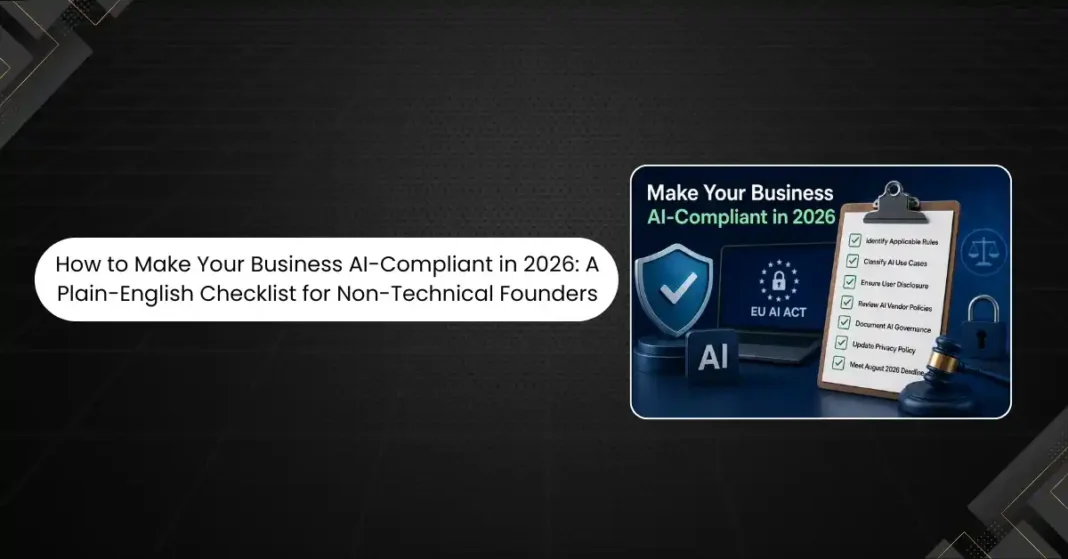
Most founders using AI tools in their business in 2026 are not thinking about compliance. They are thinking about whether the tool makes something faster or better. That is a reasonable default, but the regulatory environment shifted materially in 2025 and 2026 in ways that create real obligations, particularly for businesses serving customers in Europe or handling data in sensitive categories.
This checklist is for founders who do not have a legal team, did not go to law school, and need to understand what they are actually required to do rather than what a law firm’s marketing department wants to charge them to explain. It covers the EU AI Act enforcement timeline, what the US regulatory posture means for non-EU businesses, and the practical steps that matter most.
Step 1: Find Out Which Rules Actually Apply to You
The EU AI Act is the most significant AI regulation in effect in 2026. Full enforcement for high-risk AI systems begins August 2, 2026. The Act applies to any business whose AI system is used by EU residents, regardless of where the business is headquartered. A SaaS company based in India serving a customer in Germany is in scope.
Before doing anything else, answer two questions. First, does your business have any customers in the EU? Second, are you using AI in a way that affects decisions about those customers, specifically in areas like hiring, credit, education, healthcare, critical infrastructure, biometrics, or law enforcement?
If the answer to both is yes, you have EU AI Act obligations to address before August 2026. If you have EU customers but your AI use is limited to customer support chatbots, content generation, or internal productivity tools, you fall under the limited or minimal risk category with lighter requirements.
If you have no EU customers and operate only in the US, the EU Act does not apply. US federal AI regulation in 2026 remains sector-specific and advisory rather than comprehensive. The FTC has issued guidance on AI-related deception and unfair practices, and sector-specific rules apply in healthcare, finance, and employment. The practical US requirement for most small businesses is disclosure and basic fairness.
Step 2: Classify Your AI Use Cases
The EU AI Act divides AI into four categories. Prohibited uses are banned outright and include social scoring by governments, real-time biometric surveillance in public spaces, and AI that manipulates behavior by exploiting vulnerabilities. If your product does any of these, it cannot operate in the EU at all.
High-risk AI covers eight categories: biometric identification, critical infrastructure management, education and vocational training systems, employment and HR tools, essential public services including credit scoring and insurance, law enforcement applications, migration management, and administration of justice. If your product operates in any of these categories and makes or influences decisions about people, you have the highest level of compliance obligations.
Limited-risk AI includes chatbots and AI-generated content where the main obligation is transparency. You must tell users when they are interacting with an AI and when content has been AI-generated. This applies to most founders who use AI for customer-facing chat or marketing content.
Minimal-risk AI includes most consumer applications, writing tools, and internal productivity AI. No mandatory requirements apply here, though voluntary compliance is encouraged.
Step 3: Handle Disclosure if You Use AI in Customer-Facing Contexts
If your business uses any AI-generated content in marketing, support, or customer communication, the EU AI Act requires disclosure when EU customers are the audience. The practical implementation is not complicated: add a brief line to your privacy policy explaining that you use AI tools, and disclose clearly when a customer is interacting with an AI chatbot rather than a human.
In the US, the FTC’s guidance on AI disclosures recommends the same approach without making it a hard legal requirement for most businesses. The practical advice is the same regardless of jurisdiction: be clear about when AI is involved, particularly in high-stakes or personalized interactions.
Step 4: Check What Your AI Vendors Are Doing with Your Data
Most founders do not read the data processing agreements or terms of service for the AI tools they use. In 2026, with significant fines attached to data protection failures, this is worth changing.
For each AI tool you use, find out three things. First, whether your data is used to train the vendor’s models. Most enterprise AI agreements allow an opt-out from training data use. Second, where the data is processed and stored, which matters for GDPR if you have EU customers. Third, whether the vendor has appropriate security certifications. SOC 2 Type II for US vendors and ISO 27001 for international vendors are the standard benchmarks.
Tools that process personal data about your EU customers need to have a Data Processing Agreement in place. Most major AI vendors provide standard DPAs. If your vendor does not, that is a signal to ask explicitly or consider switching.
Step 5: Build Basic AI Governance Documentation
This step applies primarily if you are in or near the high-risk category. If you are in the minimal or limited risk category, lightweight documentation still protects you if a regulator or enterprise customer asks questions.
Create a one-page AI systems inventory that lists every AI tool you use, what it does, what data it accesses, and which customers or processes it touches. This takes an afternoon and becomes the foundation for any compliance conversation.
For high-risk systems, the EU AI Act requires a risk management plan, technical documentation covering how the system works, data governance documentation, and a process for human oversight of AI-generated decisions. These do not need to be sophisticated documents for small businesses. They need to exist and be accurate.
Step 6: Add AI Transparency to Your Privacy Policy
Your privacy policy should mention that you use AI tools, describe the categories of AI use, explain what data the AI accesses, and note any third-party AI providers by name or category. Legal guidance varies on how specific this needs to be, but the general standard is enough detail that a user understands how their data might interact with AI systems.
If your privacy policy was last updated before 2025 and you have added AI tools since then, update it. The August 2026 enforcement deadline is the forcing function for this work.
Step 7: Know the Deadline and Make a Decision
August 2, 2026 is the full enforcement date for high-risk AI systems under the EU AI Act. Businesses that have EU customers and AI touching high-risk categories need to be compliant by that date. The fines are real: up to 35 million euros or 7 percent of global annual turnover for the most serious violations, and up to 15 million euros or 3 percent for high-risk system violations.
For most small businesses, the practical compliance work is not enormous. The steps above cover the meaningful obligations. What matters is doing them rather than assuming the rules do not apply or that enforcement is far off. August 2026 is not far off.