Key Takeaways
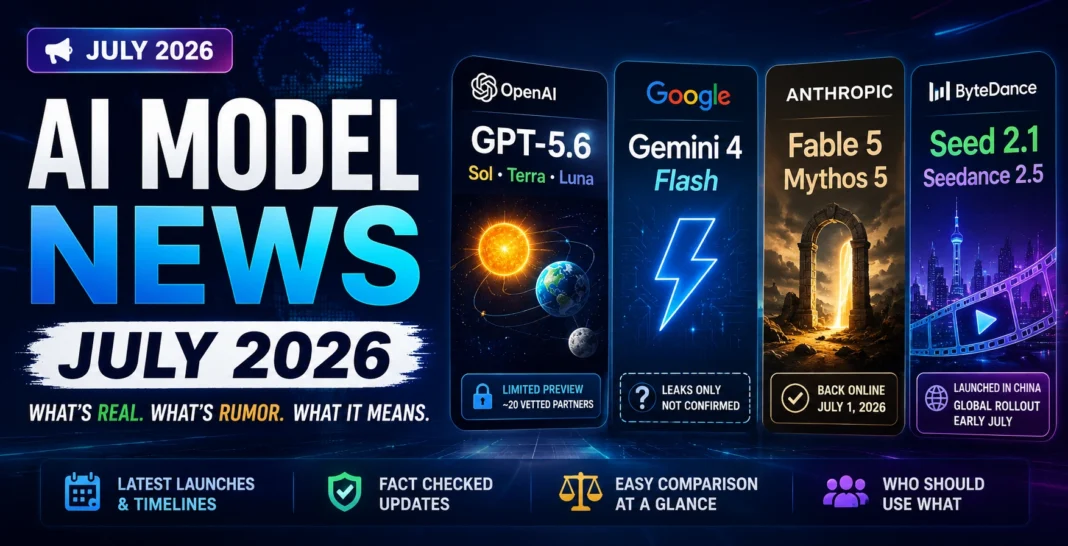
- GPT-5.6 (Sol, Terra, Luna) launched June 26, 2026, but only to about 20 vetted partner organizations, at the U.S. government’s request. Wider access is expected “in the coming weeks,” with no confirmed date.
- Gemini 4 Flash has not officially launched. What’s circulating is leaked, unconfirmed detail about strong SVG/graphics handling paired with weaker multi-step reasoning.
- Anthropic’s Fable 5 and Mythos 5 were briefly pulled from availability on June 12, 2026, to comply with U.S. export controls, then restored on July 1, 2026, after the Commerce Department lifted those controls on June 30.
- ByteDance’s Seed 2.1 language model and Seedance 2.5 video model both launched in China in June 2026, with Seedance 2.5 aiming for a global rollout in early July.
- None of this is settled. Company blog posts and system cards are confirmed; everything else, especially specific benchmark numbers for unreleased models, is a claim someone hasn’t independently checked yet.
Introduction
If you tried to keep up with AI news this week, you probably gave up somewhere around the third new model name. That’s not you falling behind — it’s the industry moving faster than any single person can track.
In the span of about ten days, OpenAI previewed a three-tier model family, Anthropic’s flagship models disappeared and came back, leaks about Google’s next Gemini started circulating, and ByteDance pushed out a fresh language model and a video model that claims 30-second, single-pass 4K clips.
The hard part isn’t finding AI news. It’s telling the difference between what a company has actually confirmed, what’s a limited preview dressed up as a launch, and what’s just a rumor with a confident headline attached.
This guide walks through what’s real, what’s still gated, and what’s genuinely just speculation, so you can decide what to act on — and what to ignore until it actually ships.
What you’ll learn:
- What GPT-5.6 Sol, Terra, and Luna actually are, and who can use them right now
- Why Gemini 4 Flash headlines are running ahead of any confirmed Google announcement
- The full timeline of what happened to Anthropic’s Fable 5 and Mythos 5
- Where ByteDance’s Seed 2.1 and Seedance 2.5 fit into the picture
- A simple way to decide which model news is worth your attention
GPT-5.6: A Three-Tier Family With an Unusual Rollout
OpenAI began a limited preview of GPT-5.6 on June 26, 2026. The family comes in three tiers, each named after something in the sky: Sol (the flagship), Terra (a balanced, everyday option), and Luna (the cheapest, fastest tier).
That naming choice isn’t just branding. OpenAI says the number in “GPT-5.6” marks the generation, while Sol, Terra, and Luna are meant to be durable tier names that can each get upgraded on their own schedule going forward, rather than the whole family being replaced as one block.
What’s genuinely new:
- Sol sets a new high score on Terminal-Bench 2.1, a benchmark for command-line, multi-step technical work.
- A new “max” reasoning mode gives Sol more time to think before answering.
- An “ultra” mode adds sub-agents that split up complex tasks instead of relying on one continuous chain of reasoning.
- Pricing lands at $5 input / $30 output per million tokens for Sol, $2.50 / $15 for Terra, and $1 / $6 for Luna — with Terra pitched as roughly GPT-5.5-level performance at about half the cost.
The catch: access. At the request of the U.S. government, OpenAI is starting this rollout with roughly 20 vetted partner organizations, reachable only through the API and Codex. It isn’t available in ChatGPT yet, and there’s no waitlist for the general public. OpenAI says broad availability is coming “in the coming weeks,” but hasn’t committed to a date.
Expert tip: if you’re building a product on top of frontier models, don’t wait on GPT-5.6 to ship features. Teams that route tasks through an abstraction layer — swapping model providers without rewriting application code — can adopt whichever tier turns out to be best a week after GA, instead of redesigning their whole pipeline around a name that might not be available to them yet.
Gemini 4 Flash: Mostly Leaks, Not an Announcement
Here’s where a lot of confusion is happening. Search “Gemini 4 Flash” this week and you’ll find confident claims about its SVG rendering strengths and its weaknesses in abstract, multi-step reasoning. What you won’t find is a Google blog post confirming any of it.
As of early July 2026, Google’s confirmed public lineup tops out at Gemini 3.5 Flash and Gemini 3.1 Pro, both announced at Google I/O in May 2026. There is no official documentation, API listing, or model card for a product called “Gemini 4” or “Gemini 4 Flash.” A prediction market tracking whether Gemini 4.0 would launch by the end of June 2026 closed with traders overwhelmingly betting “no,” citing the absence of developer docs or API access.
What’s circulating instead is unconfirmed reporting: that a leaked Gemini 4 Flash handles vector graphics and design-style tasks well, but struggles with the kind of layered, multi-step reasoning that separates a good model from a great one — and that its release may be delayed by regulatory review rather than technical readiness.
Common mistake: treating “leaked” as a synonym for “confirmed.” A leak, even a detailed one, is still someone’s unverified claim until the company publishes it. Until Google ships a model card, benchmark numbers attached to “Gemini 4” belong in the rumor bucket, not the fact bucket.
Industry chatter around Google I/O 2026 also suggested the next Gemini release could land somewhere between OpenAI’s GPT-5.5 tier and Anthropic’s top-end models — but that framing traces back to anonymous sourcing, not a published benchmark, so it’s worth holding loosely.
Fable 5 and Mythos 5: A Launch, a Pause, and a Restoration
Anthropic’s Fable 5 and Mythos 5 had one of the more unusual rollouts of the year. Both models share the same underlying architecture; Fable 5 carries additional safety measures around biology, cybersecurity, and AI research capabilities that Mythos 5 doesn’t.
Here’s the full sequence:
| Date | Event |
|---|---|
| June 9, 2026 | Fable 5 and Mythos 5 first released |
| June 12, 2026 | Anthropic suspends access to both models to comply with U.S. Department of Commerce export controls |
| June 30, 2026 | The Department of Commerce lifts those export controls |
| July 1, 2026 | Anthropic restores global access to both models |
In practical terms: if you tried Fable 5 in mid-June and hit a wall, that wasn’t a bug — it was a compliance pause tied to a specific export-control rule, not a quality or safety rollback. As of July 1, 2026, both models are back and available.
Separately, a small number of trusted organizations have access to an even newer, unreleased model called Claude Mythos Preview, as part of a program Anthropic calls Project Glasswing. That one isn’t publicly available, and there’s no announced date for when — or whether — it will be.
Expert tip: if you’re evaluating Anthropic’s models for a production workflow, build in a fallback plan. A model that’s technically excellent but occasionally paused for regulatory reasons needs a backup route in your stack, the same way you’d plan around any vendor’s rate limits or outages.
ByteDance’s Seed 2.1 and Seedance 2.5: The Quiet Frontier Push
While the U.S. story dominated headlines, ByteDance shipped two separate but related updates.
Seed 2.1, a text-based agent model, officially launched on June 23, 2026, through Doubao and Volcano Engine. ByteDance is positioning it around real-world “agent” work — research, planning, and multi-step task completion — rather than chatbot-style single answers. The company reports strong results on its own Workspace Bench and Agent Startup Bench evaluations, plus a competitive score on the newer Agents’ Last Exam benchmark.
Seedance 2.5, ByteDance’s video generation model, was announced at the same window (June 23, 2026) at the Volcano Engine FORCE conference. The headline claims are a single continuous 30-second clip in native 4K, up to 50 reference inputs for consistency, and localized “re-draw” editing that fixes one part of a scene without regenerating the whole clip. As of this writing it’s in global enterprise beta, with ByteDance targeting a broader public launch in early July 2026.
Two things are worth separating here: what ByteDance has stated, and what’s independently verified. All of the Seedance 2.5 specifications above are the company’s own claims from a stage announcement — reasonable, and consistent across multiple outlets covering the event, but not yet checked by outside testers. Seedance 2.0, its predecessor, is also still working through legal disputes with major U.S. studios over copyright, following cease-and-desist actions earlier in 2026. ByteDance has added filters aimed at blocking recognizable real faces and copyrighted characters, and says those carry forward into 2.5, but the underlying legal disputes remain unresolved.
Comparison: Where Each Model Stands Right Now
| Model | Status | Who Can Access It | Standout Claim |
|---|---|---|---|
| GPT-5.6 (Sol/Terra/Luna) | Limited preview | ~20 vetted partners, via API + Codex | New state of the art on Terminal-Bench 2.1 |
| Gemini 4 Flash | Unconfirmed / rumored | No one publicly | Strong SVG handling, weaker multi-step reasoning (unverified) |
| Fable 5 / Mythos 5 | Publicly available | Everyone (restored July 1, 2026) | Full capability restored after export-control pause |
| Seed 2.1 | Publicly available | Doubao / Volcano Engine users | Strong agent and workplace-task benchmarks |
| Seedance 2.5 | Enterprise beta | Qualifying organizations; wider launch targeted early July | Single-pass 30-second native 4K video |
Benefits of Following Model Releases Closely
Main benefits: you avoid building on a model that’s about to be deprecated, you catch pricing drops early (like Terra’s roughly 50% discount versus GPT-5.5-class performance), and you can match a task to the model actually built for it instead of defaulting to whatever you used last month.
Real-world applications: engineering teams route coding tasks to whichever model currently leads on agentic benchmarks; content teams track video models like Seedance for production speed; compliance and legal teams need to know about pauses like Anthropic’s export-control suspension before they build a dependency on a single provider.
Who should pay close attention: developers with model-agnostic infrastructure, product teams evaluating vendor lock-in risk, and anyone doing AI-adjacent journalism or research.
Who can safely ignore the noise: casual users who just want a chatbot for everyday questions. The model you already have access to is almost certainly good enough; chasing every announcement adds stress without adding much value.
Common Mistakes to Avoid
- Treating a limited preview as a public launch. GPT-5.6 “launched” June 26, but almost no one can actually use it yet. Check the access details, not just the announcement date.
- Confusing leaks with confirmed specs. Gemini 4 Flash headlines are running well ahead of anything Google has published. Wait for the model card.
- Assuming a paused model is a failed model. Fable 5’s suspension was a regulatory compliance issue tied to export controls, not a performance or safety failure.
- Comparing benchmark scores across different testing conditions. A model that “sets a new state of the art” on one benchmark suite isn’t automatically better at your specific task.
- Ignoring the legal and compliance layer. Seedance’s ongoing copyright disputes matter just as much as its technical specs if you’re considering it for commercial content.
Expert Tips
- When a company announces a staggered or gated rollout, read the fine print on why. Government-requested reviews (like GPT-5.6’s) signal something different than a simple capacity-driven staged launch.
- Bookmark the official changelog or release-notes page for any model you rely on professionally, rather than relying on aggregator roundups — those pages update faster and more accurately than most news coverage.
- If a headline benchmark number has no linked source or system card, treat it as marketing until proven otherwise.
- Build your workflows around task type, not brand loyalty. A model that leads on video generation this month may not be the best pick for text reasoning six weeks from now.
Future Trends: What’s Next
A few patterns are worth watching heading into the rest of 2026:
- Government involvement in release timing is becoming a real factor, not a hypothetical one. GPT-5.6’s gated rollout and Fable 5’s export-control pause both show regulators shaping when the public gets access to a model, separate from whether it’s ready.
- Tiered model families are replacing single flagship releases. OpenAI’s Sol/Terra/Luna split lets the company update each tier on its own schedule, and it wouldn’t be surprising to see competitors adopt similar structures.
- Video generation is catching up to text generation in commercial stakes. Seedance’s copyright disputes are a preview of the legal questions that will follow every major video model as clip length and realism keep climbing.
- “Leak season” before major releases is intensifying. Expect more Gemini-4-style speculation cycles, where unconfirmed details circulate for weeks before an official announcement — treat these as entertainment, not planning input.
Conclusion
The honest summary of AI model news in early July 2026 is this: some things shipped, some things are gated behind a small partner list, one thing got paused and un-paused for regulatory reasons, and one widely-discussed model doesn’t officially exist yet.
GPT-5.6 is real but not broadly available. Fable 5 and Mythos 5 are back to full public access after a two-and-a-half-week export-control pause. Seed 2.1 and Seedance 2.5 are ByteDance’s answer on the agent and video fronts, with the video model’s legal situation still unresolved. Gemini 4 Flash, despite the headlines, remains unconfirmed.
The best move isn’t to chase every announcement — it’s to check the primary source before you plan around a headline, and to keep a model-agnostic setup so you’re not stuck waiting on any single company’s rollout schedule.
FAQ Section
Is GPT-5.6 available to the public yet? Not fully. As of early July 2026, GPT-5.6 (Sol, Terra, and Luna) is in a limited preview available only to about 20 vetted partner organizations through the API and Codex. OpenAI has said broad availability is coming “in the coming weeks” but hasn’t given a firm date.
What are Sol, Terra, and Luna? They’re the three tiers of the GPT-5.6 family. Sol is the flagship model, Terra is a balanced everyday option priced roughly half of GPT-5.5-class performance, and Luna is the fastest, most affordable tier.
Has Google officially released Gemini 4 or Gemini 4 Flash? No. As of this writing, Google’s most recent confirmed public models are Gemini 3.5 Flash and Gemini 3.1 Pro. Reports about “Gemini 4 Flash” are based on leaks and unconfirmed sourcing, not an official Google announcement.
Why was Claude’s Fable 5 unavailable in June 2026? Anthropic suspended access to Fable 5 and Mythos 5 on June 12, 2026, to comply with U.S. Department of Commerce export controls. The Commerce Department lifted those controls on June 30, 2026, and Anthropic restored global access on July 1, 2026.
What’s the difference between Fable 5 and Mythos 5? Both share the same underlying model. Fable 5 includes additional safety measures around biology, cybersecurity, and AI research capabilities that Mythos 5 does not.
What is Project Glasswing? It’s the name of a limited access program giving a small number of trusted organizations early use of an unreleased model called Claude Mythos Preview. It isn’t publicly available.
Is Seedance 2.5 available now? It’s currently in global enterprise beta, announced June 23, 2026. ByteDance has targeted a broader public launch for early July 2026, but that’s a company target, not a confirmed date.
What does Seedance 2.5 claim to do differently from other video models? ByteDance says it can generate a single continuous 30-second clip in native 4K in one pass, rather than stitching together shorter clips, along with support for up to 50 reference inputs and localized editing of specific regions in a scene.
Is Seedance facing legal issues? Yes. Its predecessor, Seedance 2.0, faced cease-and-desist actions and public criticism from major U.S. studios and lawmakers over copyright infringement concerns in early 2026. ByteDance has added filters aimed at blocking real faces and copyrighted characters, but the underlying legal disputes haven’t been resolved.
What is Seed 2.1? Seed 2.1 is ByteDance’s text-based agent model family, launched June 23, 2026, aimed at multi-step “agentic” tasks like research, planning, and workplace productivity, available through Doubao and Volcano Engine.
Why did the U.S. government get involved in GPT-5.6’s rollout? OpenAI says it previewed GPT-5.6’s capabilities to the U.S. government ahead of launch, and at the government’s request, began with a small group of vetted partner organizations before wider release — tied to the model’s strong capabilities in domains like cybersecurity.
How much does GPT-5.6 cost? Per million tokens: Sol is $5 input / $30 output, Terra is $2.50 input / $15 output, and Luna is $1 input / $6 output. GPT-5.6 also introduces prompt caching with a 30-minute minimum cache life.
Should I switch to a newer model as soon as it’s announced? Not necessarily. Many “announcements” are limited previews with restricted access. Check whether a model is actually available to you before planning a switch, and weigh benchmark claims against your specific use case rather than a single headline score.
Where can I find official information instead of rumors? Go to the company’s own changelog, release notes, or system card pages — for example, OpenAI’s Codex changelog, Google’s Gemini API release notes, and Anthropic’s official announcements — rather than aggregator articles.
Will Gemini 4 definitely launch in 2026? There’s no confirmed date. Some industry forecasts point to late 2026 or early 2027, but Google hasn’t made an official announcement about a model named “Gemini 4.”