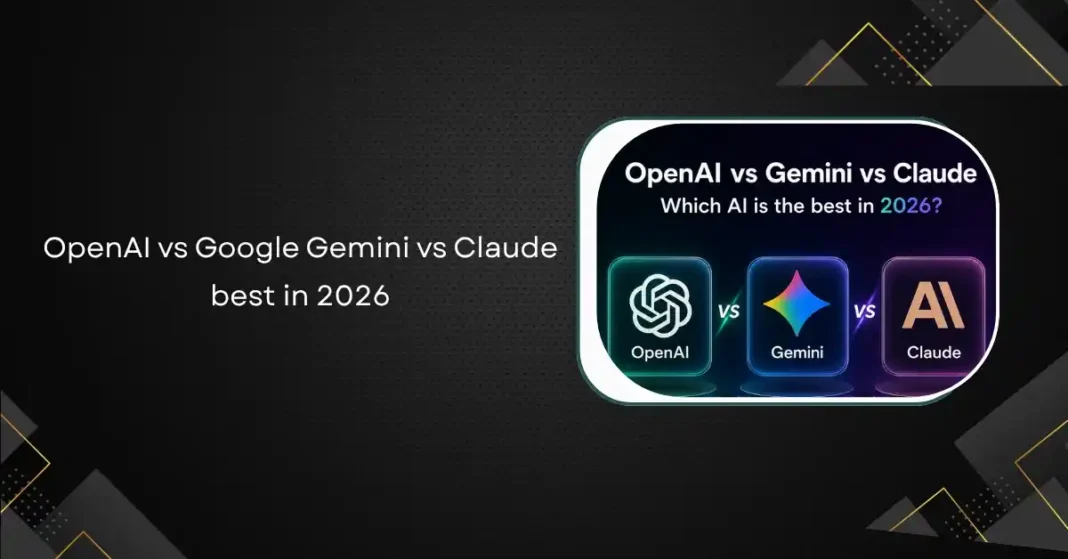
Choosing between OpenAI’s ChatGPT, Google’s Gemini, and Anthropic’s Claude in 2026 is not a simple question anymore. All three platforms have reached what researchers call frontier-tier capability. The differences that matter are not dramatic on standard benchmarks. They sit in specific use cases, pricing structures, ecosystem integration, and where each model genuinely leads the others. The smartest 2026 users run all three. But if you have to pick one, or want to know where each earns its keep, here is what the data actually shows.
Where Things Stand on Benchmarks
The most credible independent picture in mid-2026 comes from Artificial Analysis, whose live leaderboard places GPT-5.5 first on its Intelligence Index at 60, with Claude Opus 4.7 and Gemini 3.1 Pro both at 57. The gap is real but narrow. On MMLU, Gemini 3.1 Pro Preview leads at 94.1%, followed by GPT-5.2 at 91.4% and Claude Opus 4.6 at 90.5%. On SWE-bench Verified, the gold standard for software engineering, Claude Opus 4.7 scores 87.6%, the highest of any publicly available model as of April 2026. On multimodal and abstract reasoning tasks including ARC-AGI-2, Gemini 3.1 leads. OpenAI leads on composite agentic benchmarks and computer-use tasks, where GPT-5.5 scores 75% on OSWorld.
The key conclusion is that no model wins everything. Task-dependent performance is not a marketing qualifier. It is the actual shape of the market in 2026.
OpenAI: The Ecosystem Advantage
OpenAI’s primary strength in 2026 is not any single benchmark. It is breadth. ChatGPT has the largest user base, the most mature developer ecosystem, the widest range of integrations, and the most extensive library of custom GPTs and tooling. Its Python and Node.js SDKs have the largest community of tutorials, open-source projects, and Stack Overflow answers. For developers building production applications, that depth matters.
GPT-5.5 leads on agentic workflows. Computer-use capability, where AI agents operate a computer interface to complete multi-step tasks, is a genuine differentiator. OpenAI’s DALL-E and Sora integrations give it native multimodal generation that neither Anthropic nor Google offers in quite the same way. Pricing runs from a free tier up to $200 per month for the Pro plan with full model access. API pricing sits at roughly $1.75 per million input tokens for standard models, with premium variants higher.
Claude: Writing, Coding, and Instruction-Following
Anthropic’s Claude leads on three things that matter to a specific type of professional user: natural prose quality, coding accuracy, and instruction-following precision. Independent testing consistently places Claude ahead on long-form writing tasks. Claude Opus 4.7’s 87.6% on SWE-bench means it can resolve the majority of real GitHub issues autonomously when given the tools to do so. Claude powers the two most popular AI coding editors in 2026, Cursor and Windsurf, which speaks to where practitioners are placing their trust for sustained engineering work.
Claude’s 200,000-token context window is smaller than Gemini’s 1 million but significantly larger than older OpenAI models. For legal contracts, long codebases, and complex research synthesis, the difference between being able to see the whole document and having to chunk it is substantial. Enterprise pricing via API sits at $5 per million input tokens and $25 per million output tokens for flagship models, with up to 90% savings through prompt caching. Claude is available through Claude.ai, the API, Amazon Bedrock, and Google Cloud’s Vertex AI.
Gemini: Multimodal Power and Google Integration
Gemini’s defining advantage in 2026 is its 1 million token context window, which sits in a category of its own for tasks like analyzing entire codebases or lengthy research reports in a single pass. For document-heavy workflows, research synthesis, or analyzing an entire year of meeting transcripts, that capacity matters in ways that raw benchmark scores do not capture.
Gemini also leads on price-per-token at scale. Gemini 3.1 Pro outputs at roughly 120 tokens per second, about twice Claude’s throughput at comparable model tiers. For high-volume applications where cost efficiency matters, Gemini offers a real advantage. Its native integration with Google Workspace, Search, and YouTube means it is most powerful when it operates inside Google’s ecosystem rather than as a standalone chat interface.
Which One Should You Actually Use?
For complex coding and autonomous software engineering, Claude Opus 4.7 remains the benchmark leader. For multimodal tasks including video, audio, and image analysis at scale, Gemini 3.1 Pro is the strongest option. For agentic workflows where an AI needs to operate software interfaces and complete multi-step tasks with tools, GPT-5.5 leads. For natural prose, long-form writing, and document-intensive knowledge work, Claude produces the most consistent results. For budget-conscious API usage at volume, Gemini offers the cheapest output pricing.
If you are a developer building AI-powered applications and you can only test one: start with OpenAI for its ecosystem maturity. If you write a lot of long documents or deal with large codebases: Claude’s instruction-following and coding accuracy will serve you better. If you live inside Google Workspace and need deep integration with Gmail, Docs, and Drive: Gemini is the obvious fit.
The honest answer is that the platform boundary matters less than the use case boundary in 2026. Each of the three platforms offers multiple distinct models, and picking the wrong model tier within a platform will give you worse results than picking a different platform entirely. Read the documentation before you commit. Test with your actual workloads. And expect the rankings to shift again before the end of the year.