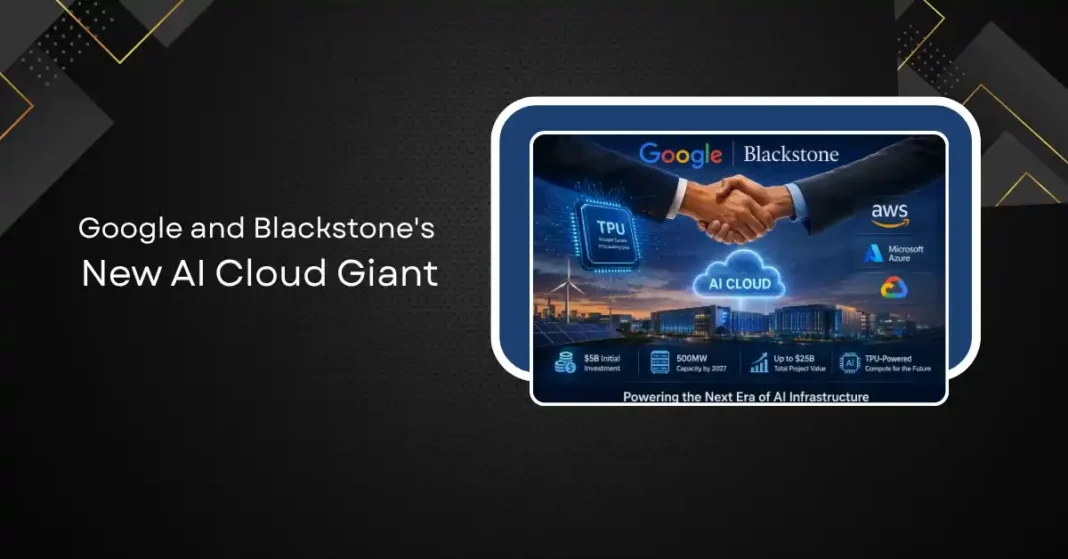
In January 2026, Google and Blackstone, one of the world’s largest private equity and infrastructure investment firms, announced a landmark joint venture: a new AI cloud computing entity that pairs Google’s proprietary Tensor Processing Unit (TPU) chips with Blackstone’s capital strength and data centre development expertise.
The venture has drawn significant attention from investors and industry analysts, not just because of its scale, but because of what it signals about the future of cloud infrastructure. AI compute is becoming an institutionally investable infrastructure asset class, and the battle for dominance between Google Cloud, AWS, and Microsoft Azure is entering a more capital-intensive phase than anything that came before it.
What Is the Google-Blackstone Joint Venture
The new entity, described as a compute-as-a-service venture, is structured as a US joint venture with Blackstone committing $5 billion in initial capital. The venture’s first target is 500 megawatts of computing capacity, expected to be operational by 2027, and the total project value could reach up to $25 billion including additional leverage.
At its core, the venture offers enterprises access to Google’s proprietary TPU infrastructure (the custom chips that power Google’s own AI systems including Gemini) through a dedicated, co-invested infrastructure partner. This is distinct from standard Google Cloud access. It targets customers who want large-scale, dedicated AI compute backed by institutional capital, often with longer-term contractual arrangements than typical hyperscale cloud agreements.
Google’s strategic motivation is straightforward. TPUs give the company a meaningful hardware advantage over AWS (which uses a mix of Nvidia GPUs and its own Trainium and Inferentia chips) and Microsoft Azure (which still relies heavily on Nvidia GPUs). Making TPUs available through this new commercial entity, in addition to the standard Google Cloud product, gives Google another distribution channel for its most valuable AI infrastructure asset.
Why Blackstone Is Involved
Blackstone’s involvement is a signal in itself. The firm has spent years building expertise in digital infrastructure, including data centres, fibre networks, and industrial properties. AI data centres are now where that expertise converges with the most consequential technology investment opportunity of the decade.
Blackstone brings not just capital, but the ability to finance, develop, and operate data centre campuses at institutional scale. Its entry into AI compute infrastructure is part of a broader trend. Private equity and infrastructure funds are starting to treat AI compute the same way they treat toll roads, ports, and utility assets. Long-duration, high-demand, inflation-protected infrastructure with predictable cash flow profiles.
This shift in capital structure is important to understand. Until very recently, AI infrastructure was funded almost entirely from hyperscaler balance sheets or venture capital. Bringing in patient infrastructure capital fundamentally changes the economics. Hyperscalers can deploy more capacity faster without straining their own credit ratings or earnings profiles. The infrastructure funds get exposure to a fast-growing asset class. The result is more aggregate AI compute coming online sooner than any of the participants could have funded alone.
What Are TPUs and Why Do They Matter
For context, Tensor Processing Units are application-specific integrated circuits (ASICs) that Google has been designing in-house since 2015. They are optimised specifically for the matrix mathematics that underlie modern machine learning. Compared with general-purpose GPUs, TPUs typically offer better performance-per-watt and better cost-per-token for the AI workloads they are designed for, particularly for training and inference of large language models.
The latest generations of TPUs are competitive with the highest-end Nvidia GPUs on most relevant benchmarks, and in some workloads they meaningfully exceed them. Google has used TPUs to train and serve its Gemini models, the Search Generative Experience, and the agentic AI features rolling out across Workspace and Vertex AI.
Until now, TPU access has been gated to Google Cloud customers. The Blackstone joint venture changes that distribution model and makes TPU-based AI compute available to a broader set of enterprise customers who may have specific reasons to prefer a co-invested, infrastructure-fund-backed deployment model over a standard cloud subscription.
What Does This Mean for AWS and Microsoft Azure
The established hyperscale cloud market has three dominant players. Amazon Web Services is the largest, with a meaningful lead in overall cloud market share. Microsoft Azure is second, with deep enterprise relationships and the partnership with OpenAI that has driven much of its AI growth. Google Cloud is the smallest of the three but has been the fastest-growing in 2025 and 2026; it reported an annual run rate of approximately $50 billion and has lined up $58 billion in new revenue commitments over the next two years.
The Google-Blackstone venture complicates the competitive picture for AWS and Azure in several specific ways.
First, it accelerates Google Cloud’s AI infrastructure deployment without requiring Google to shoulder the entire capital burden alone. The combination of Google’s hardware advantage and Blackstone’s capital means Google can stand up new AI capacity faster than it otherwise could.
Second, it creates a new commercial entity that can sell TPU access to enterprises who prefer a dedicated co-investment model over a traditional cloud subscription. Some large enterprises, particularly in financial services and pharmaceuticals, have shown a preference for dedicated capacity arrangements that look more like infrastructure ownership than cloud rental.
Third, it signals that AI-specific compute infrastructure, not general-purpose cloud, is becoming the competitive differentiator in 2026 and beyond. The cloud wars of the 2010s were largely about compute, storage, and developer services. The cloud wars of the late 2020s are going to be predominantly about who has the most AI compute, the most efficient AI chips, and the most accessible AI tooling.
AWS and Microsoft are not standing still. AWS continues to invest heavily in its Trainium and Inferentia AI chips and has deepened its partnership with Anthropic. Microsoft has committed approximately $80 billion to AI data centres in 2026 alone and remains the largest single buyer of Nvidia GPUs globally. Both have publicly signalled openness to similar institutional capital partnerships.
But the Google-Blackstone model is the first explicit, named, multi-billion-dollar partnership that brings private infrastructure capital into the AI compute race at this scale. It will not be the last.
The Broader Picture
The Google-Blackstone venture is part of a pattern visible across Big Tech in 2026 that is worth stepping back to see clearly.
Meta has committed $115 to $145 billion to AI infrastructure for 2026 alone, nearly double its 2025 spending. Microsoft has pledged approximately $80 billion for AI data centres in 2026. Amazon continues expanding AWS capacity globally with significant infrastructure investment. And now Google has found a structural way to bring institutional infrastructure capital into the fight without it landing entirely on its own balance sheet.
The aggregate amount of capital being directed at AI compute infrastructure in 2026 is genuinely without precedent in the history of technology. By rough estimate, the combined hyperscaler capex on AI infrastructure this year will exceed $400 billion. That is roughly comparable to the total capital investment in the global telecom industry in a typical year. The scale of buildout is enormous, and the implications for energy infrastructure, semiconductor supply chains, and skilled labour markets are going to shape multiple industries for the rest of the decade.
What This Means for Enterprises Evaluating Cloud Strategy
For business leaders thinking about cloud strategy, the takeaway is important and worth stating plainly. The compute layer is becoming as strategically significant as the software layer. The companies and institutions that control AI compute infrastructure will have substantial leverage over the economics of AI development for the rest of the decade.
Practical implications for enterprise IT and procurement teams:
- Multi-cloud strategies are likely to become more important, not less. Enterprises that lock themselves into a single provider’s AI stack are accepting concentration risk that may not be wise given how fast the competitive landscape is shifting.
- Cost optimisation on AI workloads needs to become a first-class discipline. The total cost of AI inference for many enterprises is rising fast, and the difference between optimised and unoptimised deployments can be a multiple.
- Workload portability matters more than it did in the cloud era. Building AI applications against open standards and avoiding deep coupling to provider-specific features keeps your options open as the competitive landscape evolves.
- For Indian enterprises specifically, the broader expansion of AI cloud capacity is good news. Pricing pressure tends to flow downstream from increased competition, and the gap between Indian and US AI compute pricing has been narrowing. The arrival of more competitive options through ventures like Google-Blackstone, combined with continued investment by all three hyperscalers in Indian data centre capacity, should mean Indian businesses have meaningfully better AI infrastructure options in 2027 than they do today, at lower per-unit costs.
What This Means for the AI Industry Broadly
The structural shift here is that AI compute is no longer just a hyperscaler-funded build-out. It is becoming an asset class. Once that happens at scale, several second-order effects follow.
The cost of capital for AI infrastructure projects declines as more institutional money becomes comfortable underwriting them. The pace of capacity expansion accelerates. The geographic distribution of compute infrastructure broadens because infrastructure funds are willing to invest in locations that hyperscalers might not prioritise. And new financial products will emerge around AI compute, in much the same way that data centre REITs, fibre infrastructure funds, and renewable energy yield-cos emerged in earlier infrastructure waves.
This is genuinely new territory for the technology industry. The combination of hyperscalers, institutional infrastructure capital, and increasingly sophisticated AI workloads is going to produce a much larger, more diverse, and more competitive cloud landscape over the next five years than the one we have today.
The Bottom Line
The Google-Blackstone joint venture is not just a transaction. It is a signal about how AI infrastructure is going to be financed and built for the rest of the decade. The hyperscalers cannot fund the build-out alone, even at their current historic levels of spending. Institutional capital is now part of the equation, and that changes the pace, the geography, and the competitive dynamics of the cloud market in ways that are still being worked out. For enterprises, for investors, and for anyone trying to anticipate where the technology industry is heading, this is one of the more important developments of 2026.
Frequently Asked Questions
What is the Google and Blackstone AI cloud joint venture?
A: It is a compute-as-a-service joint venture launched in January 2026, with Blackstone committing $5 billion in initial capital and Google contributing its proprietary TPU chip infrastructure. The venture targets 500 megawatts of AI computing capacity by 2027 and could reach a total value of approximately $25 billion.
What are Google’s TPU chips and why do they matter?
Tensor Processing Units are Google’s custom AI chips, designed specifically for machine learning workloads. They power Google’s own AI systems including Gemini and offer competitive performance and cost characteristics versus the Nvidia GPUs used by AWS and Microsoft Azure.
How does this venture compete with AWS and Microsoft Azure?
It gives Google another channel to scale TPU access beyond Google Cloud, targeting enterprises that want dedicated, institutionally-backed AI compute. This intensifies competition in the AI cloud segment and could accelerate Google Cloud’s growth against larger rivals.
Why is Blackstone investing in AI cloud infrastructure?
Blackstone treats AI compute as a long-duration infrastructure asset, similar to data centres and utilities, with strong demand and pricing power driven by the AI boom. Its capital and data centre expertise complement Google’s hardware advantage.
What is the expected capacity of the Google-Blackstone venture?
The first target is 500 megawatts of computing capacity by 2027, with the potential for the venture to grow to approximately $25 billion in total value including leverage.
What does this mean for enterprises evaluating their cloud strategy?
Multi-cloud strategies become more important, AI cost optimisation becomes a first-class discipline, workload portability becomes a strategic priority, and the pace of new AI compute capacity coming online means pricing pressure should continue to favour enterprise buyers through 2027.