Flagship smartphones in 2026 can cost well over $1,200. But here is the thing that reviewers who spend all their time with premium devices do not always say clearly enough: most people do not need to spend anywhere near that much to get a very good phone.
Budget smartphones have made enormous strides in the past two years. At the $200 to $300 price point, you can now find devices with OLED displays, multi-lens cameras, 5G connectivity, the latest Android operating system, and four to six years of guaranteed software updates. The compromises at this price point are real (expect lower zoom range on cameras, slower processing for demanding tasks, and simpler build materials than flagship phones), but for everyday use, the gap has narrowed dramatically.
This guide covers the best budget smartphones available under $300 in 2026, with honest commentary on what each one is good for and what it is not. If you are on a tight budget but want a phone that will still feel reasonable three years from now, one of these is almost certainly the right answer.
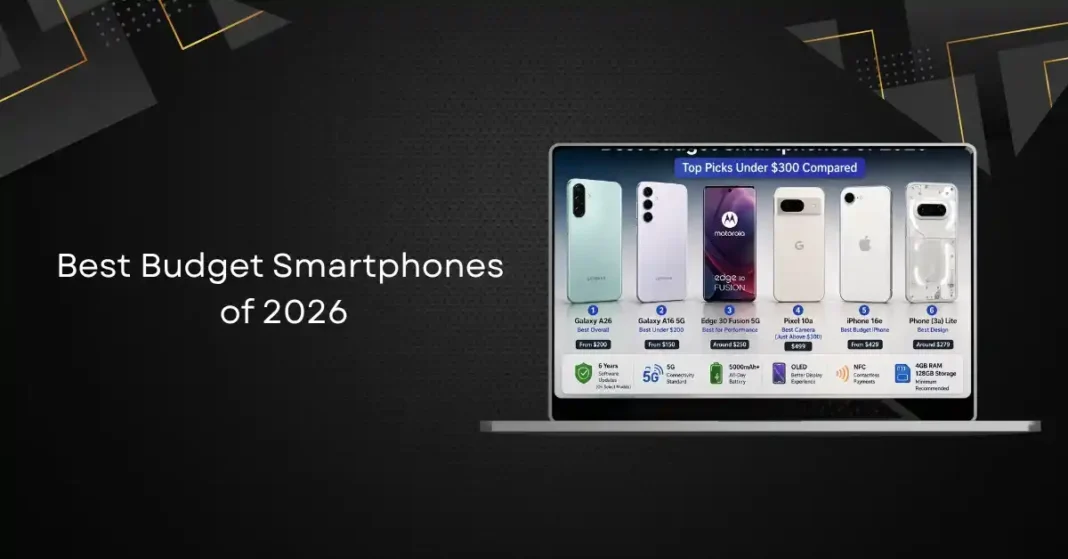
1. Samsung Galaxy A26: Best Overall Budget Android
Price: From $200 (128GB)
The Galaxy A26 is the strongest overall value in the sub-$300 market right now. It starts at $200 for the 128GB configuration and includes a 50MP main camera, a 5,000mAh battery, and runs the latest Android version. Samsung has committed to six years of OS updates on this model, which is an industry-leading promise at this price and significantly extends the practical useful life of the device.
The A26 does not offer the processing headroom of more expensive devices. Heavy gaming will see frame rate drops on demanding titles, and video editing on the device itself is slow. For browsing, social media, streaming, light photography, video calls, and the standard messaging and productivity apps, performance is comfortable.
The display is a 6.5-inch Super AMOLED panel with a 90Hz refresh rate. It is bright enough for outdoor use and the colours are noticeably better than the LCD displays still common at this price point. Build quality is plastic but feels solid in hand, and the fingerprint sensor is reliable.
If you want a phone you can buy for $200, hand to a teenager or a less tech-focused family member, and not have to think about again for several years, this is the place to start.
Who it is for
First-time smartphone buyers, students, parents buying for older relatives, anyone who wants reliable Samsung software support without a flagship price.
2. Samsung Galaxy A16 5G: Best Under $200
Price: From $150
If your budget is closer to $150 than $200, the Galaxy A16 5G is the standout option. It is among the most affordable 5G Samsung phones available, and it does not compromise on the essentials: a large 6.7-inch display, reliable 5G connectivity, and Samsung’s strong software update commitment.
For first-time smartphone buyers, budget-conscious switchers from feature phones, or anyone who wants a secondary device, the A16 5G delivers genuine value. The camera is more basic than the A26 (a 50MP main shooter with a less capable secondary sensor), the display is LCD rather than OLED, and the processor is a step down. For the price difference, those compromises are fair.
Who it is for
Buyers on the tightest budgets, secondary device shoppers, anyone replacing a phone that died.
3. Motorola Edge 30 Fusion 5G: Best for Performance
Price: Around $250
For users who prioritise performance and display quality over brand familiarity, the Motorola Edge 30 Fusion stands out. It features a 144Hz pOLED display, a Snapdragon 888+ chipset, and a clean near-stock Android experience with very little of the pre-installed software clutter that other manufacturers tend to add.
It is one of the fastest-performing phones on this list for the price, which makes it a good choice for casual gamers, heavy multitaskers, or anyone who has been frustrated by the responsiveness of cheaper Android phones in the past. Motorola’s minimal software skin is also a genuinely refreshing change from heavily customised Android versions.
The trade-off is shorter software update commitment than Samsung. Motorola typically promises three years of OS updates rather than six. For a phone you plan to keep two to three years, this is not a problem. For a phone you want to use for five years, it matters.
Who it is for
Performance-conscious users, casual mobile gamers, anyone who values clean Android over heavy manufacturer customisation.
4. Google Pixel 10a: Best Camera (Just Above $300)
Price: $499
Technically over the $300 threshold, but the Pixel 10a is worth including because it regularly appears in deals that bring it below $400, and because it offers something no other phone on this list can match. Google’s computational photography.
If a great camera is your priority and you can stretch your budget, the Pixel 10a, with its AI-powered image processing, exceptional night mode, and tight Google Assistant integration, punches significantly above its price class. Photo quality in challenging lighting is the closest you can get to flagship-level results without paying flagship prices.
You also get long software support (Google guarantees seven years of OS and security updates on the Pixel a-series), exclusive access to Pixel-specific features such as Magic Editor and Call Screen, and the fastest software updates of any Android phone (they ship the same day as Google’s other Pixel devices).
The trade-offs are that the build is plastic rather than the aluminium found on the more expensive Pixel 10, the chipset is one generation behind the flagship, and the camera hardware itself is more basic, even though the processing produces excellent results.
Who it is for
Anyone who takes a lot of photos and can stretch budget slightly, Pixel ecosystem users, people who value long software support above all else.
5. iPhone 16e: Best Budget iPhone
Price: From $429
For buyers committed to the Apple ecosystem, the iPhone 16e is the entry point. It runs the same iOS as the latest iPhones, receives years of software updates (Apple’s track record on this remains the industry benchmark, with iPhones still receiving updates six or more years after launch), and offers Apple’s characteristic polish in both design and software.
Like the Pixel 10a, it sits above $300, but for iOS users who want the lowest possible price of entry to the Apple ecosystem, it is the right choice. It also retains key Apple-only features such as iMessage integration, AirDrop, deep integration with Mac and iPad if you own them, and access to Apple Pay.
The trade-offs against the more expensive iPhone 16 are a single camera lens (rather than dual or triple), a slightly older chip, and no MagSafe charging. For most users coming from older iPhones, these will be acceptable compromises.
Who it is for
Existing iPhone users on tight budgets, families with mixed Apple devices, buyers prioritising long-term software support and ecosystem integration.
6. Nothing Phone (3a) Lite: Best Design
Price: Around $279
Worth including for design-conscious buyers. The Nothing Phone (3a) Lite carries the brand’s distinctive transparent back design and Glyph Interface LED notification system at a budget price. It runs Nothing OS, which is one of the cleaner Android skins, and offers respectable performance for the price.
Camera quality is a step below the Samsung and Pixel options, and Nothing’s software update commitment is shorter than Samsung’s. But for buyers who want a phone that looks distinct from every other budget Android, this is genuinely interesting.
Who it is for
Design-conscious buyers, anyone who wants a phone that does not look like every other budget Android.
Should You Consider a Refurbished Flagship Instead
An alternative worth serious consideration before buying any of the above is a certified refurbished flagship from one or two generations ago.
A refurbished iPhone 14 or Samsung Galaxy S23 can often be found under $300 and offers a faster processor, better camera hardware, and premium build materials compared to a new budget phone. The trade-offs are lower remaining software update lifespan, possibly reduced battery capacity, and the slightly higher risk that comes with any used device.
If you decide to go this route, buy only from reputable sellers that offer a warranty of at least 12 months. Avoid private sellers and unbranded marketplaces unless you genuinely know what you are doing. The certified refurbished programmes run by Apple, Samsung, and the major carriers are the safest options, although they tend to be slightly more expensive than third-party refurbishers.
What to Look For in a Budget Smartphone in 2026
If you are shopping outside the specific recommendations above, here are the criteria that matter most at this price point.
Software longevity. Prioritise phones that promise at least four years of OS updates. A phone that becomes unsupported in two years is not actually saving you money, because you will need to replace it sooner.
5G support. Nearly all phones in this category now support 5G. There is very little reason to buy a budget phone without it in 2026.
Battery size. Look for at least 4,500mAh. Budget phones may charge more slowly than flagships, so starting with a larger battery makes a meaningful difference to daily usability.
OLED display. OLED screens offer better contrast, deeper blacks, and better battery efficiency than LCD. They are increasingly available at the budget tier and are worth prioritising where the price allows.
NFC. Essential for contactless payments through Google Pay, Samsung Pay, or Apple Pay. Verify NFC support before buying, particularly with cheaper models sold in markets outside the US and EU.
RAM and storage. At least 4GB of RAM and 128GB of storage. Lower amounts will start to feel slow within a year or two as apps and operating systems become more demanding.
Build materials and water resistance. Plastic is standard at this price, and that is fine. An IP rating of at least IP54 (resistance to splashes) is worth having if your budget allows.
What to Avoid
A few things worth steering clear of when shopping in this price bracket.
Avoid phones from manufacturers with no clear software update commitment. If the brand will not state in writing how many years of updates the phone will receive, assume the answer is one year or less.
Avoid phones with less than 64GB of storage. Even with cloud backup, you will run out faster than you expect.
Avoid phones with non-removable batteries from manufacturers without local service centres. Battery replacement is going to be necessary eventually, and a phone that cannot be serviced in your country becomes e-waste.
Avoid phones bundled with locked-down carrier software or excessive pre-installed apps. These tend to be slower, more annoying to use, and harder to switch away from later.
The Bottom Line
The best budget smartphone under $300 in 2026, for most people, is the Samsung Galaxy A26. If your budget is closer to $150, the Galaxy A16 5G is the right answer. If you want strong performance, look at the Motorola Edge 30 Fusion. If you can stretch budget for a better camera, the Pixel 10a is excellent. If you want iOS specifically, the iPhone 16e is the entry point.
The good news for budget buyers is that 2026 is genuinely a strong year for sub-$300 phones. The hardware has gotten meaningfully better, software support is now competitive with mid-range phones from a few years ago, and 5G is standard. You can buy a budget phone today and reasonably expect it to serve you well for four to six years.
Frequently Asked Questions
Q1: What is the best budget smartphone under $300 in 2026?
A: The Samsung Galaxy A26 is the top overall pick, starting at $200 with a 50MP camera, 5,000mAh battery, and six years of guaranteed software updates. For the best phone under $200, the Samsung Galaxy A16 5G is the standout choice.
Q2: Is it worth buying a refurbished flagship instead of a new budget phone?
A: Often yes. A certified refurbished iPhone 14 or Samsung Galaxy S23 under $300 offers better hardware than a new budget phone. The trade-offs are shorter remaining software support and potentially reduced battery life. Buy from reputable sellers with at least a 12-month warranty.
Q3: Do budget phones under $300 support 5G in 2026?
A: Yes. Nearly all phones in this price range now include 5G support, including the Samsung Galaxy A16 5G and Galaxy A26.
Q4: What should I look for when buying a budget phone?
A: Prioritise software update longevity (at least four years), 5G connectivity, battery size (4,500mAh or more), NFC for contactless payments, an OLED display where possible, at least 4GB of RAM, and 128GB of storage.
Q5: Is the Google Pixel 10a worth buying?
A: The Pixel 10a ($499) is above the $300 threshold but offers best-in-class computational photography, exceptional night mode, and seven years of guaranteed software updates. If a great camera and long software support matter to you and your budget can stretch, it is worth the premium.
Q6: What is the best budget iPhone in 2026?
A: The iPhone 16e is Apple’s most affordable iPhone, starting at $429. It offers the latest iOS, years of software updates, and full Apple ecosystem integration, with compromises on camera hardware and MagSafe charging compared to the iPhone 16.