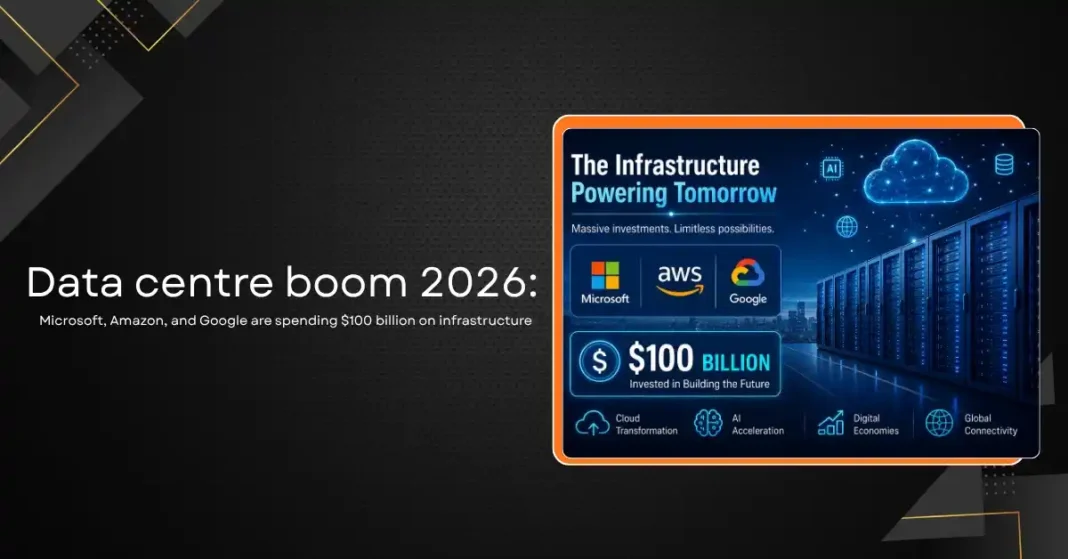
The numbers coming out of Big Tech earnings calls in 2026 are unlike anything the technology sector has produced before. Alphabet, Amazon, Meta, and Microsoft are projected to spend a combined $725 billion on capital expenditure this year, up 77% from 2025, which was itself a record year. Roughly 75% of that sum is going directly into AI infrastructure: data centers, GPUs, networking equipment, and the power systems to run them. Amazon’s annual data center capital expenditure alone has crossed $100 billion, a figure comparable to the entire GDP of Costa Rica. Microsoft has set its 2026 capex at $190 billion. The question worth asking is: why does AI require this much physical infrastructure?
Training and Inference at Scale
Every AI model that exists today was trained on enormous clusters of specialized processors running for months. GPT-5, Claude Opus 4.7, and Gemini 3.1 each required compute resources on a scale that did not exist five years ago. Training is capital-intensive but a one-time cost per model version. Inference, the process of running a trained model to respond to user queries, is the ongoing cost that scales with adoption. As hundreds of millions of users ask AI assistants questions, generate images, write code, and analyze documents every day, the compute required to serve those requests demands infrastructure at a scale that no existing data center network was built to provide.
Microsoft’s CFO Amy Hood attributed $25 billion of the company’s record capex budget to rising prices for memory chips and other components. Despite that spending, Microsoft told investors it expects to remain capacity-constrained through at least 2026 as it works to bring GPU, CPU, and storage infrastructure online. The constraint is not strategic. It is physical: building and powering data centers at this scale takes time that investment cannot compress.
Where the Data Centers Are Going
Meta’s first gigawatt-class data center, called Prometheus, is under construction in New Albany, Ohio. The company’s Hyperion facility in Louisiana, projected to come online by 2028, will be almost as large as the footprint of Manhattan. An on-site natural gas power generation project for Meta’s Ohio site is planned to be operational by November 2026. Microsoft operates 131 known data centers with another 111 under construction. Google recently announced a $600 million expansion of its facility in The Dalles, Oregon, one of its oldest data center sites.
The geographic distribution of new data center investment reflects both power availability and political calculation. US states that have committed to renewable energy infrastructure have become preferred sites because AI training is electricity-intensive at a scale that makes power cost a primary operating variable. 70% of Americans now express opposition to data centers near their homes, according to surveys, creating political friction around siting that has started affecting permitting timelines.
The Memory Bottleneck
Memory will consume 30% of hyperscaler data center spending in 2026, a fourfold increase from 2023. Modern AI accelerators require vast amounts of high-bandwidth memory to hold model weights during inference. As model sizes grow, so does the memory requirement per query. The result is a supply constraint that money alone cannot immediately resolve. Hynix, Samsung, and Micron are running their advanced memory production at maximum capacity. Component pricing has risen accordingly, which is part of what pushed Microsoft’s capex estimate above analyst projections.
The Return-on-Investment Question
The spending scale is not without skeptics. Dec Mullarkey at SLC Management told the Financial Times that investors are growing uneasy with Meta’s escalating infrastructure costs, questioning whether a historically lean business is becoming far more capital-hungry. McKinsey research published earlier this year found that many corporate executives remain skeptical about whether large AI infrastructure investments will produce measurable returns in the near future.
The counterargument from tech leadership is consistent. Amazon CEO Andy Jassy wrote in his annual shareholder letter that AI is a once-in-a-lifetime opportunity where current growth is unprecedented and future growth even larger. Google’s cloud contract backlog reached $460 billion in the most recent quarter, roughly double the $240 billion reported at the end of 2025. Amazon reported $364 billion in its own pipeline. The hyperscalers are not building infrastructure speculatively. They are building to fulfill contracts that already exist.
What This Means Beyond Tech
The data center boom is reshaping energy policy, real estate markets, and supply chains at a national scale. US states are competing for data center investment the way they competed for automotive manufacturing plants in the 1980s. Semiconductor policy, power grid investment, and water rights law are all being influenced by the infrastructure requirements of AI. The $725 billion spending figure is not just a measure of Big Tech’s ambition. It is a signal about where the next decade of economic activity will be anchored.