Nvidia has been the dominant supplier of chips for AI training and inference since the deep learning wave began in 2012. Its H100 and H200 GPU clusters are the hardware that most frontier AI models run on. But Google has spent a decade building an alternative, the Tensor Processing Unit, or TPU, and in 2026 that investment is starting to reshape the competitive landscape for AI infrastructure. Understanding what a TPU is, how it differs from a GPU, and why Google is building cloud infrastructure around it matters for anyone trying to understand where AI hardware is headed.
What a TPU Actually Is
A Tensor Processing Unit is an application-specific integrated circuit, or ASIC, designed by Google specifically for machine learning workloads. Unlike general-purpose graphics processing units, which were originally built for rendering graphics and later repurposed for parallel computation, TPUs were designed from the ground up to accelerate the specific mathematical operations that neural networks require: matrix multiplications, tensor operations, and the forward and backward passes of training runs.
The current generation is Google’s TPU v6, announced at Google Cloud Next 2024 and deployed at scale through 2025 and 2026. TPU v6 delivers approximately three times the performance of its predecessor per chip and is designed to operate efficiently in large multi-chip configurations called pods. A TPU pod contains thousands of interconnected chips that can be treated as a single compute unit for training runs, with high-bandwidth interconnects that reduce the bottleneck of moving data between processors.
TPU vs GPU: Where Each Wins
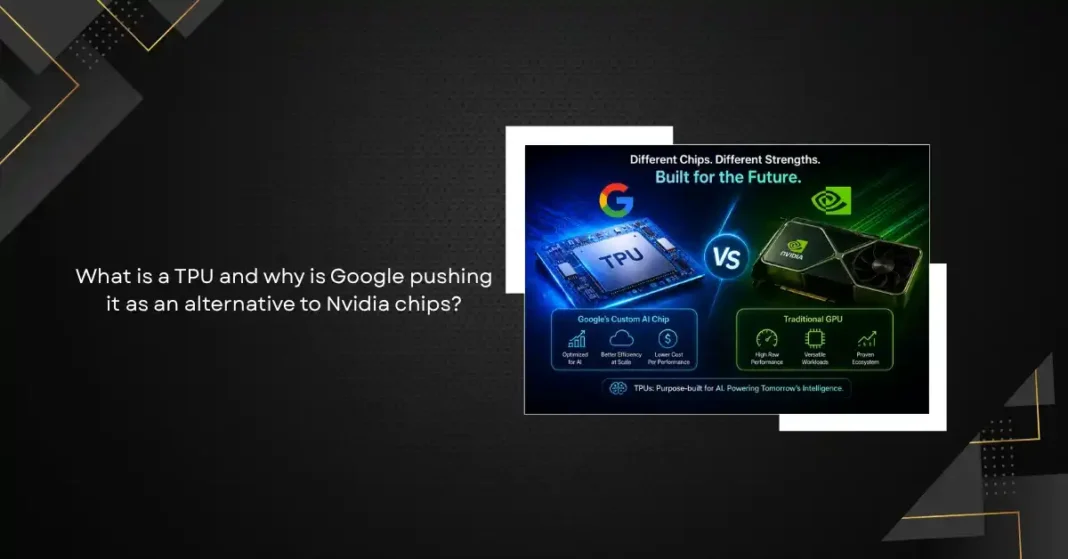
The core difference comes down to specificity versus flexibility. Nvidia GPUs are highly flexible. They run a wide variety of workloads including graphics rendering, scientific simulation, cryptocurrency mining, and AI. That flexibility makes them the default choice when you are not sure exactly what computation your workload requires. TPUs sacrifice that flexibility for efficiency on a specific class of operations. For training large neural networks and running inference on them at scale, TPUs can deliver better performance per dollar and better performance per watt than equivalent Nvidia hardware.
The trade-off is software. Nvidia’s CUDA programming model has been the standard for AI development for over a decade. The ecosystem of libraries, frameworks, and developer tools built on CUDA is vast. Google has built its own JAX and XLA software stack for TPUs, and TensorFlow has native TPU support, but switching from a CUDA-based workflow to a TPU-based one requires real engineering effort. For researchers who need maximum flexibility or who are using libraries that have not been optimized for TPUs, Nvidia hardware remains the easier choice.
The Blackstone Partnership and the Strategic Play
Google’s January 2026 joint venture with Blackstone, a $5 billion AI cloud venture targeting 500 megawatts of capacity by 2027, was specifically built around TPU chips rather than GPU clusters. The decision was not accidental. By building a hyperscale cloud offering on its own silicon, Google captures the economics of the chip layer rather than paying Nvidia’s margins for third-party hardware. For a company running AI inference at the scale of Google Search, YouTube, and Google Workspace, the difference between paying $30,000 per H100 GPU and manufacturing the equivalent compute internally represents an enormous long-term cost advantage.
Why This Matters for the Nvidia Question
Nvidia’s dominance in AI hardware rests on the gap between what it can deliver and what alternatives can provide. Google’s TPU program, along with Amazon’s Trainium chips, Meta’s MTIA silicon, and Microsoft’s Maia processors, represents a coordinated effort by the largest buyers of AI compute to reduce their dependence on a single supplier. None of these in-house chips matches Nvidia’s performance on every workload in 2026. But the trend is clear: hyperscalers are investing in alternatives because the economics of buying all their compute from Nvidia are unsustainable at the scale they are projecting.
For developers and organizations buying AI compute rather than building it, the practical implication is simpler. Google Cloud’s TPU instances offer a genuine price-performance alternative for training workloads that are compatible with JAX and TensorFlow. For inference at high volume, TPU pricing is increasingly competitive with equivalent GPU configurations. The choice is not ideological. It is workload-specific: if your training pipeline is already in a TPU-compatible framework and you are running on Google Cloud, the economics favor TPUs. If you need maximum flexibility or have a CUDA-dependent stack, Nvidia GPUs remain the practical choice for now.