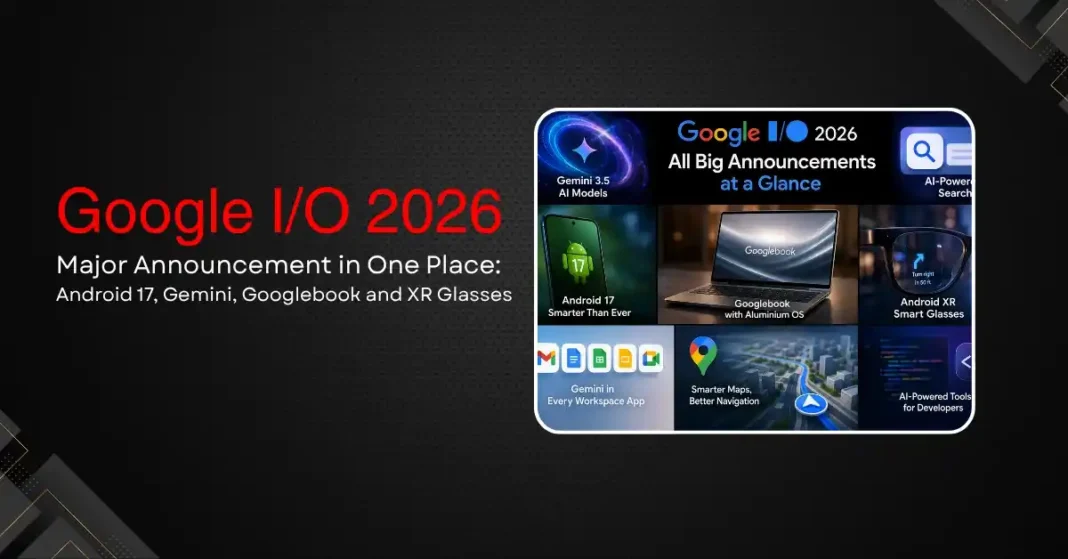
Google I/O 2026 was one of the most packed developer conferences the company has ever run. Held at the Shoreline Amphitheatre in Mountain View in May 2026, the keynote and developer sessions covered sweeping changes across every major product line: a new version of Android, the next generation of Gemini models and their integration across Google’s ecosystem, the surprise reveal of the Googlebook laptop running Aluminium OS, and the consumer debut of Android XR smart glasses. This is everything announced, consolidated into a single place.
Gemini 3.5 and the New AI Model Family
The Gemini announcements were the center of gravity for this year’s I/O. Google announced Gemini 3.5, a family of models spanning three tiers: Gemini 3.5 Flash, 3.5 Pro, and 3.5 Ultra. Gemini 3.5 Flash launched immediately and is positioned as the speed-optimized model for everyday tasks, with Google claiming a fourfold speed improvement over Gemini 2.0 Flash at equivalent output quality. It features a one million token context window and new multimodal capabilities that include native audio and video understanding.
Gemini 3.5 Pro, targeted at complex reasoning and professional use cases, was announced for gradual rollout through Google One and Google Workspace starting June 2026. Gemini 3.5 Ultra, the frontier research model, was previewed but given no firm consumer release date. Google showed benchmark results positioning Ultra above GPT-5 on several coding and reasoning tasks, while noting that independent validation of those benchmarks is forthcoming.
All three models support native function calling for agentic applications, tool use across Google’s product ecosystem, and what Google is calling Gemini Intelligence, a persistent AI layer that knows your context, history, and preferences across all Google products. The practical implication is that Gemini knows your Google Calendar, Gmail history, Drive documents, and search history when you interact with it, and can act on information across all of those services in a single conversation.
Google AI Mode: Search Gets a Full Redesign
The biggest structural change to Google Search since the introduction of AI Overviews is the official launch of Google AI Mode, which debuted in limited testing in early 2026 and was announced for full rollout at I/O. AI Mode replaces the traditional search results page for complex, multi-part, or conversational queries with an interface that looks more like a chat window than a search page, while still surfacing links and sources.
In AI Mode, Gemini 3.5 Flash handles the synthesis and conversation layer, while supporting links and source citations appear alongside the AI response rather than below it. Users can follow up, refine, and ask follow-on questions without reformulating their search. Google showed a live demo of a user planning a home renovation project through a series of follow-up questions, with Gemini surfacing contractor review sites, building permit information, and cost estimation tools at relevant moments in the conversation.
Google was direct about the intended outcome: AI Mode is designed to handle the queries where users currently bounce between search and AI assistants. The product explicitly competes with Perplexity’s answer engine model and with ChatGPT’s web browsing mode, and its distribution advantage of being the default search experience for billions of existing Google users gives it structural reach that standalone AI search tools cannot match.
Android 17: What Is New
Android 17 was previewed extensively at I/O with a public beta available immediately for Pixel devices and a small number of Samsung and other OEM partner devices. The headline features center on Gemini Intelligence, the system-level AI integration that makes Gemini aware of everything happening on the device and able to act across apps in ways that previous versions of Google Assistant could not.
The most practically significant Android 17 feature is the new App Actions framework. Previously, Google Assistant could trigger specific pre-programmed actions inside apps. With the Gemini Intelligence integration in Android 17, the AI can navigate any installed app using accessibility-layer understanding of the interface, not just apps that have explicitly built Google integrations. A user can ask Gemini to find an email from a specific contact, forward the relevant attachment to a colleague, and add a follow-up reminder, and Gemini navigates Gmail, the Files app, and Calendar to complete each step without requiring the user to switch between apps manually.
Android 17 also includes a redesigned notification system with AI-powered prioritization, a new Privacy Dashboard that shows exactly which apps accessed which sensors and data in the past twenty-four hours, and an improved Adaptive Battery system that uses on-device machine learning to predict and optimize power draw based on individual usage patterns. The redesigned lock screen, which now supports richer widget customization and Gemini quick-access, is the most visually obvious change for most users.
The rollout timeline Google shared is Pixel 9 series and Pixel Fold 2 receiving the stable build in August 2026, with Samsung, Motorola, and OnePlus following in September and October. The App Actions and Gemini Intelligence features require Pixel 9 or newer hardware for full functionality, with partial support on other Android 14 and later devices.
Googlebook and Aluminium OS: The Laptop Surprise
The most surprising announcement of the day was the Googlebook, Google’s first consumer laptop since the Chromebook Pixel, running a new operating system called Aluminium OS. The announcement was kept secret ahead of the event, and Google CEO Sundar Pichai introduced it without preamble as ‘the computer Google has always wanted to build.’
Aluminium OS is not ChromeOS or Android. It is a new operating system built from the ground up with AI integration as a foundational architecture choice rather than an added layer. The OS runs a local instance of a compressed Gemini Nano model, which handles on-device tasks that do not require cloud connectivity, including document summarization, offline translation, smart compose across all text inputs, and the local AI assistant that operates even without an internet connection.
Cloud-connected tasks route to Gemini 3.5 Flash through a context-aware session that maintains continuity with the local assistant. The design intent is that users should not perceive a boundary between on-device and cloud AI, the experience should feel continuous regardless of which processing layer is handling a given task.
The Googlebook hardware features an Intel Core Ultra processor (partnered from Intel’s Lunar Lake generation), sixteen gigabytes of RAM, up to two terabytes of storage, a thirteen-inch high-resolution OLED display, and a keyboard layout that replaces the function row with an AI-action bar containing contextual quick-action keys that change based on what you are doing. Starting price is eight hundred and ninety nine dollars, with a release date of September 2026. ChromeOS devices will not be discontinued; Google positioned Googlebook as a complementary premium product rather than a ChromeOS replacement.
Android XR Glasses: Consumer Debut
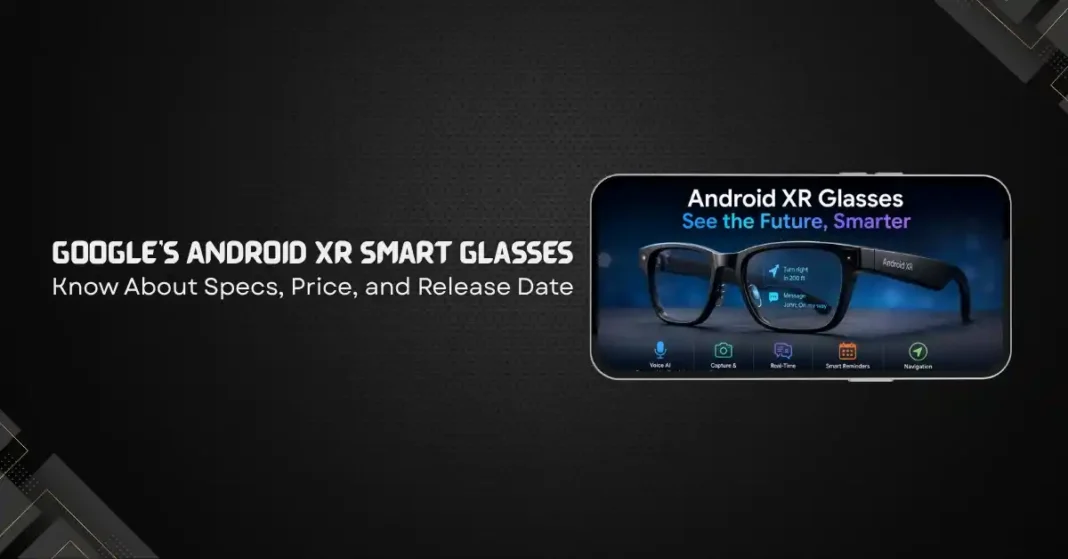
Google has been developing its Android XR platform in partnership with Samsung, and I/O 2026 was the first time the smart glasses form factor was shown to a live consumer audience rather than just developers. The glasses, produced in collaboration with eyewear brand Partners (not named in the announce; specific partner not confirmed at time of writing), look like conventional eyewear from the outside and include a small heads-up display visible only to the wearer in the right lens.
The functionality shown in the demo centers on Gemini-powered live assistance: real-time translation subtitles during a conversation in another language, navigation overlays during walking, restaurant menu analysis that shows dietary information when you look at a menu, and a contextual assistant that can answer questions about what you are looking at using the integrated camera. Google showed a demo of a user looking at a broken kitchen appliance and receiving repair guidance from Gemini based on what the camera was seeing.
Battery life in the demo was described as ‘a full day of casual use,’ which Google defined as six to eight hours of active screen-on time with the heads-up display in use. The glasses connect to an Android phone rather than being fully standalone, using the phone’s cellular connection and processing power for heavier AI tasks. No consumer pricing was announced; Google described the device as ‘coming in 2026’ with a developer preview program opening shortly after I/O.
Google Workspace: Gemini Integration Across Every App
The Workspace announcements at I/O 2026 marked a significant expansion of the Gemini integration across Gmail, Docs, Sheets, Slides, and Meet. The headline feature is what Google calls Workspace Flows, a no-code automation builder powered by Gemini that lets users create multi-app workflows using natural language. A user can describe a process (‘When I receive a contract PDF in Gmail, extract the key terms into a Sheets tracking document and add a calendar reminder for the renewal date’) and Gemini builds and runs the automation without requiring any technical setup.
Gemini in Google Meet received significant upgrades: real-time meeting transcription has been available for a while, but the new version adds contextual action suggestions during meetings (such as suggesting creating a document or assigning a task based on the conversation in progress), and a post-meeting intelligence feature that not only summarizes the call but generates a structured follow-up document including action items, decisions, and open questions, formatted for immediate use.
For Google Docs, the most useful new feature is side-by-side document comparison with AI synthesis. Users working on a contract, proposal, or report can open two versions side by side and ask Gemini to identify every meaningful difference and summarize which changes are editorial and which are substantive. Legal and business teams that spend hours on manual document comparison are the clear target audience.
Google Maps and Local AI Features
Google Maps received an AI update that stands out for practical everyday utility. The new Immersive Directions feature, expanded from its earlier preview, now covers driving and walking navigation in all major cities worldwide, not just the handful where it debuted. The feature provides a photorealistic 3D preview of the route before you start navigating, with real-time overlays showing traffic, construction, and the location of parking structures as you drive.
The AI search in Maps has been upgraded to understand multi-constraint queries more naturally. A search for ‘outdoor restaurant near me that opens before noon, has vegetarian options, and has parking’ now reliably returns filtered results that match all constraints simultaneously. Previously, Maps search required running several separate searches to narrow results that way.
Developer Tools: Gemini in the Build Pipeline
Google announced an expanded version of Gemini Code Assist, the AI coding assistant that integrates with Android Studio, VS Code, and IntelliJ. The 2026 version adds agentic coding capabilities: rather than autocomplete and inline suggestions, Gemini can now take a task description, understand the full codebase context through the expanded context window, and propose, implement, and test a complete change across multiple files. Google positioned this as directly competitive with GitHub Copilot Workspace and the coding agent features in Anthropic’s Claude.
The Google Cloud announcements covered TPU v6, the latest generation of Google’s custom AI accelerator chip that powers both Gemini inference at scale and is available to cloud customers for training and inference workloads. Google cited a forty percent cost reduction per token for Gemini inference on TPU v6 compared to v5, which has direct implications for pricing of the Gemini API across Google’s developer products.
The Takeaway From Google I/O 2026
If there is a single through-line across all of this year’s announcements, it is Google’s bet that the value of its AI investments compounds across an integrated ecosystem in a way that standalone AI products cannot match. Gemini knows your calendar, your email, your documents, your search history, and your location. Android 17 gives it the ability to act across your device. The Googlebook gives it a new hardware surface built specifically around AI interaction. The XR glasses give it a real-world perception layer. These are not independent products. They are components of a platform.
Whether that platform vision plays out depends on execution, user trust around the data access it requires, and competition from Apple Intelligence, Microsoft Copilot, and the array of independent AI tools that are building their own ecosystem layers. But the scope of what Google announced at I/O 2026 makes it clear that the company is betting its next decade on AI integration at a level of depth that goes well beyond adding a chatbot to its existing products.