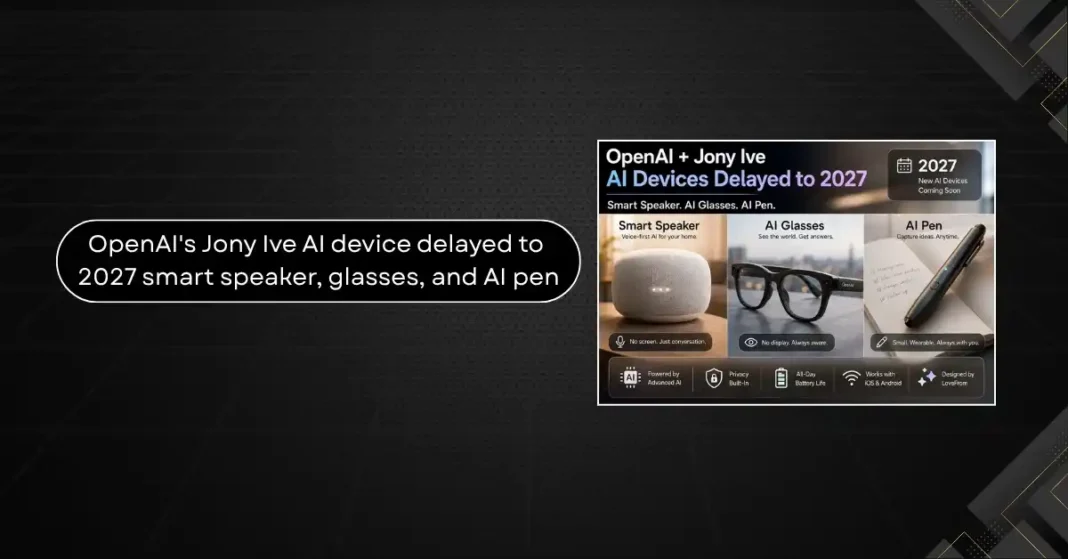
When OpenAI announced its partnership with Jony Ive in 2024, the expectation was a new category of AI device that would do for ambient computing what the iPhone did for mobile. Two years later, the project has been delayed again, with the first hardware now expected in 2027 rather than late 2026. The slip is significant, not because OpenAI is the only company building AI hardware, but because expectations for this particular collaboration were higher than anyone wants to admit.
Jony Ive’s design firm LoveFrom and OpenAI are reportedly working on a small family of devices rather than a single flagship product. The lineup includes a smart speaker for the home, a pair of AI glasses, and a small wearable that internal teams have been calling an AI pen. Each one is built around the same idea, that ambient AI works better without a screen.
Here’s what’s actually known about the delay, what each device is supposed to do, why this project has been so hard to finish, and what it means for the AI hardware race in 2026.
Why the Device Was Delayed Again
Three reasons have been cited by people familiar with the project. The first is hardware reliability. AI hardware that runs continuously, with always-on sensors and cellular connectivity, has thermal and battery challenges that engineers underestimated. Early prototypes reportedly ran hot enough to be uncomfortable to wear or hold for long periods.
The second is software maturity. The model that powers the device, reportedly a custom variant tuned for low-latency on-device tasks, was not stable enough by late 2025 to ship inside a consumer product. OpenAI has been training and re-training this model with feedback from internal testing, but the iteration cycle is slow when you have to wait for new hardware revisions to ship before you can test changes.
The third is the design itself. Ive’s team has been notoriously protective of the product details, but reports from suppliers suggest the form factor has been revised at least four times. A device that’s meant to be worn or carried all day has to feel right immediately, and the team has not yet hit that bar.
OpenAI has not publicly confirmed the new 2027 timeline, but Sam Altman has acknowledged the project is taking longer than expected. The official line is that getting this right matters more than shipping on schedule.
The Smart Speaker
The smart speaker is the most conventional of the three devices, at least on paper. It sits on a desk or shelf and acts as a home AI hub. The big difference from existing products like Amazon Echo or Google Nest is the model running inside. Instead of a narrow voice assistant trained for command-and-response, the OpenAI speaker is supposed to handle full conversations, hold context for hours, and act on your behalf across the apps and services connected to your account.
The hardware is reportedly compact, with a fabric-wrapped enclosure and minimal indicators. There is no screen. There is no touch interface beyond a single button or surface for muting the mic. Everything else is voice.
What’s been challenging is the latency. For a conversation to feel natural, response time needs to be under 300 milliseconds. Achieving that with a large language model in the cloud requires careful engineering on the network stack, the audio pipeline, and the model itself. Early demos at OpenAI’s offices apparently work well, but performance has been inconsistent outside controlled environments.
Pricing is unknown, but for the speaker to compete with Echo and Nest, it likely needs to land under $300. That’s a tough number to hit while keeping the build quality and acoustic performance Jony Ive insists on.
The AI Glasses
The glasses are the most ambitious piece of the lineup. They are described as a daily-wear product, similar in form factor to Ray-Ban Meta but with much heavier AI processing. The frames include a camera, microphones, speakers, and a small processing unit. There is reportedly no display, which differentiates them from Google’s Android XR glasses or Apple Vision Pro.
What makes the OpenAI glasses different is the always-on assistant layer. You can ask questions about what you’re seeing, get translations of signs and menus, get reminders triggered by visual context, and have conversations through the frame without taking out your phone. The model is supposed to understand both audio and visual input simultaneously, which is technically harder than handling them separately.
Battery life has been one of the biggest engineering hurdles. A pair of glasses you can wear all day needs a battery that lasts at least 8 to 10 hours under typical use, which means a lot of processing has to happen on-device or in short bursts.
Style is also a real concern. Smart glasses have failed for over a decade because they look like smart glasses. Ive’s design language is built around products that don’t draw attention to themselves, and the early renders suggest the OpenAI glasses are closer to ordinary frames than anything Meta or Google has shipped.
The AI Pen
The AI pen is the most mysterious of the three products. Reports describe it as a small wearable, around the size of a fountain pen, that you carry in your pocket or clip to a shirt. It has microphones, possibly a small camera, and a haptic feedback element. There is no display.
The use case is ambient capture. You wear the pen during meetings, while taking walks, or during creative work, and it listens for ideas you want to remember. You can also press it to dictate a note, ask a question, or trigger an action. Everything syncs to your OpenAI account so you can access notes and conversations later from any device.
This is the product that most closely resembles what Humane tried to do with the AI Pin, and Humane’s collapse is reportedly one reason OpenAI has been so cautious about shipping. The mistakes Humane made, including poor battery life, an unreliable assistant, and a confused use case, are exactly the mistakes the OpenAI project is trying to avoid.
There is also a privacy question with always-listening devices that has not been fully answered yet. The pen would need clear visual indicators when it’s recording, opt-out controls for people around the wearer, and strict on-device processing for sensitive contexts.
What This Tells Us About AI Hardware
The repeated delays on the OpenAI and Ive collaboration tell us several things about where AI hardware is in 2026. The first is that screenless ambient AI is genuinely hard. We’ve had decent smart speakers for years, but anything that goes beyond simple voice commands runs into model latency, context windows, and reliability problems that screen-based AI doesn’t face in the same way.
The second is that hardware companies have an advantage that pure software companies don’t. Apple, Samsung, and Google have decades of experience designing, manufacturing, and supporting consumer hardware at scale. OpenAI is learning all of that from scratch, even with Jony Ive on the team. The supply chain, retail relationships, repair infrastructure, and customer support operations are all areas where OpenAI is building capability that the established hardware players already have.
The third is that the AI device category is still wide open. Humane failed. Rabbit’s R1 underwhelmed. Meta Ray-Bans are selling but only as accessories. No one has yet shipped a product that defines what AI hardware looks like in the 2020s. Whoever gets there first will have an outsized influence on the next decade of computing.
Competition in the AI Hardware Space
OpenAI is not the only company chasing ambient AI. Meta has been quietly growing the Ray-Ban Meta lineup, with the next generation reportedly adding a small display. Google’s Android XR glasses launched in early 2026 with mixed reviews but solid technical foundations. Apple has been working on a smaller, lighter version of the Vision Pro and rumours suggest Apple AI glasses are coming in 2027 or 2028.
Samsung is the surprise contender. The company partnered with Perplexity, not ChatGPT or Gemini, for its mobile AI strategy and has been hinting at hardware integrations across its Galaxy lineup. A Samsung-branded AI device of some kind is likely before the OpenAI launch.
Then there are the smaller players, including Friend AI, Bee Wearable, and Limitless, all of which have shipped or are shipping ambient AI products in the wearable category. None of them have the scale or capital of OpenAI, but they’re moving faster and learning from real customers.
The delay of the OpenAI device means competitors have at least a year of head start in the market. Whether that turns into a durable lead depends on whether the OpenAI product, when it finally arrives, is good enough to redefine the category.
Should You Wait for the OpenAI Device?
If you’ve been holding off on buying AI hardware in the hope of getting the Jony Ive product, the answer is mixed. For a smart speaker, the existing Echo and Nest devices are mature, capable, and inexpensive. The OpenAI speaker will probably be better in conversation quality, but you’ll get most of the daily utility from existing products.
For AI glasses, the Ray-Ban Meta line is the most polished option available right now, and a new generation is expected before the OpenAI glasses ship. If you want to try AI glasses today, those are the safest bet. The OpenAI version will likely have better AI capability when it arrives, but it’s a year or more away.
For an AI pen or pin, there is no obvious recommendation. The category is too new, too unstable, and too undefined to commit to one product. Wait until at least two of the major players have shipped, get reviews and real-world reports, and then decide.
Most people are better off using their existing phone with a good AI app for now. The features that make ambient AI compelling can be approximated with a smartphone, a pair of decent headphones, and the right software. The hardware will catch up eventually, and there’s no urgency to be the first to buy.
Frequently Asked Questions
When will OpenAI’s AI device actually launch?
The current best estimate is 2027, though OpenAI has not confirmed a specific date. The previous timeline was late 2026, but engineering and design challenges have pushed it back at least once already.
How much will the OpenAI smart speaker cost?
OpenAI has not announced pricing. Based on the design quality Jony Ive is targeting and typical category pricing, expect a premium tier somewhere between $300 and $500 for the speaker. The glasses and pen will likely be priced separately.
Will the OpenAI device work with my iPhone or Android phone?
Yes, the devices are expected to be platform-agnostic, working with both iOS and Android. Your OpenAI account, including ChatGPT history and personal context, would sync across devices and the hardware.
Is the OpenAI device replacing the smartphone?
No. Sam Altman has been clear that the device is meant to complement your phone, not replace it. The form factor is built for ambient interactions that don’t make sense on a phone, like asking questions through the day or capturing thoughts hands-free.
How is this different from Humane’s AI Pin?
Humane built a single device with a built-in cellular plan and an integrated AI service. The OpenAI lineup includes multiple form factors, leverages your existing phone and connectivity, and uses GPT-5 or its successor as the underlying model. The bigger model and clearer use cases are the main differences.
Will the OpenAI device need a subscription?
Almost certainly yes. The device will likely require a ChatGPT Plus or higher subscription for full functionality. Some basic features may work without a subscription, but the agentic capabilities and the most capable models will be tied to a paid plan.
Final Thoughts
The OpenAI and Jony Ive collaboration is taking longer than anyone hoped, but the delay may end up being a good thing. AI hardware is a category that punishes early failure. Humane learned this the hard way. Rabbit learned it. Meta is still learning it. The companies that take their time, get the basics right, and ship something polished tend to dominate the category long term.
The 2027 timeline is not great for OpenAI’s competitive position, but it gives the company another year of model improvements, design iteration, and supply chain readiness. By the time the device launches, GPT-5.5 or its successor will be running on it, the model will be tuned for the form factor, and Jony Ive will have had enough time to make the product feel like the kind of thing you’d want to own.
Whether the wait is worth it depends entirely on the execution. If the device feels obvious and inevitable when you use it, the delay will be forgotten quickly. If it feels rushed or unfocused, OpenAI will have spent three years and significant capital on a product that competitors will already have improved on. The next 12 months will tell us which way it goes.