Anthropic has rarely been the loudest company in the AI race, but in 2026 the company is suddenly hard to ignore. Reports out of Cupertino and Mountain View suggest Apple and Google have both been given early access to an unreleased Anthropic frontier model that engineers internally are calling Claude Mythos. No public benchmarks, no formal announcement, no model card. Just a steady drip of leaks from people who’ve used it.
If you follow AI closely, you’ll have noticed Anthropic moving from Sonnet and Opus naming conventions to model families that sound more like literary categories. Mythos fits that trend. It also fits a pattern where Anthropic ships its biggest model to a handful of enterprise partners months before the public ever sees a chat interface.
Here’s what we know about Claude Mythos so far, why Apple and Google have it, what it can apparently do, and what it tells us about where Anthropic is going in 2026.
What Claude Mythos Actually Is
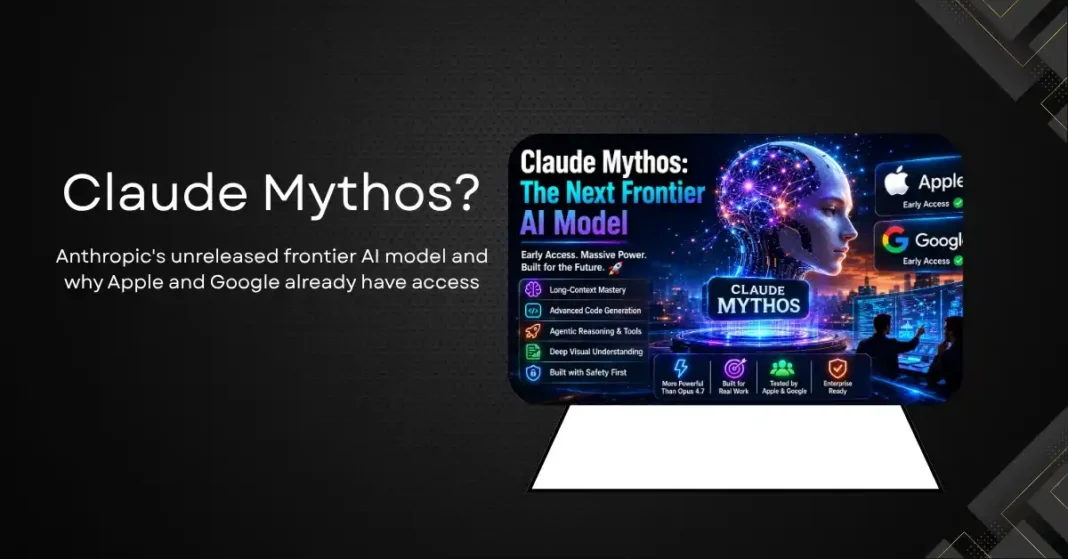
Claude Mythos is Anthropic’s next-generation frontier model, sitting one step beyond Claude Opus 4.7. The company has not officially confirmed the name, but multiple sources have used it consistently in interviews and conference talks. From what’s been reported, Mythos is significantly larger than Opus 4.7 in parameter count, trained on a substantially longer context window, and built with stronger agentic reasoning baked in from the start.
Sources close to the development describe it as Anthropic’s most capable model to date for long-form reasoning, code generation, and tool use. The model can apparently maintain context across hundreds of thousands of tokens without losing coherence, plan and execute long multi-step tasks reliably, and produce code that runs on the first try at rates well above what Opus 4.7 can manage today.
The ‘frontier’ label matters here. Anthropic, OpenAI, and Google use the word to describe models that push past the current capability ceiling. These models tend to consume far more compute, cost far more to serve, and behave in ways that are harder to predict, which is why they are usually rolled out cautiously.
Why Apple and Google Have Early Access
The reason Apple and Google have Mythos is partly commercial and partly safety-driven. Both companies are building consumer AI products that depend on the best available models, and both have struck deep integration deals with Anthropic over the last year. Apple is reportedly using Claude as one of the fallback models when Apple Intelligence routes a tough query off-device. Google, oddly, is using Claude inside several developer-facing tools, despite owning Gemini.
Early access to Mythos gives both companies time to test integration before launch, fine-tune for their specific use cases, and stress test for edge cases that only show up at scale. Apple in particular cares about offline reliability and small-form factor performance, neither of which are Mythos’s strengths today. Google, meanwhile, is interested in agentic workflows for Workspace and developer tools.
Anthropic also benefits from this. Running a frontier model against real workloads at Apple and Google scale generates feedback that’s almost impossible to get from internal testing. It also locks in two of the biggest enterprise customers in tech ahead of the public launch.
Reported Capabilities
The most consistent piece of feedback from people who’ve used Mythos is that it doesn’t feel like a chatbot anymore. The model handles long-running tasks, like writing and revising a 200-page document over a multi-hour session, with the same context discipline that human writers use. It remembers what it decided three hours ago and refers back to it.
Code generation is reportedly a step change. Engineers comparing Mythos to Opus 4.7 on real codebases describe the difference as similar to the gap between Sonnet 3.5 and Opus 3 back in 2024. Multi-file refactors, complex architectural changes, and bug hunts in large repositories are areas where Mythos apparently shines.
Tool use is the other major upgrade. Mythos appears to be much better at chaining API calls, recovering from tool errors, and reasoning about which tool to use without explicit prompting. This is the foundation for the agentic products everyone is building toward, and it’s the area where Anthropic has been investing most heavily in 2026.
Visual reasoning is another area where Mythos has reportedly improved. The model can now interpret complex diagrams, scientific figures, and technical schematics with much higher accuracy. It also handles document layout, including tables, equations, and footnotes, far better than its predecessors.
What Anthropic Has Not Said
Anthropic has neither confirmed nor denied the existence of Claude Mythos, which is consistent with how the company has handled previous frontier models. The pattern is usually a quiet rollout to enterprise partners, then a public preview, then a full release with model card and benchmark scores. We are likely somewhere in the middle of that cycle right now.
What we don’t know is the exact size of the model, the training data cutoff, the cost per token, the context window length, or the safety evaluations Anthropic has run. We also don’t know whether Mythos is one model or a family. Anthropic’s recent strategy has been to release models in tiers, like Sonnet for everyday use, Opus for the hardest tasks, and Haiku for speed. Mythos may be the new top tier, or it may be a different category entirely.
The other open question is timing. If Anthropic follows the pattern from earlier launches, expect a public preview in late 2026 or early 2027, with broad API access a few months after that. Apple and Google would have several months of head start over other enterprise customers.
Why This Matters for the AI Industry
Claude Mythos matters because it is the first credible competitor to OpenAI’s GPT-5.5 and Google’s Gemini Ultra in the highest tier of frontier models. For the last 18 months, OpenAI and Google have been seen as the leaders, with Anthropic catching up. Mythos may flip that order.
The other reason it matters is the agentic workflow angle. Every major AI company is racing to ship reliable agents that can complete real work without supervision. The model that proves it can do this safely and consistently will define the next phase of enterprise AI adoption. Mythos, by all reports, is closer to that goal than any model currently shipping.
There is also the funding angle. Anthropic is reportedly in talks for a $50 billion funding round at a near $1 trillion valuation, with Google and Amazon both contributing. A frontier model that outperforms the competition would justify those numbers in a way that previous Claude releases could not.
For enterprise buyers, Mythos changes the calculation. Many companies have been hesitant to bet their AI strategy on a single vendor, but with three credible frontier model providers, the pricing power and feature competition shift in favour of customers. Expect aggressive enterprise pricing from all three over the next 12 months.
What This Means for Developers and SMEs
Developers should treat Mythos as a likely 2026 release and plan accordingly. If your current Claude integration relies on Opus 4.7 for the heaviest tasks, you’ll want to test Mythos as soon as preview access opens. The cost-to-capability ratio will likely improve, which means cheaper inference for the same task or much more capability at the same cost.
Small businesses using Claude through Anthropic’s chat product won’t see Mythos directly for some time. The pattern with Anthropic has been to ship frontier models to enterprise and API customers first, with consumer-facing chat upgrades following weeks or months later.
For Indian agencies and SMEs that already use Claude via the API for content, code, or customer support workflows, the practical advice is to keep your prompts and tools modular. Frontier model upgrades tend to break edge cases as much as they improve common ones, and the agencies that benefit fastest are the ones who can swap models without rewriting their entire pipeline.
Anthropic has also been improving its enterprise tier, including better SLAs, dedicated capacity, and stronger data residency commitments. If your business is in a regulated industry, those improvements may matter more than the raw capability bump from Mythos.
Safety and Alignment Concerns
Anthropic has built its reputation on safety research, and Mythos is reportedly going through the most extensive evaluation regime the company has ever run. This includes red-teaming for misuse, capability evaluations across dangerous domains, and external testing by independent researchers.
The reason this matters is that frontier models tend to surface new risks. As models become better at long-horizon planning, code generation, and tool use, the failure modes change. A model that can chain together fifty API calls without supervision can cause real damage if something goes wrong. Anthropic’s Responsible Scaling Policy is the framework the company uses to decide when a model is safe enough to release.
Both Apple and Google have their own safety review processes for any model they integrate. Apple’s stricter content policies are likely one reason Mythos is being tuned for its product before launch. Google’s enterprise customers expect a specific set of guardrails around healthcare, finance, and legal use cases, and Mythos will likely be evaluated against all of them.
If you’re tracking AI safety, Mythos is one of the most important launches of 2026 to watch. The decisions Anthropic makes about how to release it, what guardrails to include, and which use cases to restrict will shape industry norms for years.
Frequently Asked Questions
Is Claude Mythos officially confirmed by Anthropic?
No. Anthropic has neither confirmed nor denied the existence of Claude Mythos. The information comes from sources at companies with early access, and the naming convention fits Anthropic’s recent pattern of literary-sounding model families.
When will Claude Mythos be available to the public?
There is no public release date. Based on Anthropic’s history, expect a public preview in late 2026 or early 2027, with broader API access following soon after. Consumer chat access typically comes weeks after the API.
Why is Google using Claude when it owns Gemini?
Google uses different models for different purposes. Inside Google Workspace and Google Cloud, Claude is offered as one option for enterprise customers who prefer Anthropic’s safety positioning. Google’s own products use Gemini by default.
Will Claude Mythos replace Claude Opus 4.7?
Likely not immediately. Anthropic tends to keep older models available for customers who have stable workflows built around them. Mythos will probably sit at the top of the model hierarchy with Opus 4.7 below it.
Can small businesses access Claude Mythos?
Not yet. Early access is limited to a small number of enterprise partners. Once Mythos enters public preview, small businesses will be able to use it through the standard Anthropic API with usage-based pricing.
How does Claude Mythos compare to GPT-5.5 and Gemini 3.5 Pro?
Until benchmarks are published, comparisons are speculative. Early reports suggest Mythos leads on agentic reasoning and long-context coding tasks, while GPT-5.5 and Gemini 3.5 Pro are competitive in their own areas. A clearer picture will emerge once independent benchmarks are released.
Final Thoughts
Claude Mythos is the kind of release that doesn’t make headlines on launch day but reshapes the industry over the following 12 months. Frontier models change what’s possible for enterprise AI, and the gap between the best models and the rest tends to widen during these transitions. Anthropic going head-to-head with OpenAI and Google at the top tier means more competition, better pricing, and faster feature improvements for everyone building with AI.
For now, treat Mythos as an open secret. It exists. It’s better than what’s currently shipping. Apple and Google have it. The rest of us will get our turn soon enough, and when we do, the bar for what counts as a good AI product will move again.