
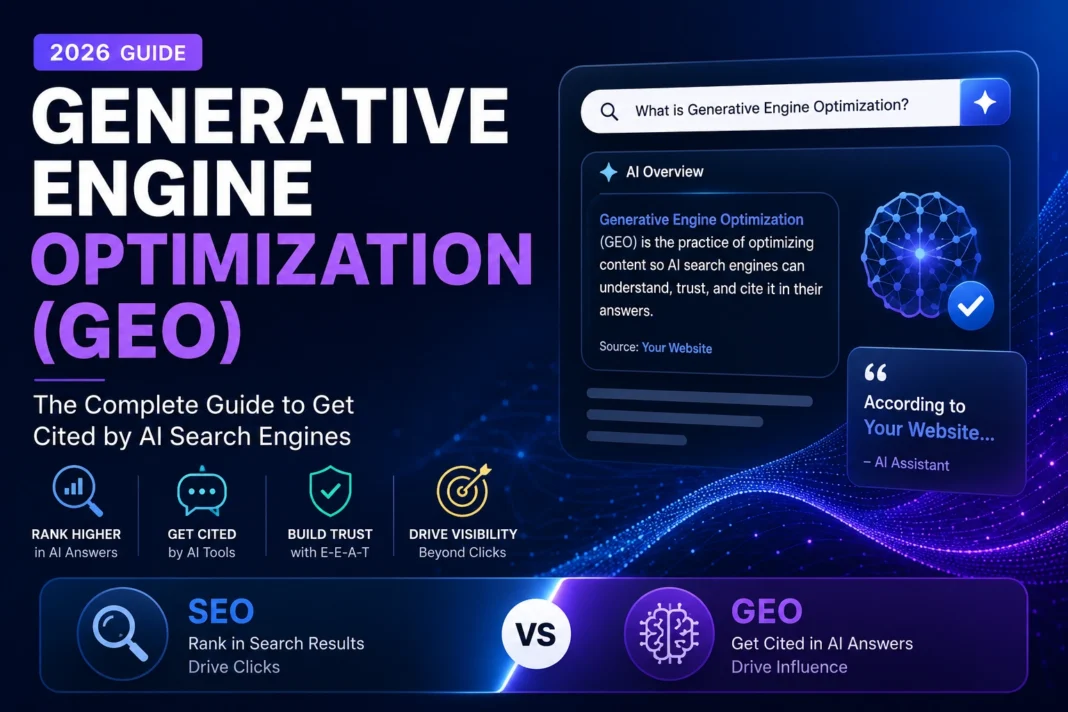
Introduction
Type a question into Google or ChatGPT today, and there’s a good chance you’ll get a full answer before you ever visit a website. That answer came from somewhere. Increasingly, marketers are asking: how do I make sure it comes from my content?
That’s the exact question Generative Engine Optimization (GEO) answers.
For years, SEO meant one thing: rank on page one of Google. But search itself has changed shape. AI-powered search summaries, chatbots, and voice assistants now answer questions directly, often without sending a single click to any website. If your content isn’t built to be understood and trusted by these AI systems, you’re becoming invisible in a growing share of searches.
This guide breaks down what GEO actually is, how it’s different from traditional SEO, and the concrete steps to get your content cited by AI search tools in 2026.
Here’s what you’ll learn:
- What GEO means and why it exists
- How GEO differs from traditional SEO (with a side-by-side comparison)
- A step-by-step process to optimize your content for AI search
- Mistakes that keep content invisible to AI systems
Key Takeaways
- GEO (Generative Engine Optimization) is the practice of structuring content so AI search tools can understand, trust, and cite it.
- Visibility is shifting from “ranking highest” to “being cited as authoritative.”
- E-E-A-T (Experience, Expertise, Authoritativeness, Trustworthiness) matters more than ever for AI citation.
- Clear, direct answers near the top of content perform best in AI summaries.
- GEO doesn’t replace SEO — it builds on it.
What Is Generative Engine Optimization (GEO)?
Generative Engine Optimization is the process of optimizing content so it gets picked up, understood, and cited by AI-powered search systems — including AI Overviews, chatbots, and conversational search assistants.
Where traditional SEO focuses on ranking a page for a keyword, GEO focuses on becoming the source an AI model trusts enough to reference when answering a question.
Think of it this way: SEO gets you in front of the person searching. GEO gets you in front of the AI that’s now doing some of the searching for that person.
Why GEO Exists Now
Search behavior has fundamentally shifted. People are asking full, natural-language questions inside AI chat tools instead of typing short keyword strings into a search bar. At the same time, AI systems have gotten good enough to generate confident, complete-sounding answers on the spot — reducing the need to click through for simple questions.
This means the old goal of “rank #1” is no longer the whole game. The new goal is “get referenced as the trustworthy source,” whether or not that leads to an immediate click.
GEO vs. SEO: A Side-by-Side Comparison
| Factor | Traditional SEO | Generative Engine Optimization (GEO) |
|---|---|---|
| Main goal | Rank high in search results | Get cited inside AI-generated answers |
| Success signal | Click-through rate, rankings | Citations, brand mentions, AI visibility |
| Content style | Keyword-optimized | Clearly structured, directly answers questions |
| Trust signals | Backlinks, domain authority | E-E-A-T, original data, credible authorship |
| Optimization unit | A single page for a keyword | A topic ecosystem of authoritative content |
| Where it shows up | Search engine results page | AI Overviews, chatbots, voice assistants |
GEO isn’t a replacement for SEO — it’s an added layer. Strong SEO fundamentals (fast pages, clear structure, quality backlinks) still make your content easier for AI systems to find and trust in the first place.
Step-by-Step: How to Optimize Content for AI Search (GEO)
Step 1: Answer the Question Immediately
Put a clear, direct answer to the core question in the first two to three sentences of your content. AI systems tend to pull from content that gets straight to the point rather than building up to an answer.
Step 2: Structure Content for Extraction
Use clear H2/H3 headings that mirror real questions. Add short, scannable paragraphs. Use bullet points and numbered lists where relevant — these are easier for AI models to parse and quote accurately.
Step 3: Add Original Data or a Clear Opinion
Generic, rehashed content has little value to an AI system that already has access to thousands of similar articles. Original research, a case study, or a clearly stated expert opinion gives AI a reason to cite you specifically.
Step 4: Strengthen E-E-A-T Signals
- Add a named author bio with real credentials.
- Cite credible sources and link to authoritative external sites.
- Keep information accurate and up to date — outdated content loses citation value fast.
Step 5: Build a Topic Ecosystem, Not Just One Page
AI systems tend to trust sites that demonstrate depth on a topic. Instead of one article, build a cluster: a main guide plus several supporting pieces that link to each other and cover related subtopics.
Step 6: Monitor AI Citations Manually
There’s no perfect analytics tool for this yet. Periodically ask relevant questions inside AI search tools and note whether your brand or content gets referenced.
Requirements: A content management system, basic on-page SEO knowledge, access to your site’s analytics and Search Console.
Best practice: Update cornerstone content every few months — freshness is a strong trust signal for AI systems.
Troubleshooting tip: If your content isn’t getting cited despite good structure, check whether it says anything an AI system couldn’t already summarize from ten other sources. Distinctiveness is often the missing piece.
Who Should Prioritize GEO (and Who Shouldn’t)
Good fit for:
- Content-driven businesses and blogs competing on informational queries
- B2B companies where being seen as an authority matters for trust and sales
- Anyone publishing how-to, comparison, or educational content
Less urgent for:
- Purely local, in-person service businesses with minimal informational search relevance
- Sites still missing basic SEO fundamentals — fix technical SEO and site structure first, since GEO builds on top of it
Common Mistakes to Avoid
- Burying the answer in the fifth paragraph. Fix: Lead with a direct, clear answer.
- Writing generic, AI-sounding content. Fix: Add original insight, data, or a real opinion.
- Skipping author credentials. Fix: Add a real name and relevant expertise to every piece.
- Treating GEO as a one-time task. Fix: Revisit and refresh cornerstone content regularly.
- Ignoring traditional SEO basics. Fix: Keep technical SEO strong — GEO depends on it.
Expert Tips
- Write in a “citable” style — short, self-contained statements that make sense out of context, since that’s how AI systems tend to extract and quote content.
- Use FAQ sections deliberately — they’re a natural fit for AI Overview and voice search extraction.
- Don’t chase every AI platform separately. Strong E-E-A-T and structure tend to help across Google AI Overviews, chatbots, and voice assistants simultaneously.
- Track branded search volume as an indirect signal — if AI citations are working, more people will search your brand name after encountering it in an AI answer.
Future Trends: What’s Next for GEO
- AI search citation tracking tools will mature, giving marketers clearer visibility into what’s getting cited and why.
- E-E-A-T will keep growing in importance, as AI systems get better at filtering out low-quality, generic content.
- Multimodal content (video, audio, structured data) will play a bigger role in AI search summaries, not just text.
- GEO and traditional SEO will fully merge into a single discipline focused on overall search visibility, rather than being treated as separate strategies.
Conclusion
Generative Engine Optimization isn’t a passing trend — it’s a reflection of how search itself is evolving. The brands that adapt now, by leading with clear answers, real expertise, and original insight, will be the ones AI systems trust enough to cite. The ones that keep publishing generic, keyword-stuffed content will quietly become invisible.
Start with one cornerstone piece of content: restructure it to answer clearly, add a real author, and strengthen its authority. Then watch how it performs over the next few months.
FAQ
1. What is Generative Engine Optimization (GEO)? GEO is the practice of optimizing content so AI-powered search tools — like AI Overviews and chatbots — can understand, trust, and cite it in their answers.
2. How is GEO different from SEO? SEO focuses on ranking pages in traditional search results; GEO focuses on getting content cited inside AI-generated answers. They work together rather than replacing each other.
3. Do I need to abandon SEO to focus on GEO? No. Strong SEO fundamentals make it easier for AI systems to find and trust your content in the first place.
4. What is E-E-A-T and why does it matter for GEO? E-E-A-T stands for Experience, Expertise, Authoritativeness, and Trustworthiness — signals AI systems use to decide which sources are credible enough to cite.
5. How can I tell if AI search tools are citing my content? There’s no perfect tool yet, but you can manually ask relevant questions inside AI search assistants and check whether your brand or content appears in the answer.
6. What type of content performs best for GEO? Content with a clear, direct answer near the top, original data or opinions, and a credible named author tends to perform best.
7. Does GEO apply to small businesses and blogs? Yes — any content-driven business or blog answering informational questions can benefit from GEO principles.
8. How often should I update content for GEO? Regularly — every few months for cornerstone content, since freshness and accuracy are strong trust signals for AI systems.
9. Can original research really improve AI citation chances? Yes. Original data or case studies give AI systems a unique reason to cite your content instead of a dozen similar articles.
10. Is GEO only relevant for Google? No. GEO principles apply across AI search tools, chatbots, and voice assistants, not just one platform.
11. What role do FAQ sections play in GEO? FAQ sections are well-suited for AI extraction because they’re structured as direct questions and answers, making them easy to summarize or quote.
12. Will GEO eventually replace SEO entirely? It’s more likely that GEO and SEO will merge into one broader discipline focused on total search visibility, rather than one replacing the other.
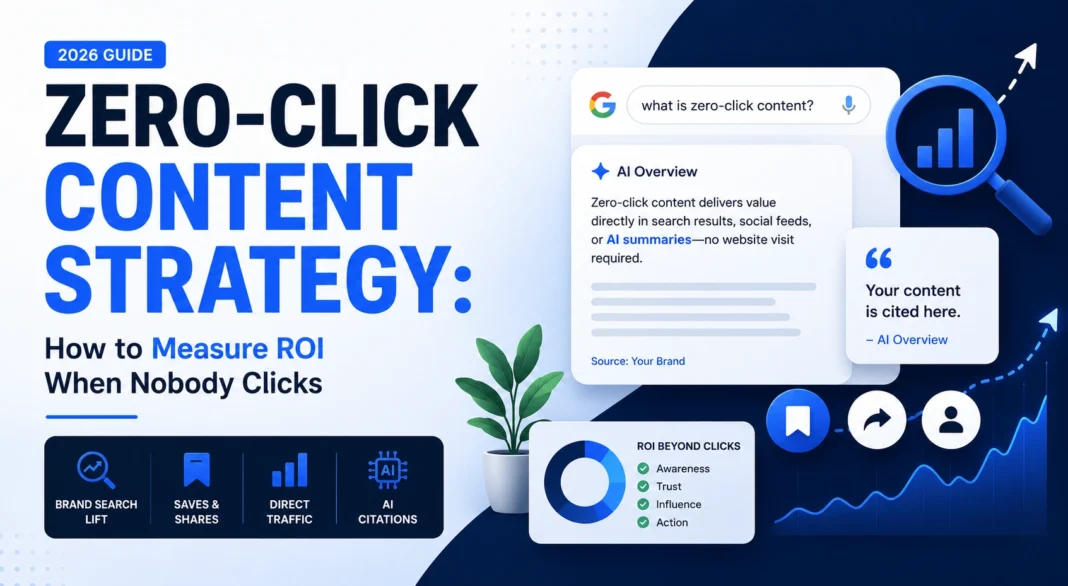

: what it is, how it differs from SEO, and the steps to get your content cited by AI search engines.)