Key Takeaways
- Google Search in 2026 is built around AI Overviews and AI Mode, which now cover roughly half of all tracked queries.
- Ranking #1 no longer guarantees clicks — AI Overviews can answer the query before anyone reaches your page.
- AI Mode increasingly builds its own separate source list. Overlap between traditional top-10 rankings and AI Mode citations has dropped sharply since 2025.
- Google itself says this is still SEO — quality, expertise, and technical accessibility drive both traditional rankings and AI citation visibility.
- The real shift: you’re now optimizing for two outcomes — being ranked and being cited — and they don’t always overlap.
Introduction
Here’s a strange thing that’s been happening to a lot of site owners in 2026. You check Search Console. Your rankings look fine. Position 1, position 2, right where you’ve always been. But your traffic? Down. Sometimes way down.
You didn’t get penalized. Nothing broke. What happened is simpler and stranger: Google answered the question before anyone reached your page.
This is the reality of ranking on Google in 2026. <cite index=”19-1″>Google search doesn’t work the way it did two years ago, and if your traffic has been quietly dropping even though your rankings haven’t changed, you’re not imagining it.</cite>
The title of this article is a little provocative — “it’s not SEO anymore” — but that’s not quite right either. <cite index=”14-1″>Google itself has stated that optimizing for AI Overviews and AI Mode is still SEO, built on the same fundamentals of quality, expertise, and technical accessibility that have always driven rankings.</cite> What’s changed is what “ranking” even means, and how many separate games you now have to win at once.
By the end of this guide, you’ll understand exactly what changed, why your traffic and rankings can disagree with each other, and the concrete steps to stay visible in both classic search results and AI-generated answers.
What Actually Changed in 2026
Let’s use a simple picture. Imagine Google search used to be a bookstore with shelves. You wanted your book on the front shelf, at eye level. That was the whole game.
Now imagine a librarian stands at the door and just tells people the answer before they even walk to the shelves. That librarian is AI Overviews and AI Mode. The shelves still exist. But fewer people are walking past them.
<cite index=”14-1″>AI Overviews expanded from roughly a third of queries in late 2025 to nearly half of all searches by early 2026, and Google’s leadership has described this as a coordinated shift of the entire discovery experience toward AI-generated answers, not just a single feature launch.</cite>
At the same time, <cite index=”14-1″>Google has pushed through two major core updates already this year, rebuilt large parts of its search interface around AI Mode and AI Overviews, and started enforcing new spam policies aimed squarely at manipulative and AI-generated content abuse.</cite>
The Scale Is Bigger Than Most People Realize
<cite index=”14-1″>At Google I/O 2026, Google confirmed AI Mode had crossed one billion monthly users, with query volume doubling every quarter.</cite> This isn’t a side experiment anymore. It’s becoming the default way a huge share of people interact with search.
Expert Tip
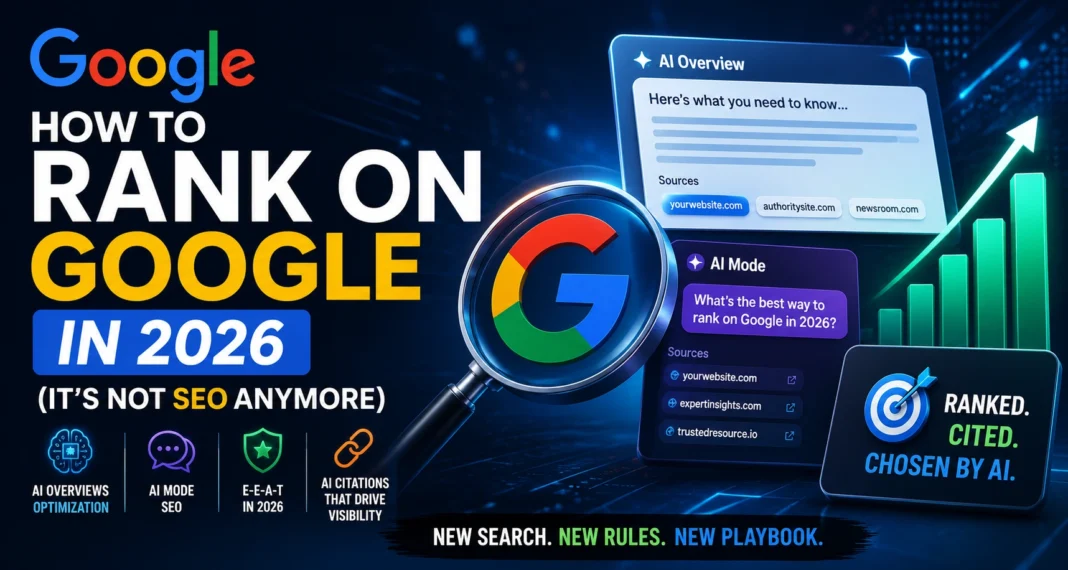
Don’t treat “AI Overviews” and “AI Mode” as the same thing. AI Overviews are the answer boxes that appear above traditional results for many queries. AI Mode is a fully separate, conversational search experience that builds its own source list. You need a strategy for both.
Why Your Rankings Can Stay the Same While Your Traffic Drops
This confuses almost everyone at first, so let’s slow down.
<cite index=”19-1″>The classic pattern looks like this: your traffic drops significantly, but your rankings stay exactly where they were. That’s because Google didn’t penalize you — AI Overviews simply absorbed the query before the user ever reached your result.</cite>
Here’s how to check if this is happening to you:
<cite index=”19-1″>Look at your Google Search Console data for a drop in click-through rate on informational keywords — the “how,” “what,” and “why” queries — while impressions stayed roughly flat. If that’s the pattern you see, AI Overviews are almost certainly the cause, not an algorithm penalty.</cite>
That distinction matters enormously. A ranking penalty means something is wrong with your site. A click cannibalization pattern means your content is being used — just not clicked.
Common Mistake #1
Panicking and rewriting content that Google is already treating as authoritative, when the real issue is a UX shift in the SERP, not a quality problem with your page.
AI Overviews vs. AI Mode vs. Traditional Rankings
These three things behave differently enough that treating them as one thing will waste your time. Here’s the breakdown.
| Feature | Traditional Rankings | AI Overviews | AI Mode |
|---|---|---|---|
| Source | Google’s main web index | Same web index, layered with Gemini selection | Increasingly its own source list |
| Format | Ten blue links | AI-generated summary with citation chips | Fully conversational, multi-query synthesis |
| What earns visibility | Classic ranking factors, backlinks, relevance | Passages extracted from already-ranking pages | Deep topical coverage of narrow sub-questions |
| Overlap with top-10 rankings | N/A (this is the top-10) | High — pulls from top-ranking pages | Falling sharply — as low as 17% by early 2026, down from ~76% in 2025 |
<cite index=”19-1″>In 2025, about 76% of pages cited in AI Mode also ranked in Google’s traditional top 10. By early 2026, that overlap had fallen to as low as 17%, meaning AI Mode is building its own source list and just ranking well on Google no longer guarantees you’ll appear in AI-generated answers.</cite>
That single statistic is probably the most important thing in this entire article. Read it twice if you need to.
Step-by-Step: How to Actually Rank (and Get Cited) in 2026
Requirements Before You Start
- Full HTTPS with correctly configured redirects
- Clean, crawlable HTML (heavy client-side JavaScript can hide content from crawlers)
- A Google Search Console account connected and verified
- A baseline understanding of your current top informational keywords
Step 1: Fix the Technical Foundation First
<cite index=”14-1″>Priorities for 2026 include fast, stable Core Web Vitals across mobile and desktop, clean and crawlable HTML that doesn’t hide critical content behind heavy client-side JavaScript, full HTTPS deployment with correctly configured redirects, and complete, accurate structured data including Article, FAQPage, HowTo, Organization, and BreadcrumbList schema where relevant.</cite>
None of the AI-era changes remove the need for solid technical SEO. If anything, they raise the stakes, since a broken technical foundation blocks both traditional indexing and AI crawler access at once.
Step 2: Check Your Crawler Access — Carefully
<cite index=”14-1″>Confirm that AI crawlers from Google, OpenAI, Anthropic, and Perplexity aren’t accidentally blocked in robots.txt if you want visibility across AI-driven discovery platforms beyond Google itself.</cite>
<cite index=”12-1″>The engines do not share infrastructure — blocking GPTBot does not help your Gemini visibility, and it costs you ChatGPT visibility, which remains the highest-traffic conversational surface.</cite> Treat each crawler decision separately rather than applying one blanket robots.txt rule.
Step 3: Write for One Sub-Question at a Time
<cite index=”19-1″>For a query like “what’s the best SEO strategy for a small business in 2026,” AI Mode might separately search several narrower sub-questions, which means broad, generic articles are less useful than focused, thorough pages that completely answer one specific question — the AI is looking for the clearest answer to each sub-question, not the most comprehensive overview of everything.</cite>
Step 4: Build Genuine Topical Authority, Not Prompt-Bait
<cite index=”12-1″>Despite the rhetoric about backlinks dying, citation chips in AI Overviews continue to skew toward pages on domains with strong topical authority — the same mechanic that powered traditional SEO: pages on well-linked domains rank, and AI Overviews extract from pages that already rank.</cite>
Step 5: Avoid Answer-Bait Tricks
<cite index=”12-1″>Patterns like “prompt-optimized” copy that reads like answer-engine sludge, or stuffing “what is X” headers without a real answer underneath, don’t help — Gemini detects the pattern and discounts the content. Hidden answer-bait divs, like cloaking answers in display:none containers, don’t work either, because Google reads the DOM as users actually see it.</cite>
Step 6: Keep Content Genuinely Fresh
<cite index=”15-1″>AI systems favor comprehensive, current content, assessing things like byline dates, URL dates, and timestamps showing when a page was last updated, and refreshing existing posts is often more effective than publishing new ones.</cite>
Step 7: Track the Right Metrics
<cite index=”20-1″>It typically takes around 6 to 8 weeks after publishing for citation changes to show up, and adding an author bio, FAQ schema, and topical clusters can help results appear faster.</cite>
Best Practices
- Update your most important pages every few months rather than letting them go stale
- Add a visible “last updated” date
- Use structured, question-based headings that match how people actually phrase queries
Troubleshooting Tips
- If impressions are steady but clicks are falling, look at AI Overview click cannibalization before assuming a ranking penalty
- If a page has always ranked but never gets cited in AI Mode, check whether it answers one clear sub-question or tries to cover too much at once
- If nothing seems to work, check for accidental crawler blocks in robots.txt before touching your content strategy
Benefits of Adapting Your Strategy Now
Main benefit: Sites that adapt early get compounding visibility across both traditional rankings and AI-generated answers, instead of slowly losing share of both.
Real-world application: A publisher who restructures long articles into focused, sub-question-driven sections often sees citation gains in AI Mode without losing traditional ranking position, since the underlying content quality hasn’t changed — only its structure has.
Who should prioritize this now: Content-heavy sites competing on informational queries, publishers, SaaS companies with how-to content, and any brand relying on organic traffic for awareness.
Who can move more slowly: Highly transactional, brand-searched, or local-intent businesses where AI Overviews rarely intervene between the searcher and the click.
Common Mistakes to Avoid
- Treating AI Overviews and AI Mode as the same optimization target. They pull from different source pools and need separate tracking.
- Blocking all AI crawlers out of caution. This can quietly remove you from citation opportunities on platforms your customers actually use.
- Writing broad “everything about X” articles instead of tightly focused answers. AI Mode increasingly rewards depth on narrow sub-questions over broad coverage.
- Assuming a traffic drop always means a penalty. Check CTR against impressions before concluding your rankings actually fell.
- Stuffing question-style headers without real answers underneath. This pattern is actively detected and discounted rather than rewarded.
- Letting high-performing pages go stale. Freshness signals matter more for AI citation than most site owners assume.
Expert Tips Not Commonly Discussed
- Watch the overlap gap, not just your rankings. The shrinking overlap between traditional top-10 rankings and AI Mode citations is the single clearest signal that these are becoming two separate games.
- Category answers beat brand mentions in commercial queries. <cite index=”12-1″>On shopping-adjacent queries, AI Overviews behaves as a category-answer surface rather than a brand-recommendation surface, so the real opportunity is owning the category-defining answer block that gets paraphrased, not chasing a direct brand mention.</cite>
- Separate your crawler strategy by platform. Treat Googlebot, GPTBot, ClaudeBot, and PerplexityBot as four different visibility decisions, not one blanket robots.txt policy.
- Give citation changes time before judging a rewrite. A 6–8 week lag between publishing and citation changes is normal — don’t declare a strategy a failure after two weeks.
Future Trends: What’s Next for Ranking on Google
<cite index=”20-1″>AI search is continuing to evolve around multimodal search, more conversational experiences, deeper natural language understanding, and increasingly customized responses, with growth expected in entity-based search, topical authority weighting, and voice-driven queries.</cite>
A few patterns worth planning around for the rest of 2026 and beyond:
- Search diversification is becoming a genuine strategy, not just a hedge. <cite index=”14-1″>Google still commands the largest share of global search traffic in most markets, but 2026’s volatility — disruptive core updates, expanding AI Overviews eating into click-through rates, and constant algorithm recalibration — has made a strong case for building a technical and content foundation solid enough to perform across the whole search landscape, including Bing, Brave Search, and DuckDuckGo.</cite>
- No separate technical file replaces good SEO. <cite index=”14-1″>Google’s official generative AI optimization guidance explicitly states that no llms.txt file or separate GEO strategy is required for Google specifically — standard crawlability, indexability, and content quality are what determine AI Overview and AI Mode visibility.</cite>
- Expect AI Mode’s independent source list to keep growing. As the overlap with traditional rankings shrinks further, dedicated AI Mode optimization will likely become its own line item in content strategy rather than an afterthought.
- CRO and click behavior data will matter more, not less. <cite index=”15-1″>Google’s internal Navboost feature tracks and uses clicks as a ranking signal, which means conversion rate optimization increasingly overlaps with SEO strategy rather than sitting in a separate discipline.</cite>
Conclusion
The headline “it’s not SEO anymore” is catchy, but the more accurate version is this: it’s SEO plus something new layered on top, and that something new increasingly behaves like its own separate discipline.
Google itself is clear that the fundamentals haven’t disappeared — quality, expertise, technical accessibility, and genuine authority still drive both traditional rankings and AI citation visibility. What’s changed is that ranking #1 no longer guarantees a click, AI Mode is quietly building its own independent list of sources, and the gap between “ranked” and “cited” is only getting wider.
If you take one thing from this guide, let it be this: check your Search Console data for the CTR-vs-impressions pattern before assuming any drop is a penalty, then split your strategy into two lanes — one for classic rankings, one for AI citation — because by every indicator available right now, those two lanes are only going to keep diverging.
FAQ Section
1. How do I rank on Google in 2026? Focus on technical SEO fundamentals, genuine topical authority, and content structured around clear, focused answers to specific sub-questions, since these now drive both traditional rankings and AI citation visibility.
2. Is SEO dead in 2026 because of AI Overviews? No. Google has stated that optimizing for AI Overviews and AI Mode is still SEO, built on the same quality and technical fundamentals that have always mattered.
3. Why did my traffic drop even though my rankings stayed the same? This usually means AI Overviews absorbed the query before users reached your page. Check for falling click-through rate alongside flat impressions in Search Console to confirm.
4. What’s the difference between AI Overviews and AI Mode? AI Overviews are AI-generated answer boxes shown above traditional results for many queries. AI Mode is a fully separate, conversational search experience that increasingly builds its own independent source list.
5. Does ranking #1 guarantee I’ll appear in AI Overviews or AI Mode? No. The overlap between traditional top-10 rankings and AI Mode citations has fallen sharply, meaning strong traditional rankings no longer guarantee AI citation visibility.
6. What is GEO (Generative Engine Optimization)? GEO is the practice of optimizing content specifically to be cited inside AI-generated answers across platforms like Google AI Overviews, ChatGPT, and Perplexity.
7. Do I need a separate llms.txt file for Google? No. Google’s own guidance states that no llms.txt file or separate GEO strategy is required specifically for Google — standard crawlability and content quality determine AI visibility there.
8. Should I block AI crawlers like GPTBot? Not automatically. Blocking one crawler doesn’t help your visibility on other AI platforms and can cost you citation opportunities on high-traffic conversational surfaces.
9. How long does it take to see AI citation results after publishing? Typically around 6 to 8 weeks, though adding author bios, FAQ schema, and topical clusters can help results appear sooner.
10. Does content freshness matter for AI Overviews? Yes. AI systems weigh byline dates, URL dates, and last-updated timestamps, and refreshing existing content is often more effective than publishing new pages.
11. What mistakes hurt AI Overview visibility the most? Prompt-bait style headers without real answers underneath, and hidden or cloaked answer content, both get detected and discounted rather than rewarded.
12. Do backlinks still matter in 2026? Yes. Pages on domains with strong topical authority and genuine backlinks are still more likely to be extracted into AI Overviews, since the underlying mechanic mirrors traditional SEO.
13. What should I track instead of just rankings? Track click-through rate against impressions in Search Console, manually check AI Overview and AI Mode appearance for key queries, and monitor citation share over time.
14. Is voice search still relevant in 2026? Yes, and it’s growing alongside conversational and multimodal search, reinforcing the need for clear, direct answers structured around natural-language questions.
15. Should I diversify beyond Google search? It’s increasingly worth considering. Given the volatility from core updates and AI Overviews reshaping click-through rates, building content that performs across Bing, Brave Search, and DuckDuckGo is a reasonable hedge.