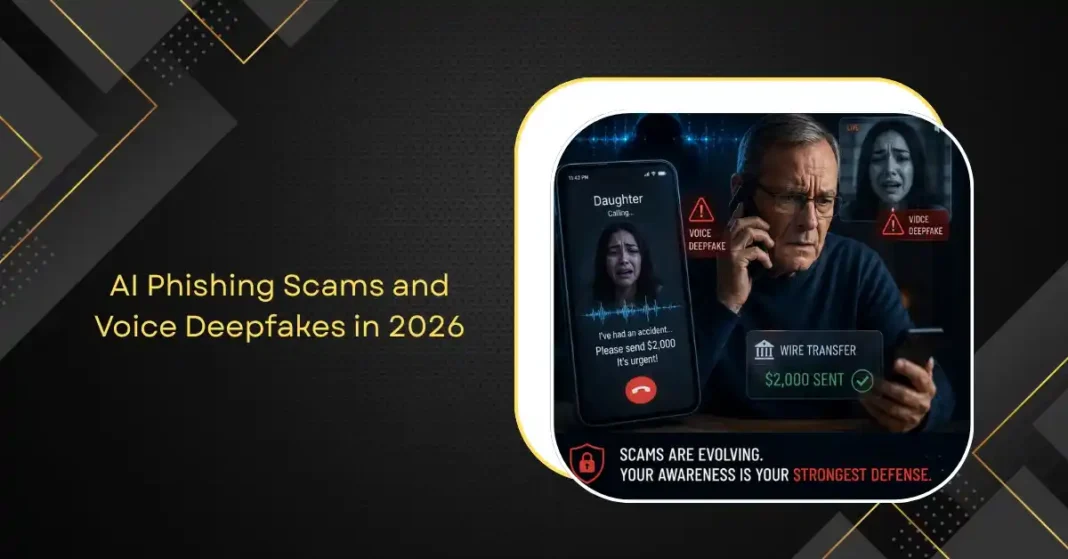
A phone call lands at 11:42 p.m. It is your daughter’s voice on the other end, breaking with panic, saying she has been in an accident and the police are asking for a $2,000 bond before they will let her go. You can see her face on a quick video clip she sends through. You wire the money. Twenty minutes later your actual daughter calls from her dorm room, confused about why you are checking on her at midnight.
This scenario, a grandparent scam rebuilt with AI deepfake technology, is no longer hypothetical. It is happening every day in the United States, the United Kingdom, Canada, Australia, India, and most large internet economies in 2026. The voice on the call was real, in the sense that the audio waveform matched your daughter’s voice almost perfectly. It was generated by an AI model that was trained on twelve seconds of her speech, scraped from an Instagram reel she posted last summer.
AI-powered fraud in 2026 has reached a level of sophistication that makes most of the advice your bank has been emailing you for the past decade dangerously out of date. Telling someone to “watch for poor spelling and grammar in suspicious emails” stopped being useful in late 2023. This guide explains exactly how the current generation of scams works, why traditional spotting techniques fail, and what actually protects you in practice.
The Scale of the Problem
The numbers are alarming, and worth stating plainly.
AI-generated phishing emails achieve click-through rates more than four times higher than their human-crafted equivalents, according to recent enterprise security research. A single deepfake video call cost the global engineering firm Arup an estimated $25.6 million in 2024, in what remains the largest publicly documented case of business deepfake fraud. One in four Americans has already received at least one AI-generated deepfake voice call. Losses from AI-powered fraud are projected to exceed $40 billion annually by 2027. According to the World Economic Forum’s Global Cybersecurity Outlook 2026, 73% of organisations were directly affected by cyber-enabled fraud in 2025.
For consumers, the most common vector is voice cloning. Deepfake voice scams surged roughly 700% in 2025 alone, and the curve has not flattened in 2026.
Why AI Scams Are Different From What Came Before
The old scam tells were good while they lasted. Bad grammar, awkward phrasing, a fake bank login page with a slightly wrong logo, a robotic phone voice that sounded like a 2010s GPS unit. AI removes every single one of those signals.
A modern AI scam uses a large language model to write a perfectly polished, brand-accurate email in your local English dialect. It uses a voice cloning model to produce speech indistinguishable from someone you know. It uses real-time video deepfake technology to render a face on a Zoom or Google Meet call that moves correctly when it talks. The tools to do all of this are either free or available on subscription for less than the cost of a streaming service. According to the 2026 International AI Safety Report, they require no technical expertise to use and can be operated anonymously through public web interfaces.
The result is that the burden of detection has shifted from spotting obvious mistakes to questioning the authenticity of every unsolicited contact, even one that looks and sounds completely normal.
The Most Common AI Scams in 2026
1. Voice Cloning Scams
Scammers use AI to replicate a target’s voice, usually a family member, a spouse, a boss, or an elderly parent, and then call the victim claiming an emergency. The voice clone is built from social media videos, voicemail greetings, podcast appearances, or even a few seconds of audio captured during a previous spam call.
The classic version is the grandparent scam: a grandchild’s voice, in tears, claiming to have been arrested or in an accident, asking for a quick bond payment. The variant aimed at working adults is the boss scam: a CFO or CEO’s voice instructing a finance employee to make an urgent wire transfer to a new vendor.
2. Deepfake Video Fraud
Real-time video deepfakes now run cleanly on consumer hardware. This lets a scammer impersonate someone on a live video call. The Arup case in 2024 is the most famous example, where an employee was instructed to make 15 separate wire transfers totalling $25.6 million by a video meeting populated entirely by deepfaked colleagues, including the CFO. Smaller versions of the same attack now hit mid-sized businesses regularly.
3. AI Phishing Emails and Texts
Large language models let scammers write phishing messages that match the writing style, tone, branding, and even the typical employee signature format of real organisations such as banks, government agencies, courier companies, and tax authorities. The messages are personalised at scale, often using data from previous breaches to reference real account numbers, recent purchases, or specific delivery addresses.
4. AI Chatbot Scams
Scammers deploy AI-powered chatbots on fake investment platforms, romance scam profiles, and fake customer service chats. The bots maintain conversations for days or weeks, building trust before asking for money, crypto deposits, or sensitive credentials.
5. Biometric Harvesting
As banks, fintech platforms, and government services increasingly use Face ID, voice verification, and behavioural biometrics, scammers are collecting high-quality biometric data from public social media to eventually defeat those systems. A high-resolution selfie video posted on Instagram is more useful to a fraud ring than most people realise.
6. AI-Powered Romance Scams
Long-running romance scams have always been expensive for criminals to operate because each victim required weeks of one-on-one human conversation. AI chatbots have collapsed that cost. A single scammer can now run dozens of simultaneous romance conversations, each personalised, each maintaining context, each slowly building toward the moment a payment request lands.
How to Protect Yourself: A Practical 2026 Guide
Verify Before You Act
If you receive an urgent call, even from a voice you absolutely recognise, hang up and call back using a number you already have saved in your phone. Do not call any number the caller provides. This single habit defeats the majority of voice cloning scams in one step.
Set up a family safe word that only your relatives know. If someone claiming to be a family member in distress cannot provide the safe word, the call is a scam. Tell your children, your parents, your siblings. Make it boring, make it forgettable from the outside, and never write it down anywhere a stranger could see.
Limit Your Public Voice Exposure
Scammers need only a few seconds of clear audio to clone a voice. Review your social media privacy settings. Make videos and voice notes friends-only by default. Be aware that a podcast appearance, a public WhatsApp Status, a YouTube Short, or an Instagram Reel all provide enough material to build a usable clone.
This is harder for public figures, business owners, and content creators who need a public voice presence. The mitigation for them is to assume their voice can be cloned and to set up family and workplace verification routines that do not depend on voice authentication.
Turn On Multi-Factor Authentication
MFA does not stop a scammer who socially engineers you into reading them an MFA code voluntarily. But it does stop an attacker who has stolen your password from accessing your account. Enable it on every service that supports it, especially email, banking, and any account used for password resets on other services. Use an authenticator app, not SMS, where the choice is available.
Use a Password Manager
A password manager generates long, random, unique passwords for every login and stores them securely. This breaks the most common credential-stuffing attack vector, where a password leaked in one breach is used to access dozens of other accounts.
Treat Urgency as a Red Flag
AI scams rely on manufactured urgency to short-circuit your rational thinking. Any message, call, email, or text demanding immediate payment or threatening serious consequences if you do not act in the next few minutes should be treated as a scam by default, with the burden of proof on the caller to demonstrate otherwise. Real banks, real tax authorities, and real police forces do not demand instant payments by phone.
Check for Deepfake Tells
On video calls, look for subtle inconsistencies in lighting around the face, lip synchronisation issues during fast speech, unnatural blinking patterns, and odd behaviour at the hairline or jawline. Ask the caller to do something unexpected, such as turning their head sideways briefly, putting a hand in front of their face, or holding up a specific number of fingers. Most current real-time deepfake models struggle with sudden movements or partial face occlusion.
On voice calls, listen for unnatural pauses, slightly off cadence, and ask an unexpected personal question that only the real person would know.
Never Wire Money Based on a Phone Call Alone
No legitimate organisation, including any bank, tax authority, court, or employer, will ask you to wire money, buy gift cards, or send cryptocurrency based on a phone call. Treat any such request as a scam, regardless of who the caller appears to be.
What Businesses Should Do
For enterprises the stakes are higher and the protections need to be more structured.
First, every wire transfer above a defined threshold should require multi-channel verification. If the CFO requests a payment by email, a finance employee must call back on a known internal number and confirm verbally. If the request comes by video call, the verification has to happen on a separate channel entirely. The whole point of multi-channel verification is that compromising one channel does not let an attacker complete the fraud.
Second, train employees specifically on AI-powered social engineering. Generic security awareness training that teaches people to “spot phishing emails” is no longer sufficient. Run simulated deepfake voice and video exercises against your finance, HR, and procurement teams. The first time someone hears a cloned version of their boss’s voice should not be the day a scammer calls.
Third, deploy AI fraud detection tools that flag unusual communication patterns. Several enterprise security vendors now offer voice deepfake detection that runs on live calls, and email security platforms have meaningfully improved their detection of LLM-generated phishing in the last twelve months.
Fourth, write down a clear incident response plan that assumes a successful deepfake attack will eventually happen. Who in finance can stop an in-flight wire? What is the SLA with your bank for recall attempts? Who notifies customers, regulators, and law enforcement, and in what order? These are not questions to answer at 9 p.m. on a Friday when a payment has just gone out the door.
The average successful CEO fraud attack results in losses of $125,000 or more. For mid-sized businesses, a single successful attack can wipe out a year of profit.
What Is Coming Next
The current generation of AI scams is built mostly on voice cloning and asynchronous video deepfakes. The next generation, already in early use by more sophisticated criminal groups, combines real-time deepfake video with conversational AI agents that can autonomously hold a video meeting, react in real time, and adapt their behaviour to the victim. The cost per scam attempt is collapsing, which means the number of attempts per victim is going to keep rising for at least the next eighteen months.
The defensive response will eventually catch up. Liveness detection, hardware-bound device identity, and cryptographic communication channels for high-value transactions are all becoming more available. Banks in several markets, including India, are piloting voice and behavioural biometrics that are deliberately resistant to current cloning techniques. But the gap between attack capability and average user awareness is wider in 2026 than it was at any previous point in the history of internet fraud, and that gap is the window scammers are operating in.
The Bottom Line
In 2026, a face on a video call and a voice on the phone are no longer proof of identity. The single most powerful defence is not a piece of software. It is a household and workplace culture of pausing for thirty seconds before acting on any urgent request, and verifying through a second channel before money or sensitive data moves.
The scams are getting better every quarter. The protection that matters most is also the simplest: stop, verify, then act.
Frequently Asked Questions
Q1: How do voice cloning scams work in 2026?
A: Scammers use AI tools to clone a person’s voice from as little as three to ten seconds of audio sourced from social media videos, voicemails, podcasts, or earlier spam calls. They then call victims impersonating the cloned person, usually claiming an emergency that requires immediate money. The voice clones in 2026 are good enough to fool close family members in most cases.
Q2: How can I tell if a voice call is an AI deepfake?
A: Listen for unnatural pauses, slightly off cadence, and ask an unexpected personal question that only the real person would know. Better still, hang up and call back on a number you already have saved. This single habit defeats most voice cloning scams.
Q3: What is the best way to protect yourself from AI phishing emails?
A: Never click links in unsolicited emails. Go directly to the official website by typing the URL into your browser. Enable multi-factor authentication on all accounts and use a password manager so you are not reusing passwords across services.
Q4: Can multi-factor authentication stop deepfake attacks?
A: MFA stops attackers who have obtained your password but not those who socially engineer you into giving them the MFA code voluntarily. It is still an essential layer of protection but it has to be combined with vigilance and a habit of independent verification.
Q5: How widespread are AI scam losses in 2026?
A: AI-powered fraud losses are projected to exceed $40 billion annually by 2027. A single deepfake video call cost engineering firm Arup an estimated $25.6 million, and 73% of organisations were affected by cyber-enabled fraud in 2025, according to the World Economic Forum’s Global Cybersecurity Outlook 2026.
Q6: What should businesses do to protect against deepfake CEO fraud?
A: Require multi-channel verification for all wire transfers above a defined threshold, train finance and HR staff specifically on AI social engineering, deploy enterprise voice deepfake detection where available, and have a clear incident response plan that assumes a successful attack will eventually happen.