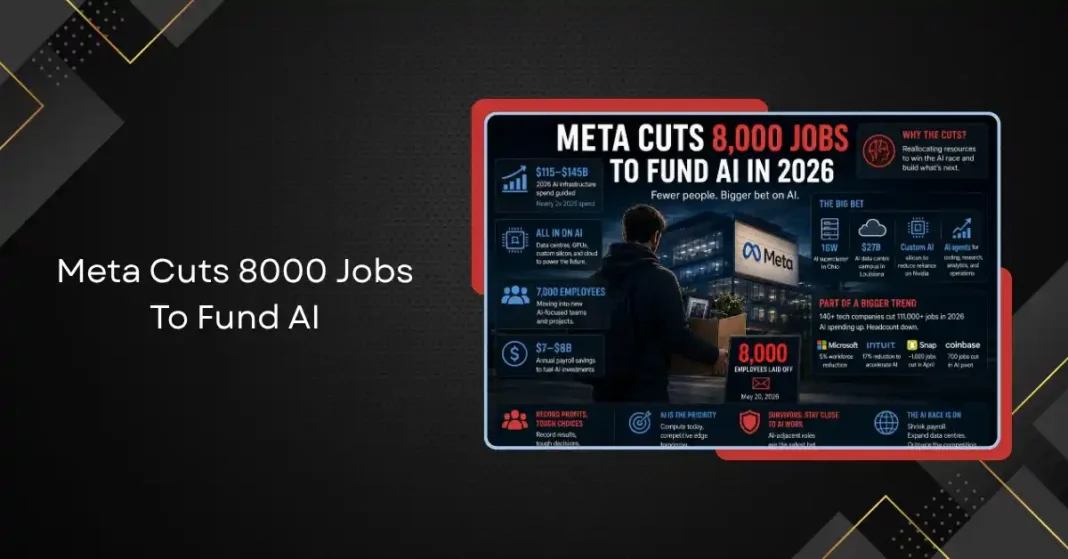
On the morning of 20 May 2026, around 8,000 Meta employees opened a laptop in Singapore, in London, in Menlo Park, and found out they no longer had a job. The notifications went out in a rolling wave timed to local mornings. Singapore got hit first at 4 a.m. local time. North American staff were asked to work from home that day, and the emails reached them as their workday began.
The number lands at roughly 10% of Meta’s global workforce, which sat just under 80,000 at the end of March. On top of the layoffs, Meta cancelled 6,000 open roles it had planned to fill. That brings the effective headcount reduction to around 14,000 positions.
The timing is the part that catches the eye. These cuts arrived four weeks after Meta posted its strongest quarter on record: revenue of $56.31 billion, net income of $26.8 billion, both in the first three months of 2026. Wall Street still rates the stock a Strong Buy, with a consensus price target near $839 across 38 analysts.
So why is the most profitable Meta in years cutting more jobs than it has at any point since the 2023 “Year of Efficiency”? The short answer is on the company’s balance sheet, and it has very little to do with weakness.
The $145 Billion Reason
Meta has guided 2026 capital expenditure to somewhere between $115 billion and $145 billion. The top of that range is nearly double what the company spent in 2025 ($72.2 billion), and almost four times what it spent in 2024 ($39.2 billion). In a single quarter, Meta also added $107 billion in new contractual commitments for cloud and infrastructure deals.
Most of that money is going into one thing: AI compute. Data centres, Nvidia GPUs, Meta’s own custom silicon, the power infrastructure to feed them, and the physical buildings to hold them. Specific projects already disclosed include:
• Prometheus, a one-gigawatt AI supercluster being brought online in Ohio in 2026.
• A $27 billion joint venture with Nebius for a gigawatt-scale AI data centre campus in Louisiana.
• Continued expansion of in-house AI silicon to reduce dependence on Nvidia.
Bank of America estimates the layoffs will generate $7 to $8 billion in annualised payroll savings. That is small relative to the capex bill, but the point is direction, not magnitude. Every dollar pulled out of headcount is a dollar that can be put back into compute. Chief People Officer Janelle Gale framed it in her internal memo as a way to “run the company more efficiently and to offset other investments we are making.” That is the polite version of: payroll funds chips.
What the Cuts Actually Look Like
The May round is the third wave of layoffs Meta has done this year. In January, the company cut around 10% of its Reality Labs division and shut down several of its VR game studios. In March, it eliminated 700 positions spread across at least five divisions including Reality Labs, the Facebook social division, recruiting, sales, and global operations. The May wave is wider and structural rather than performance-based, a distinction Gale’s memo made explicitly. People are not being told they failed. They are being told the org chart no longer has a slot for them.
About 7,000 employees are being moved sideways into new AI-focused units with names like Applied AI Engineering, Agent Transformation Accelerator XFN, and Central Analytics. The brief for those teams is to build agents that can handle coding, research, internal analytics, and operations workloads. So Meta is, in net terms, smaller, but the engineering headcount focused on AI agents is larger.
US workers being let go get 16 weeks of base pay, two additional weeks for every year of service, and 18 months of health coverage. By Silicon Valley standards that is a fair package. By the standards of someone who just lost a job in a tight tech market, it is several months of runway and not much else.
The Surveillance Subtext
Sitting alongside the layoffs is something less talked about but worth flagging. A workplace monitoring tool internally called MCI is deployed on Meta employee laptops in the US. It tracks mouse movement, keystrokes, and takes periodic screenshots. More than 1,000 employees have signed petitions criticising it. The official rationale is that the data is being used to train internal AI agents that automate routine work. The unofficial reading is that employees are now training the systems that may eventually replace some of them.
That is uncomfortable on its face, and the optics are not getting better. The employee petitions have specifically called for the company to disclose what MCI data is being captured, who has access to it, how long it is retained, and whether it is being used as input for any model that affects performance reviews. So far Meta has not committed to any of those disclosures. There is a version of this story where surveillance data plus AI agents plus continued layoffs becomes a serious labour relations problem for Meta in the second half of 2026, and it is no longer a small one.
A Pattern, Not an Exception
If you look only at Meta, the May cuts look extreme. Look across the sector and they look like a template. So far in 2026, more than 140 tech companies have cut over 111,000 positions, according to Layoffs.fyi. The cadence works out to roughly 825 people per day since 1 January.
A short list of who else has cut, and why:
• Microsoft trimmed around 5% of its global workforce earlier this year while raising AI spending.
• Intuit announced a 17% reduction to streamline operations and accelerate AI integration. Its shares fell nearly 5% on the announcement.
• Snap cut around 1,000 jobs in April under similar AI-funding logic.
• Coinbase eliminated 700 positions during an AI pivot.
• Walmart trimmed 1,000 corporate roles without naming AI directly, though the timing fits the broader pattern.
• Pinterest reduced headcount alongside an AI-driven restructuring.
The shared rationale is straightforward. AI infrastructure is now the single largest discretionary line item on these companies’ books, and headcount is the most flexible variable to fund it with. Investors are rewarding the companies that articulate a clear AI compute story and punishing those that cannot. Meta shares were down roughly 7% year to date heading into May, making it the worst-performing megacap tech stock other than Microsoft despite the record revenue. That tells you exactly what the market is pricing for.
How This Differs From the 2023 Round
Mark Zuckerberg’s previous efficiency campaign in 2022 and 2023 eliminated roughly 21,000 positions across two waves. At the time, critics said the cuts went too deep. The stock then proceeded to hit record highs over the next two years and the decision was largely vindicated.
The 2026 round is different in three ways worth noting.
First, the prior cuts were a response to perceived overhiring during the pandemic boom. This round arrives after years of disciplined hiring and on the back of record earnings. There is no excess to trim back to. The 2026 cuts are about repositioning the company, not about undoing past mistakes.
Second, the prior cuts were framed as efficiency. The 2026 cuts are framed as reallocation. The labels matter because they signal different things to staff who survive the round. Efficiency implies the company is becoming leaner overall. Reallocation implies that whole categories of work, not just specific roles, are being moved off the priority list.
Third, the prior cuts were not paired with an explicit, named, multi-hundred-billion-dollar bet on a single technology. This one is. Meta has also signalled that another round of layoffs may land in August, with further reductions possible later in the year. The May wave is the largest single cut Meta has made since 2023, but it does not look like the last.
What This Means for Workers, Investors, and Everyone Else
For Meta employees who survived this round, the message is fairly clear. Working on an AI-adjacent product is the safest place to be inside the company right now. Working on consumer social, recruiting, sales operations, or non-AI parts of Reality Labs is materially less safe than it was a year ago.
For tech workers outside Meta, the same pattern is playing out across the sector. Roles that touch AI infrastructure such as data centre engineering, model training, agent design, AI product management, and ML ops are being created faster than they can be filled. Most other categories are flat or shrinking. The job security premium has shifted hard toward AI work, and the rest of the tech labour market is going to feel that for the rest of the year.
For tech workers in India and the wider Asia-Pacific region, there is a second-order effect worth tracking. Singapore was the first office Meta hit, and the company employs significant numbers of engineers, analysts, and operations staff across India, the Philippines, and Australia. Historically, when US tech firms restructure, offshore and nearshore teams take a disproportionate share of cuts in the second wave because the initial round is concentrated in headquarters geographies for legal and PR reasons. The August round will be a useful signal on whether that pattern still holds in 2026, or whether the AI restructuring is broadly geography-neutral.
For investors, the relevant question is whether the capex bet pays off. Meta is spending $125 billion or more in 2026 on the hope that the resulting infrastructure produces measurable gains in advertising revenue, user engagement, and new AI product lines. If that conversion shows up in the next four quarters, Zuckerberg will look smart and the stock will reward him for it. If it does not, the conversation about whether Big Tech is overspending on AI will get a lot louder in 2027.
For the wider technology industry, the more interesting consequence is the precedent. Meta has just demonstrated, very publicly, that record profits do not protect headcount when there is an alternative use for the payroll dollars. Every other megacap tech CEO is now in a position where doing the same thing is easier to justify to their board. The August round of Meta cuts, if it lands as expected, will not be a surprise. It will be the next data point in a sequence that started in 2022 and has been accelerating since.
Meta is not the only company doing this. It is the most visible one. And for the rest of 2026, what happens at Meta will set the tone for how the rest of Big Tech handles the same trade-off: shrink the payroll, expand the data centres, and try to get the AI story to convert before investors lose patience.
Frequently Asked Questions
Q1: Why is Meta laying off 8,000 employees in 2026?
Meta is cutting approximately 10% of its workforce to generate savings, estimated at $7 to $8 billion annually, that can be redirected toward its $115 to $145 billion AI infrastructure spending plan for 2026.
Q2: How many employees does Meta have after the layoffs?
Meta had just under 80,000 employees at the end of March 2026. After cutting 8,000 jobs and cancelling 6,000 open roles, the effective headcount reduction is around 14,000 positions, though 7,000 employees are being moved into new AI-focused teams rather than leaving the company.
Q3: What is Meta spending $145 billion on?
The funds are directed primarily at AI data centres, Nvidia GPUs, custom AI silicon, and cloud infrastructure to support Meta’s Llama model ecosystem, recommendation systems, and new AI agent products.
Q4: Is this the first time Meta has cut jobs in 2026?
No. Meta reduced Reality Labs by 10% in January 2026, shut down VR game studios, and cut 700 positions across five divisions in March. The May 2026 round is the largest and most structural cut of the year, and the company has signalled that more layoffs may follow in August.
Q5: What does the Meta layoff mean for other Big Tech companies?
It reinforces an industry-wide pattern where companies are cutting traditional headcount to fund AI infrastructure. More than 140 tech firms have cut over 111,000 positions in 2026 following the same playbook, including Microsoft, Intuit, Snap, Coinbase, and Pinterest.