Apple and Google announced something on January 12, 2026 that would have seemed impossible just two years ago. The two companies, longtime rivals in mobile, search, and almost every other major tech category, signed a multi-year partnership in which Google’s Gemini models will power the next generation of Siri and Apple Intelligence. Apple is reportedly paying Google around one billion dollars per year for access to the technology. The deal pushed Alphabet’s market capitalisation above four trillion dollars on the day of the announcement.
For Apple users, this means a much smarter Siri coming later in 2026. For Google, it means Gemini now sits at the heart of virtually every smartphone on the planet, since Gemini already powers Android. For app developers and marketers, the implications are larger and less obvious. Siri is about to become a serious AI assistant that can actually do useful things on iPhones, iPads, and Macs. The way users interact with apps, search for products, and discover content is about to change. This article breaks down what the partnership actually involves and what it means for anyone building or marketing on Apple platforms.
What the Deal Actually Involves
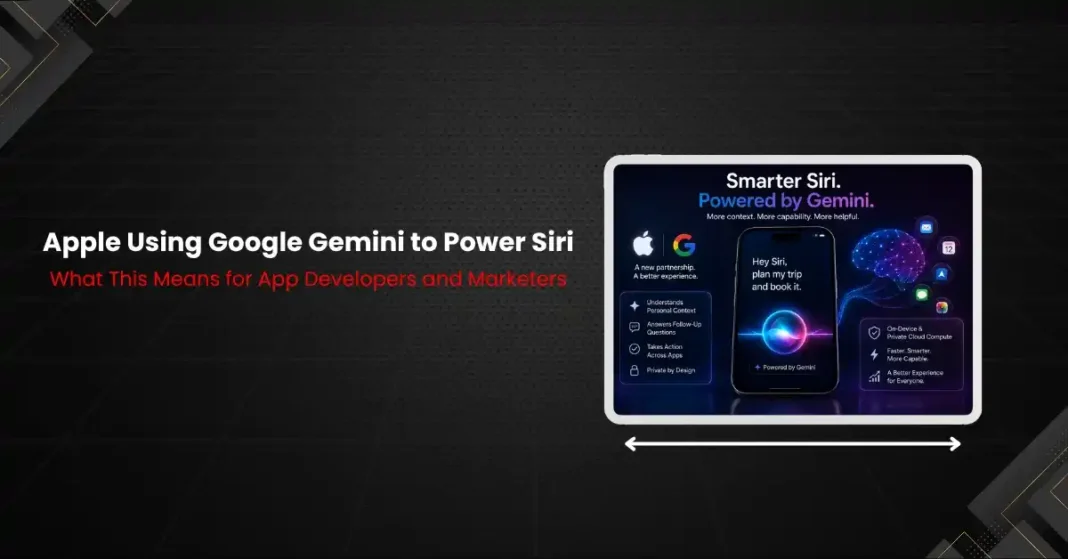
The Apple and Google partnership is structured around three layers of AI processing, each handling different types of tasks. This is the technical reality that matters for understanding how the new Siri will work and where the value sits.
Simple tasks like setting timers, opening apps, and basic dictation will run on Apple’s own on-device models. This part has not changed and continues to work without an internet connection. Apple has been quietly improving these on-device models for years, and they handle the high-volume, low-complexity Siri requests that make up most daily use.
Moderately complex tasks will run on Apple’s Private Cloud Compute servers, which are Apple-controlled infrastructure designed to provide cloud-grade compute while preserving privacy. This is the layer Apple has been developing since 2024 and which underpins much of Apple Intelligence today.
The heavy reasoning, the world knowledge, and the agentic behaviour that defines a modern AI assistant will run on a custom Gemini model. According to reporting and Tim Cook’s comments on Apple’s Q1 2026 earnings call, this Gemini model is hosted on infrastructure Apple controls, not on standard Google Cloud, which is how Apple maintains its privacy posture. Gemini is the engine, but Siri remains the face.
Why Apple Made This Deal
The simplest way to understand the partnership is that Apple finally accepted reality. Siri had fallen multiple generations behind ChatGPT, Gemini, and even Amazon’s Alexa Plus. The personalised Siri Apple promised at WWDC 2024 was delayed repeatedly. Apple Intelligence features that did ship, like Notification Summaries and Writing Tools, were underwhelming. Notification summaries occasionally invented news. The Siri rebuild kept slipping.
Tim Cook explained the decision plainly during the Q1 2026 earnings call. After careful evaluation, Apple determined that Google’s AI technology would provide the most capable foundation for Apple Foundation Models. The company tested models from OpenAI, Anthropic, and others before settling on Gemini. The reasoning was simple. Google had the most capable foundation models, and Apple needed to ship a competitive product faster than it could build one in-house.
Apple still continues its own AI work. The Apple Intelligence stack, on-device models, and Private Cloud Compute are all proprietary. But for the frontier model capability, Apple chose to license rather than build. This is the same calculation that drove the Search default deal between Apple and Google many years ago. When a competitor has the better technology in a critical area, paying for access is often the right move.
What the New Siri Will Actually Do
The Gemini-powered Siri is expected to ship incrementally across iOS 26.4, iOS 26.5, and iOS 27 through 2026 and into 2027. Apple has not published detailed developer documentation yet, but the general shape of the new Siri is clear from public statements and demos.
Personal context awareness is the biggest single change. The new Siri will understand information from your apps, including Mail, Messages, Calendar, Photos, and Notes, and use that context to answer questions. The example Apple has demonstrated is asking Siri about a flight your mother is on, where the assistant combines an email confirmation, a calendar entry, and a text message conversation to give a useful answer. This kind of cross-app reasoning is genuinely new and represents the first time a major mobile AI has worked across personal data at scale.
On-screen awareness lets Siri see what is on your screen and act on it. Asking Siri to send the photo I am looking at to a contact, or to add the event mentioned in this email to my calendar, will become routine.
Deeper per-app controls let Siri trigger specific actions inside third-party apps, going far beyond the limited App Intents and Shortcuts framework today. This is where the developer implications get serious.
What This Means for App Developers
App developers are about to face the same kind of platform shift that the launch of the App Store created in 2008. The interface to apps is changing from icons and screens to conversational requests routed through Siri. Apps that work well with this new model will benefit. Apps that do not will become harder to discover and use.
App Intents Will Become Critical Infrastructure
App Intents is Apple’s framework for letting Siri and Shortcuts interact with app functionality. Until now, App Intents has been a nice-to-have for most apps. With Gemini-powered Siri, App Intents becomes essential infrastructure. The richer your App Intents implementation, the more your app can be invoked through natural language. Apps with thin App Intents support will be invisible to the new Siri.
The practical work for developers includes mapping out the core functions of the app, exposing them as App Intents with clear parameters, providing meaningful entity types, and writing natural-sounding phrases that users might use to invoke each function. This is not glamorous work, but the apps that do it well will have a significant discovery advantage.
Discovery Will Shift From Search to Intent
Today, users discover apps through App Store search, recommendations, and friends. In a world where Siri can do useful things across apps, discovery starts to flow through the AI. When a user asks Siri to find me a flight to Bangkok next month, Siri might invoke a travel booking app the user has installed, recommend installing one if none is present, or offer multiple options. The competition for being the app Siri picks for a given category is going to become intense.
The implication for developers is that App Store Optimisation alone is no longer enough. Optimising for Siri invocation, through rich App Intents, well-defined functionality, and signal quality, is going to matter just as much.
Agent-Friendly App Design
Apps will start to be designed for two audiences at once. Humans who open the app and use the interface, and AI agents like Siri that invoke specific functions on behalf of humans. This is similar to the way websites are designed for both human visitors and search engine crawlers today. The apps that nail this dual-audience design will have a meaningful advantage. The apps that only think about the human user experience will lose ground.
Privacy and Permissions
Because Siri will be accessing personal context across apps, developers need to think carefully about what data their apps expose. Apple’s privacy framework will require explicit user consent for cross-app data access, and developers who handle sensitive data, including healthcare, finance, and messaging, need to design clear permission models. Apple’s privacy posture is non-negotiable, and apps that try to bypass it will face App Store consequences.
What This Means for Marketers
For marketers, the Apple and Google partnership has implications that go well beyond Siri itself. The way Apple users discover information, search for products, and make purchase decisions is about to change.
AI Search Now Reaches Every Apple User
Apple has roughly two billion active devices globally. Gemini-powered Siri brings serious AI search and recommendation capability to all of them. For marketers, this means the work being done for Generative Engine Optimisation and Answer Engine Optimisation matters even more. The same content that gets cited in ChatGPT, Claude, and Gemini today is likely to inform what Siri tells iPhone users tomorrow.
Brands that have invested in clear, factual, well-structured content have a head start. Brands that depend on old-school SEO tactics, thin content, and over-optimised pages will struggle to be cited by AI assistants regardless of which platform they run on.
Voice-First Marketing Becomes Real
Marketers have been talking about voice search for a decade, but it has never really mattered because the assistants were not capable enough. With Gemini powering Siri, voice and conversational interactions are about to become genuinely useful for the first time. Users will ask Siri to find restaurants for tonight, recommend a book on a topic, or compare prices for a product. Brands that show up in these AI responses get the business.
The practical implication is that brand content needs to work for conversational queries, not just keyword-driven search queries. Question-and-answer formats, clear product information, and structured data become more valuable. Long-tail conversational queries become a more important source of demand.
Shopping and Local Discovery
Apple has not yet announced an agentic commerce framework like Google’s Universal Cart, but it is hard to imagine the company not building one. With Gemini as the brain, Siri is well-positioned to handle conversational shopping flows. Marketers selling to consumers should expect AI-mediated discovery to grow significantly through 2026 and 2027. Direct-to-consumer brands, in particular, need to think about how their product information shows up in AI responses across multiple platforms.
Local businesses will see the biggest immediate impact. Siri queries like find me a coffee shop nearby that is open or book me a haircut for Saturday will increasingly route through the AI rather than through Apple Maps or Google Search. The businesses that have clean, complete, and accurate local data across Apple Business Connect, Google Business Profile, and the major review platforms will benefit.
Privacy Constraints Will Shape Marketing
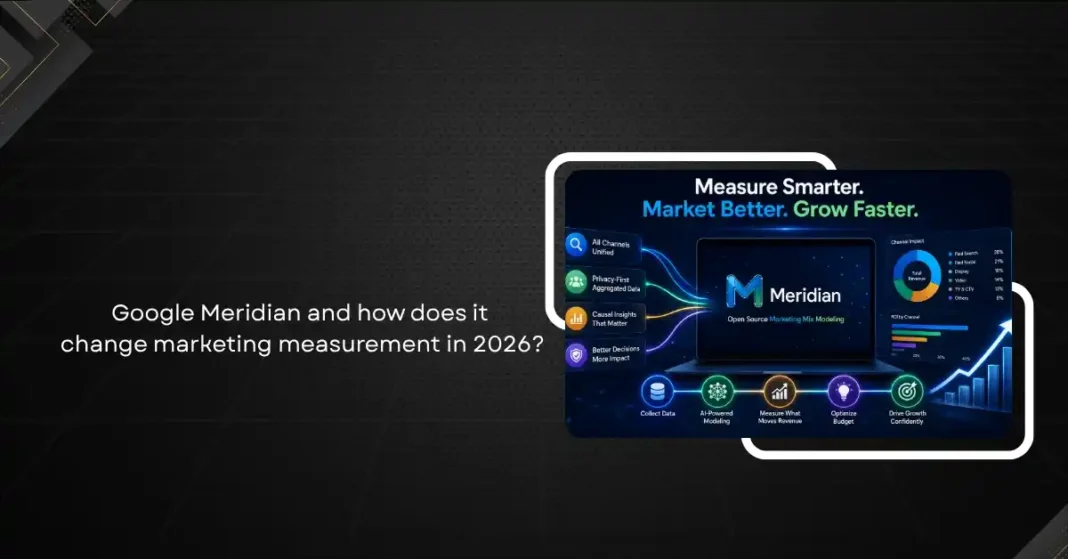
Apple has not abandoned its privacy stance with the Google deal. Personal data stays on-device or in Private Cloud Compute. Marketers cannot assume they will get user-level data from Siri interactions the way they sometimes get from web analytics. Aggregated, privacy-safe measurement, including approaches like marketing mix modelling, becomes even more important.
The Competitive Implications
The Apple-Google partnership has reshaped the AI competitive landscape in ways that are still working through the system.
OpenAI Loses Ground
Apple currently has an existing integration with OpenAI that routes complex Siri queries to ChatGPT. It is unclear how this fits with the Gemini deal, but the practical reality is that Google has taken the strategic high ground. Gemini is now the default AI on virtually every smartphone in the world, between Android and the new Siri. OpenAI’s relationship with Apple has been demoted from primary AI partner to one of several optional integrations.
For app developers and marketers, this changes the calculus around which AI ecosystem to optimise for. Building deep integrations with OpenAI’s API is still valuable, but Google’s reach through Android and now iOS is hard to argue with.
Anthropic and the Long Game
Anthropic was reportedly one of the companies Apple tested before settling on Google. The fact that Apple did not pick Anthropic does not mean Claude is out of the picture. Apple has explicitly said the Google deal is not exclusive, and ongoing reporting suggests Apple and Anthropic continue to have a relationship. For developers, this means betting on a single AI provider is a mistake. The platforms are going to keep their options open, and so should builders.
Google’s New Power Position
The deal has put Google in arguably the strongest position in AI. Gemini powers Android, now Siri, the largest enterprise AI workloads through Google Cloud, and Google’s own products including Search, Workspace, and YouTube. The reach is staggering. For marketers, this consolidation around Gemini means that getting content and products cited by Gemini is becoming a near-universal priority, not just a Google-specific optimisation.
What to Do Now
The Gemini-powered Siri rollout is happening this year, even if the timeline is still uncertain. Developers and marketers who want to be ready when it ships should be working on specific things in the meantime.
For App Developers
Audit your App Intents implementation now. Map every meaningful action your app supports and expose it as an App Intent with clear parameters and natural-language phrases. Test your app with current Siri and Shortcuts to make sure the basic invocation works. Watch WWDC 2026 closely, where Apple is expected to publish updated developer guidance specifically for the Gemini-powered Siri.
Think about what your app can do for an AI agent on behalf of a user, not just what it does when a user opens it directly. Re-architect parts of your app, if needed, to support agentic invocation cleanly.
For Marketers
Audit your content for AI citation. The same content that gets cited by ChatGPT and Gemini today will inform what Siri says tomorrow. Invest in structured content, clear answers to common questions, and quality signals that AI tools look for. Make sure your local business information is complete and accurate across Apple Business Connect, Google Business Profile, and major review sites.
Move away from any measurement approach that depends on cross-device user-level tracking. Build a measurement system based on first-party data and aggregated approaches like marketing mix modelling. Start thinking about conversational and voice queries as a meaningful source of demand, not a niche use case.
The Bottom Line
The Apple-Google partnership announced in January 2026 is one of the most consequential deals in mobile computing since the launch of the App Store. Gemini will power the next generation of Siri, which means the AI assistant on every iPhone, iPad, and Mac is about to become genuinely useful for the first time.
For app developers, this is a platform shift comparable to the introduction of search and social as discovery channels. App Intents stop being optional and become critical infrastructure. Discovery starts to flow through the AI rather than through screens and icons.
For marketers, the implications reinforce what AI-powered search was already pushing toward. Content needs to be structured for AI citation. Measurement needs to be privacy-safe. Local business data needs to be accurate everywhere. Voice and conversational queries need to be treated as real demand.
The teams that adapt their app architecture and content strategy now will be in a strong position when the Gemini-powered Siri rolls out across the rest of 2026 and into 2027. The teams that wait until they see the new Siri in action will be playing catch-up against competitors who started earlier. The shift is happening either way. The only question left is who is ready.