The EU AI Act is the most comprehensive piece of AI regulation in the world, and 2026 is the year most of its key provisions take effect. If you live in Europe, the Act directly governs which AI products you can use. If you live anywhere else, the Act still affects you, because most major AI companies build their products to comply with EU rules globally rather than maintain separate versions for different markets.
The Act is large, complex, and full of technical definitions that even legal experts find confusing. The short version is that it categorises AI systems by risk level and applies different rules to each category. Some uses are banned outright. Some are tightly regulated. Most are lightly regulated or not regulated at all.
Here’s a clear breakdown of what the EU AI Act actually does, what it bans, what it allows under conditions, what it ignores, how it affects everyday apps and services, and what businesses outside Europe need to understand about it.
The Risk-Based Framework
The Act divides AI systems into four risk tiers. Unacceptable risk, high risk, limited risk, and minimal risk.
Unacceptable risk AI is banned. This is the category that gets the most attention, because it includes some of the most discussed AI use cases.
High risk AI is allowed but tightly regulated. This includes AI used in critical infrastructure, education, employment, essential services, law enforcement, immigration, and the administration of justice. High risk AI systems must go through formal conformity assessment, document their training data and risk management practices, and undergo ongoing monitoring.
Limited risk AI is allowed with transparency obligations. This includes chatbots, deepfakes, and AI used to generate or manipulate content. Users must be told when they are interacting with AI and when content has been AI-generated.
Minimal risk AI is unregulated. This includes spam filters, AI in video games, and most consumer AI tools. The vast majority of AI applications fall into this category.
What the AI Act Bans
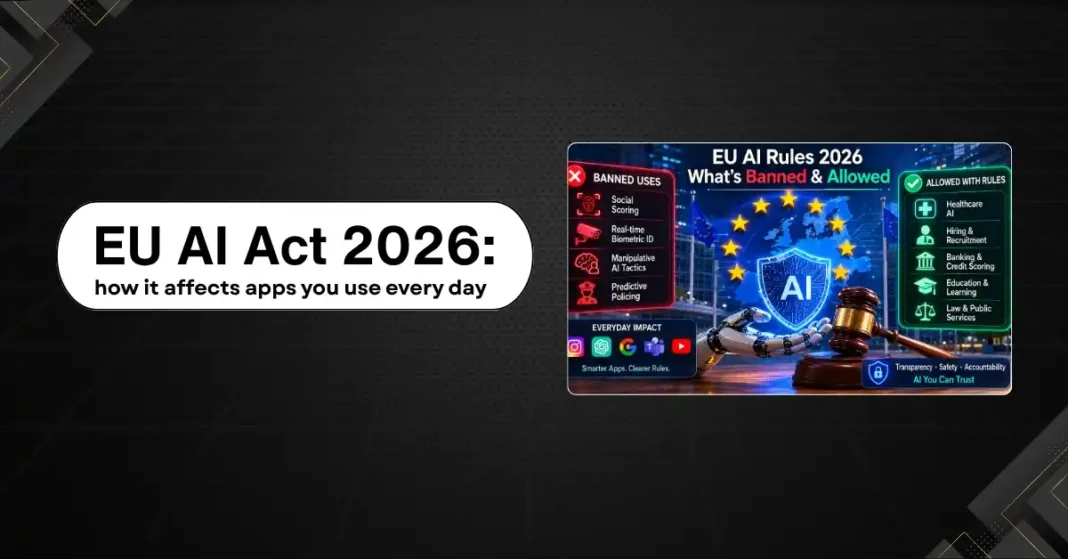
Eight specific uses of AI are banned outright in the EU. These include social scoring systems used by governments to assess citizens, real-time biometric identification in public spaces for general law enforcement purposes, AI that exploits the vulnerabilities of specific groups including children and people with disabilities, predictive policing based solely on profiling, untargeted scraping of facial images from the internet to build recognition databases, emotion recognition in workplaces and schools, biometric categorisation that infers race, political opinions, religion, or sexual orientation, and AI that uses subliminal techniques to manipulate behaviour beyond a person’s awareness.
Each of these bans has narrow exceptions. Law enforcement can use real-time biometric identification for serious crimes with judicial authorisation. Emotion recognition is allowed for medical and safety purposes. The bans are designed to prevent specific harmful uses, not to prevent the underlying technology from being developed.
Some of the bans have been controversial. The biometric identification rules in particular were watered down significantly from the original proposal, with several exceptions that critics argue undermine the protection. The final text reflects a political compromise between privacy advocates and law enforcement agencies.
What the AI Act Allows Under Conditions
High risk AI is allowed in the EU but only if it meets specific requirements. The list of high risk areas includes AI used in education to evaluate students, AI in employment to filter job candidates, AI in credit scoring and insurance, AI in critical infrastructure like power grids and water systems, AI in healthcare for diagnosis or treatment decisions, AI used by law enforcement and the judiciary, AI in migration and border control, AI in election administration, and AI in the operation of essential public services.
Companies deploying high risk AI must register their systems in an EU database, conduct conformity assessments before deployment, maintain detailed technical documentation, ensure human oversight of automated decisions, use high-quality training data, and continuously monitor system performance after deployment.
The compliance burden is significant. A small company deploying high risk AI faces costs that can run into hundreds of thousands of euros for conformity assessment alone, plus ongoing compliance costs. For large companies, the burden is more manageable, but the documentation requirements are extensive.
There are also rules for general-purpose AI models, which are the large foundation models like GPT, Gemini, and Claude. Providers of these models must publish summaries of their training data, comply with EU copyright law, and conduct evaluations for systemic risks if the model is large enough to potentially cause widespread harm.
Transparency Requirements for Limited Risk AI
Most consumer AI tools fall into the limited risk category, where the main obligation is transparency. The rules are simple: if you are interacting with an AI, you should be told. If you are seeing or hearing AI-generated content, it should be labelled.
For chatbots, this means a clear disclosure that the user is talking to an AI rather than a human. Most major chatbots already do this, so the practical impact is small.
For deepfakes and AI-generated media, the rules are stricter. AI-generated images, videos, and audio must be marked with machine-readable identifiers and labelled to users where appropriate. The exact technical implementation is being worked out, but the direction is clear: AI-generated content needs to be detectable.
For AI used in editing, summarisation, or content recommendations, the rules are lighter. Companies need to disclose when AI is being used, but they don’t need detailed labelling of every interaction. This covers most of the AI features in social media, productivity tools, and search engines.
Which Everyday Apps Are Affected
Social media apps like Instagram, TikTok, and YouTube use AI for content recommendations, creator tools, and ad targeting. Under the AI Act, these companies need to provide transparency about AI use, but the underlying recommendation algorithms are generally not considered high risk. The companies have updated their disclosures and content labelling to comply.
Productivity apps like Microsoft 365, Google Workspace, and Notion use AI for writing, summarisation, and task automation. These uses are generally low risk and require basic transparency rather than formal regulation. The companies have added AI feature labels and improved their privacy policies.
Hiring and recruitment platforms like LinkedIn, Indeed, and applicant tracking systems use AI to filter candidates, suggest matches, and generate job descriptions. These uses are high risk under the AI Act and require conformity assessment. Major platforms have invested significantly in compliance, but smaller players have struggled.
Banking and credit apps use AI for fraud detection, credit scoring, and loan decisions. Credit scoring and loan decisions are high risk uses requiring strict compliance. Fraud detection has more flexibility, but transparency to affected customers is still required.
Healthcare apps that use AI for diagnosis or treatment recommendations are high risk. Apps that use AI for general wellness, tracking, or information are generally low risk. The line between the two is sometimes blurry, and companies have been cautious about positioning their products to avoid triggering high risk requirements.
Smart home devices use AI for voice recognition, automation, and personalisation. Most of these uses are low risk, but voice recordings and biometric data are subject to additional protections under GDPR, which works alongside the AI Act.
Penalties and Enforcement
The AI Act has significant penalties. Companies that violate the prohibitions on banned AI uses face fines of up to 35 million euros or 7 percent of global annual turnover, whichever is higher. Companies that violate other requirements face fines of up to 15 million euros or 3 percent of global turnover. Companies that provide incorrect information to authorities face fines of up to 7.5 million euros or 1 percent of global turnover.
Enforcement is handled by national authorities in each EU member state, with coordination through the AI Office in Brussels. The system is similar to GDPR enforcement, which means it’s likely to be uneven across countries and to take time to mature. Major enforcement actions may not come until 2027 or 2028, after authorities have built up expertise and case law has developed.
The most important enforcement leverage is not the fines themselves but the requirement that high risk AI systems be registered and assessed before deployment. Companies that fail to comply face the prospect of being unable to operate in the EU market at all, which is a stronger deterrent than financial penalties.
Cross-border enforcement is going to be complicated. The Act applies to any AI system that is placed on the EU market or whose output is used in the EU, even if the developer is based elsewhere. This means US, Chinese, and Indian AI companies are all subject to EU rules if they have any European users.
How It Affects Businesses Outside Europe
If you run a business outside the EU and your products use AI, the AI Act probably affects you. Three scenarios cover most situations.
First, if you sell AI-powered products or services to EU customers, you need to comply with the Act regardless of where your company is based. This includes SaaS products, mobile apps, and AI APIs. Major AI providers have already adjusted their products and contracts to comply.
Second, if you use AI tools from EU-compliant vendors, you inherit some of the compliance protections automatically. Choosing vendors that have already adapted to the Act reduces your own compliance burden.
Third, if you provide services that include AI-generated content or AI-driven decisions to EU customers, you need to follow the transparency rules. This applies to marketing agencies, recruitment firms, financial services, and many other industries.
For Indian agencies and SMEs working with European clients, the practical advice is to understand which of your services involve high risk AI use cases and to ensure your vendors and processes can support EU compliance. The cost of compliance is real but manageable if planned for, and the alternative of losing EU clients is usually worse.
Criticism and Controversy
The AI Act has been criticised from multiple directions. AI industry groups argue that the Act creates compliance burdens that will slow innovation and disadvantage European companies relative to US and Chinese competitors. Several major AI labs have delayed releasing products in the EU because of regulatory uncertainty, including some Apple Intelligence features and certain Meta AI offerings.
Privacy advocates argue that the Act doesn’t go far enough, particularly on biometric identification and emotion recognition. The exceptions carved out for law enforcement are seen as too broad, and the protections for workplace AI as too weak.
Smaller businesses and startups have struggled with the compliance burden, even for AI uses that pose minimal risk. The Act includes provisions to support small and medium enterprises, including regulatory sandboxes and reduced fees, but the practical impact of these provisions varies by country.
Legal experts have noted that the Act overlaps significantly with GDPR, the Digital Services Act, and other EU regulations. Navigating the overlapping requirements is genuinely difficult, and even well-resourced companies struggle to be fully confident in their compliance.
Frequently Asked Questions
Does the EU AI Act apply to me if I’m not in Europe?
It applies if you sell AI-powered products or services to EU customers, or if your AI’s output is used in the EU. Many non-EU businesses are affected even if they’re not based in Europe.
Is ChatGPT banned in Europe under the AI Act?
No. ChatGPT and other general-purpose AI models are allowed but subject to transparency and documentation requirements. OpenAI has adjusted its product and policies to comply.
Can European companies still use AI for hiring?
Yes, but AI used for filtering job candidates is considered high risk and must meet specific requirements including human oversight, documented training data, and ongoing monitoring.
Are AI-generated images required to be labelled?
Yes. The Act requires AI-generated images, videos, and audio to be marked with machine-readable identifiers and labelled to users where appropriate. The technical implementation is still being finalised.
What’s the difference between the AI Act and GDPR?
GDPR covers personal data protection. The AI Act covers AI systems specifically. They overlap when AI uses personal data, in which case both sets of rules apply. The AI Act adds requirements on top of GDPR for AI-specific concerns.
How do I check if my business is compliant?
Start by mapping your AI uses against the risk categories in the Act. If you use AI in any high risk areas like hiring, credit, or healthcare, you likely need legal advice. For lower risk uses, transparency and basic documentation are usually sufficient. The European Commission has published guidance documents that can help, but specialist legal counsel is recommended for complex cases.
Final Thoughts
The EU AI Act is the most ambitious attempt yet to regulate AI, and 2026 is the year we find out how well it works. The framework is sensible in principle, with risk-based rules that focus regulatory attention on the AI uses most likely to cause harm. The implementation is going to be uneven, the compliance burden is real, and the enforcement will take years to mature.
For most people using everyday AI apps, the Act’s impact is subtle. You may see more disclosures, more labels on AI-generated content, and some features delayed in Europe while companies adjust. The basic experience of using social media, productivity tools, and consumer AI products remains largely unchanged.
For businesses, especially those operating in regulated industries, the Act is a significant change that requires investment. Companies that have adapted early are better positioned than those still figuring out their compliance approach. The cost of compliance is going up, but so is the cost of getting it wrong.
Beyond Europe, the Act is shaping global AI regulation. Countries from the UK to Brazil to India are watching how the EU approach plays out, and many are adopting similar risk-based frameworks. Whether the EU ends up setting the global standard for AI regulation or just one of several competing approaches will be clearer by the end of 2026.