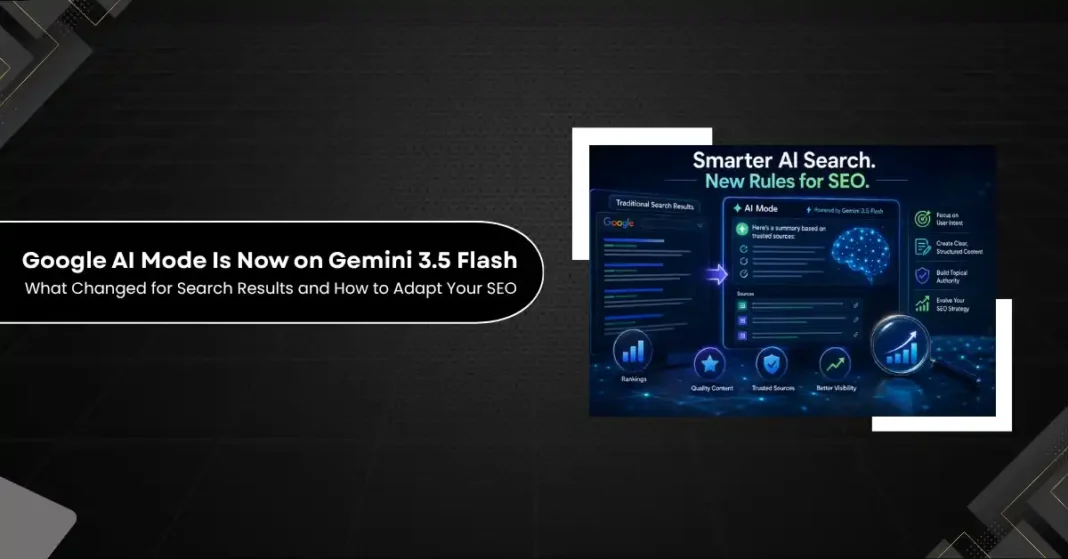
Google AI Mode, the conversational layer that sits on top of Google Search, got a major upgrade in May 2026. The model powering it has been switched from a custom Gemini variant to the new Gemini 3.5 Flash, which is faster, smarter, and built for the kind of multi-step reasoning that AI Mode requires. For users, this means better answers and faster responses. For anyone doing SEO, it means another round of strategy changes.
AI Mode is now showing up on a growing share of Google searches in the US, India, the UK, and other markets. The trigger is not just informational queries but also commercial and product-related searches. If you’re an SEO, content marketer, or business owner who relies on organic traffic, ignoring AI Mode is no longer a viable strategy.
Here’s what changed when Gemini 3.5 Flash took over, how AI Mode now selects and presents information, why traditional SEO tactics work differently inside AI Mode, and the concrete adjustments you need to make to your content strategy in 2026.
What Changed With Gemini 3.5 Flash
The biggest change is speed. Gemini 3.5 Flash is around four times faster than the model it replaced, which means AI Mode now responds in roughly the time it takes to render a traditional search results page. This matters because slow AI experiences feel worse than fast traditional results, and Google needed AI Mode to feel as snappy as classic search.
The second change is context window. Gemini 3.5 Flash supports a 1 million token context window, which means AI Mode can pull from more sources, hold more information in working memory, and produce answers that synthesise across many pages rather than summarising one or two.
The third change is reasoning ability. Gemini 3.5 Flash performs significantly better on agentic and multi-step tasks. Inside AI Mode, this shows up as answers that handle complex queries with multiple parts, follow-up suggestions that actually relate to what you just asked, and a willingness to chain together information from different sources in ways the previous model couldn’t.
The fourth change is citation quality. AI Mode now produces more granular citations, pointing to specific paragraphs or claims rather than just linking to a source URL. This is technically more demanding for the model but easier for users to verify.
How AI Mode Now Selects Sources
AI Mode does not work like classic Google Search. It does not rank pages and present them in order. Instead, it identifies sources that contain information relevant to the query, extracts the relevant pieces, and synthesises an answer. The sources cited in the answer are the ones the model judged most useful, which is different from the ones with the highest ranking on traditional Google.
The selection process favours sources that are factually dense, well-structured, and easy to extract specific claims from. Long, well-organised pages with clear headings, lists, and tables tend to perform better than meandering articles, even if the meandering article has stronger traditional SEO signals.
Domain authority still matters, but in a different way. AI Mode is more likely to trust sources that have a track record of accuracy in the topic area, that are referenced by other reliable sources, and that have clear authorship and editorial standards. Wikipedia, Reuters, major newspapers, government sites, and well-established trade publications dominate citations across many query categories.
Recency also plays a role. For queries where current information matters, including news, prices, schedules, and recent events, AI Mode strongly prefers fresh sources. Older articles, even from high-authority domains, are demoted in favour of newer coverage.
What This Means for Click-Through Rates
The most visible effect of AI Mode for SEOs is the drop in click-through rates. When AI Mode answers a question directly, fewer users click through to source pages. This effect is most pronounced for informational queries, where users get the answer they need without leaving Google.
Industry data suggests CTR drops of 18 to 30 percent on queries where AI Mode produces a complete answer. The drops are smaller on queries where users need to compare, decide, or take an action, since those queries still drive visits to source sites.
The flip side is that traffic that does click through tends to be higher intent. Users who click after seeing an AI Mode answer are more likely to engage deeply, convert, or share, because they are looking for something the AI summary couldn’t give them directly.
Long-term, the structure of organic traffic is shifting. Informational queries drive less traffic than they used to. Commercial queries, product comparisons, and transactional searches still drive significant traffic. Content strategies built primarily around top-of-funnel informational content are losing value faster than those focused on the middle and bottom of the funnel.
What Still Drives Citations in AI Mode
Getting cited in AI Mode is the new equivalent of ranking on the first page of search results. The mechanics are different from traditional SEO but not entirely unrelated.
Clear, factual content with specific claims and supporting evidence performs well. The model needs something concrete to extract, so vague generalisations and opinion pieces get cited less than data-driven explainers. If you can include statistics, dates, specific examples, and named experts, your content becomes more citation-friendly.
Structured formatting matters more than it did for traditional SEO. Heading hierarchy that clearly maps to questions, lists that contain discrete facts, tables that compare options, and concise paragraphs that each cover one idea are all easier for the model to parse and pull from.
Topical authority is still a strong signal. Sites that cover a topic comprehensively, with depth across multiple related questions and consistent updating over time, tend to get cited more than sites with thin coverage. The pattern that worked for Google’s E-E-A-T framework still works in AI Mode.
Original research, expert commentary, and unique data are highly cited because the model values information that can’t be found in many other places. If you can produce content that nobody else has, your citation rate goes up significantly.
Brand mentions across the web also matter. AI Mode increasingly correlates source credibility with off-site signals, including media coverage, references in other authoritative content, and presence in industry conversations. This is closer to how Google has handled link signals for years, but the weighting is different.
Tactical Changes to Make in 2026
Adjust your keyword strategy. Pure informational keywords are losing search volume to AI Mode. Shift focus to keywords that imply action, comparison, or decision making. Words like ‘best’, ‘vs’, ‘review’, ‘how to choose’, and ‘pricing’ continue to drive clicks because the AI summary doesn’t fully replace those needs.
Restructure your content for extraction. Lead with the direct answer to the question your article addresses. Use clear subheadings that mirror the questions people ask. Add summary boxes or TL;DR sections at the top. Use bullet points for lists, tables for comparisons, and short paragraphs that each contain one extractable idea.
Invest in primary research. Surveys, original data, case studies, and proprietary benchmarks are gold for AI Mode citations. Even small original datasets can outperform much larger pieces of regurgitated content because the model recognises uniqueness.
Build topical depth. Cover related questions in a single content cluster, with internal linking that helps both users and the model understand the relationships. Single deep guides perform better than networks of thin pages.
Update content frequently. Stale information gets demoted in AI Mode citations, especially for time-sensitive topics. Set up a process to refresh key articles every six to twelve months, with clear last-updated dates in the content itself.
Track AI Mode citations directly. Several tools have launched in 2026 that monitor whether your content is being cited in AI Mode answers across major queries in your space. Use them to measure what’s working and what isn’t, since traditional rank tracking misses this layer entirely.
Technical SEO for AI Mode
Schema markup matters more in AI Mode than in classic search. Article, FAQ, HowTo, Product, and Review schemas all help the model understand what your content is about and extract structured facts. Sites with comprehensive schema implementation get cited more often than those without.
Crawlability and indexing are still foundational. AI Mode pulls from Google’s index, so if your pages aren’t indexed properly, they can’t be cited. Standard SEO hygiene including XML sitemaps, robots.txt configuration, canonical tags, and crawl budget management still applies.
Page speed has a slightly different weight. AI Mode pulls content faster than users can click, so traditional Core Web Vitals matter less for AI Mode citations than they do for user-facing rankings. That said, slow pages tend to correlate with other quality issues, so it’s not worth ignoring speed entirely.
Mobile-first indexing continues to apply. Most AI Mode queries come from mobile users, and the underlying index is mobile-first. Your mobile experience needs to be at least as complete as your desktop one.
Structured data for entities and authors is increasingly important. AI Mode tries to attribute information to credible sources, and clear entity markup helps the model understand who wrote what and on what authority. Author bios, organisation pages, and consistent entity data across platforms all support this.
What to Stop Doing
Stop publishing thin content optimised for individual keywords. AI Mode treats clusters of related queries as one and pulls from a single comprehensive source rather than fragmenting across many shallow pages.
Stop building content primarily around keyword density. The model evaluates semantic relevance and factual depth, not keyword frequency. Stuffing keywords or following outdated TF-IDF tactics actively hurts citation chances by making content read as low quality.
Stop chasing every trend without depth. AI Mode favours sources with sustained topical coverage. Articles published once on a hot topic, then never updated, perform worse than fewer pieces that get continuous improvement.
Stop ignoring entity-level optimisation. Brand mentions, author authority, and entity relationships are now central. If you’re not building these signals, you’re handing citation share to competitors who are.
Stop assuming AI Overviews and AI Mode follow the same rules as classic search. They overlap but reward different things, and content that ranks well in classic search can fail to get citations in AI Mode if it’s not structured for extraction.
Frequently Asked Questions
Does AI Mode replace traditional Google Search results?
Not entirely. AI Mode appears as a layer on top of search results for many queries, but classic search results are still shown below or alongside the AI summary. Users can choose which to engage with.
How can I see if my site is being cited in AI Mode?
Several tools launched in 2026 track AI Mode citations across major queries. You can also check manually by searching your target queries with AI Mode enabled and looking at the cited sources. Google Search Console has begun adding AI Mode impression and click data for some accounts.
Will AI Mode hurt my organic traffic permanently?
Informational query traffic is likely to decline structurally. Commercial and transactional traffic should hold up better or even grow as users become more confident in their decisions before clicking. Total traffic patterns are shifting, but smart content strategies can compensate.
Should I optimise for AI Mode or classic search?
Both, but with overlap. The fundamentals of good content, clear structure, factual depth, and topical authority, work for both. Specific tactics like clear extraction-friendly formatting and entity markup help more with AI Mode. Keyword optimisation and link building help more with classic search.
Is link building still relevant?
Yes, but quality matters more than quantity. AI Mode evaluates source credibility partly through link patterns, but it pays much more attention to which authoritative sites reference you than to total link count. A few mentions from trusted sources outweigh many low-quality links.
How long does it take for new content to appear in AI Mode?
Indexing lag varies. Once Google has indexed and processed a page, it can appear in AI Mode citations within days for fast-moving topics. For evergreen topics, citation gains often take weeks or months as the model builds confidence in the source.
Final Thoughts
Google AI Mode running on Gemini 3.5 Flash is the most significant change to organic search behaviour in the last decade. The traditional SEO playbook still works in part, but the new layer on top demands different content design, different success metrics, and different expectations about how traffic flows.
The good news is that the principles of good content have not changed. Useful, accurate, well-structured, frequently-updated content from credible sources continues to win, whether the rules being applied are classic search ranking or AI Mode citation selection. The investment in quality compounds across both systems.
The bad news is that thin content, keyword-stuffed pages, and shallow coverage are losing relevance faster than ever. Sites that built their organic traffic on volume of mediocre pages are watching their numbers decline. Sites that invested in depth, originality, and editorial standards are gaining ground.
If you do SEO in 2026, the practical advice is straightforward. Audit your content for AI Mode-friendly structure. Invest in original research and expert content. Build topical authority instead of chasing individual keywords. Update what you have. Track citations as well as rankings. And accept that organic traffic patterns are changing in ways that won’t reverse, even as the specific tactics for navigating them keep evolving.