Key Takeaways
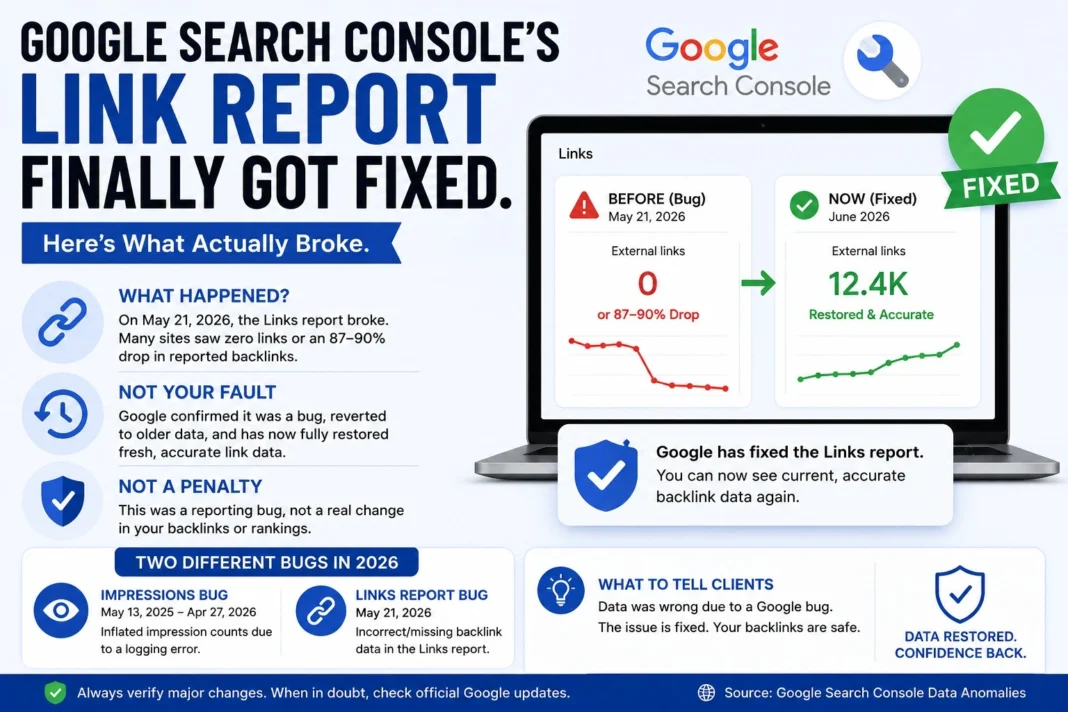
- Google Search Console’s Links report broke on May 21, 2026, with many sites seeing zero backlinks or a sudden 87 to 90 percent drop in reported links.
- Google confirmed it as a bug and temporarily reverted the report to older data while a permanent fix was developed.
- The Links report has now been restored and is showing fresh, accurate data again.
- This is separate from a different, longer-running Search Console bug that inflated impression counts from May 2025 through April 2026.
- Neither bug reflects an actual ranking penalty or real change in backlink profiles; both were reporting layer issues.
If you checked your Google Search Console Links report on the morning of May 21, 2026, and felt your stomach drop, you weren’t alone. Hundreds of SEOs woke up to either zero external links showing up entirely, or a collapse of 87 to 90 percent in their reported backlink count, seemingly overnight. The good news, both for your sanity and for any client emails you needed to send that week, is that this was confirmed as a Google bug, not a sign your site got penalized or your backlinks got devalued.
What Happened to the Links Report
On May 21, 2026, the Links report inside Google Search Console started showing wildly inaccurate numbers. For some sites, the external links count dropped to zero. For others, it fell by nearly 90 percent compared to what had been showing just days before. Google confirmed the issue and, as an interim measure, reverted the report to show an earlier, pre-bug snapshot of the data rather than the broken live numbers.
That temporary fix worked, in the sense that it stopped the alarming zero-link displays, but it also meant the report wasn’t actually current for several weeks. Anyone checking new backlinks acquired during that window simply wouldn’t see them reflected. The report was technically working again, just not with fresh data.
Google has now finished the proper fix. The Links report is back to displaying current, accurate link data rather than the reverted snapshot, closing out a multi-week stretch where one of the more commonly checked reports in Search Console simply couldn’t be trusted at face value.
This Is Not the Same as the Impressions Bug
If you’ve been following Search Console news through the first half of 2026, it’s worth being precise here, because there were two separate bugs, and conflating them in a client report makes you look like you don’t know the details.
The first issue was a logging error that caused Search Console to over-report impressions starting May 13, 2025, and running until it was resolved around April 27, 2026, nearly a year. Google’s own Data Anomalies page described it plainly: a logging error prevented Search Console from accurately reporting impressions, and clicks were not affected, only the impressions metric. That bug was first spotted by the SEO community, notably Australian consultant Brodie Clark, who flagged anomalous impression spikes in late March 2026, days before Google’s own confirmation.
The Links report issue is a different bug entirely, happening a month later, affecting a completely different report, and tied to backlink counts rather than impression volume. Both got fixed within a few months of each other in 2026, which is part of why it’s easy to mix them up if you’re catching up on the news after the fact.
Why This Matters Beyond the Inconvenience
Every time a Google reporting tool misfires, it exposes something a lot of SEO work quietly depends on: decision-making built on data that is sampled, lagged, and sometimes just wrong for a stretch of time. The Links report in particular has always functioned more as a directional signal than a precise, complete database of every link pointing at your site. Most experienced practitioners already treat it that way. Clients, stakeholders, and junior team members often don’t, and that gap is exactly where a bug like this turns into a stressful week of explaining that nothing is actually wrong with the site.
There’s also a quieter pattern worth noting. Google has been using Search Console increasingly as a primary communication channel, including sending direct warning notices about things like back-button hijacking earlier in 2026. That makes a broken reporting tool inside the same platform doubly frustrating, because GSC is often the first and sometimes only place Google tells site owners something needs attention.
What to Tell Clients or Stakeholders
If you’re explaining either of these bugs to someone who isn’t deep in SEO, keep the message short and factual, and lean on Google’s own documentation rather than your own interpretation.
For the Links report issue specifically: Google’s Links report broke in late May 2026, showing missing or sharply reduced backlink counts. Google confirmed it as a bug, temporarily reverted to older data, and has since restored the report to current, accurate numbers. Nothing about your actual backlink profile changed; this was a display and logging issue inside Search Console, not a real loss of links or a penalty.
If the impressions bug also comes up: Google had a separate logging error from May 2025 to April 2026 that inflated impression counts. Clicks were not affected, so the real traffic-driving metric remained valid throughout. Once the fix rolled out, some dashboards showed an apparent impressions drop that was actually just a correction, not a performance decline.
Linking to Google’s own Data Anomalies page when you explain either issue adds credibility. It signals this is documented by the source itself, not an excuse from the agency or marketer.
Common Mistakes to Avoid
- Panicking and assuming a links drop means a penalty. Check Google’s Search Status Dashboard and Data Anomalies page before assuming the worst; bugs like this happen periodically and rarely indicate an actual site issue.
- Conflating the Links report bug with the impressions bug. They’re separate issues affecting different reports at different times; mixing them up in client communication undermines your credibility.
- Building reporting decisions on a single Search Console chart. If your whole story rests on one metric from one source, you’re one bug away from a flawed analysis.
- Forgetting that historical inflated data stays inflated. Even after a bug is fixed going forward, the older, incorrect data typically remains in historical records unless Google explicitly backfills it.
- Not cross-checking suspicious numbers with a second source. Tools like Bing Webmaster Tools or third-party crawlers can offer a sanity check when a Google report looks off.
Expert Tips
Build a habit of checking Google’s Search Status Dashboard and Data Anomalies page whenever a metric looks unusually off, before assuming anything about your site changed. Both pages are publicly available and get updated faster than most third-party coverage.
For agencies running monthly reports, consider adding a short standing note about known Search Console data anomalies in any month where Google has publicly acknowledged an issue. It takes one sentence and saves you from fielding a worried email a week later.
What’s Next
Bugs like these are a reminder that SEO reporting in 2026 benefits from more than one data lens. Relying entirely on Search Console for either link or impression data leaves you exposed every time Google’s own logging hiccups. Pairing GSC with a secondary crawler or backlink index, and checking in periodically on Google’s own status pages, is a fairly low-effort way to avoid getting blindsided the next time something breaks.
Given how often Google has had to issue corrections on Search Console data this year, between the year-long impressions bug and this Links report failure, it would not be surprising to see Google invest more visibly in reporting infrastructure stability going forward, though nothing has been officially announced on that front.
Conclusion
Google Search Console’s Links report broke on May 21, 2026, showing missing or sharply reduced backlink counts for many sites. Google confirmed the bug, temporarily reverted to older data, and has now restored the report with accurate, current numbers. This was a separate issue from the longer-running impressions bug that ran from May 2025 to April 2026. Neither reflects a real change in your site’s backlinks or rankings; both were reporting and logging errors inside Search Console itself. The bigger lesson is a familiar one: treat any single Google reporting tool as one input among several, not the whole story.
FAQ
Why did my Google Search Console Links report show zero backlinks?
Google confirmed a bug starting May 21, 2026, that caused the Links report to show zero or sharply reduced backlink counts for many sites. It has since been fixed.
Does a drop in the Links report mean my backlinks were removed?
No. This was confirmed as a Google bug affecting the reporting layer, not an actual change to your site’s backlink profile.
Is the Links report fixed now?
Yes. Google has restored the report to show fresh, accurate link data after a multi-week period of temporarily reverted, older data.
Is this the same as the Search Console impressions bug?
No. The impressions bug ran from May 2025 to April 2026 and affected impression counts specifically. The Links report bug happened separately, starting in late May 2026, and affected backlink counts.
Did the impressions bug affect my actual traffic?
No. Google confirmed that clicks were not affected by the impressions bug, only the impressions metric itself.
How do I check if a Search Console issue is a known bug?
Check Google’s Search Status Dashboard and the Data Anomalies page within Search Console Help, which Google updates when it confirms reporting issues.
Should I tell clients about these bugs in my reports?
Yes, briefly and factually, especially if the timing overlaps with your reporting period. Linking to Google’s own documentation adds credibility to the explanation.
How can I verify my backlinks if I don’t trust Search Console temporarily?
Cross-check with a secondary source like Bing Webmaster Tools or a third-party backlink index to confirm whether your link profile looks consistent.
Did Google explain why the Links report broke?
Google confirmed the bug publicly but, similar to the impressions issue, did not release a detailed technical explanation of the root cause.
Will old, incorrect data from these bugs be corrected retroactively?
Typically no. Fixes usually apply going forward, while historical data affected by the bug tends to remain as originally logged.