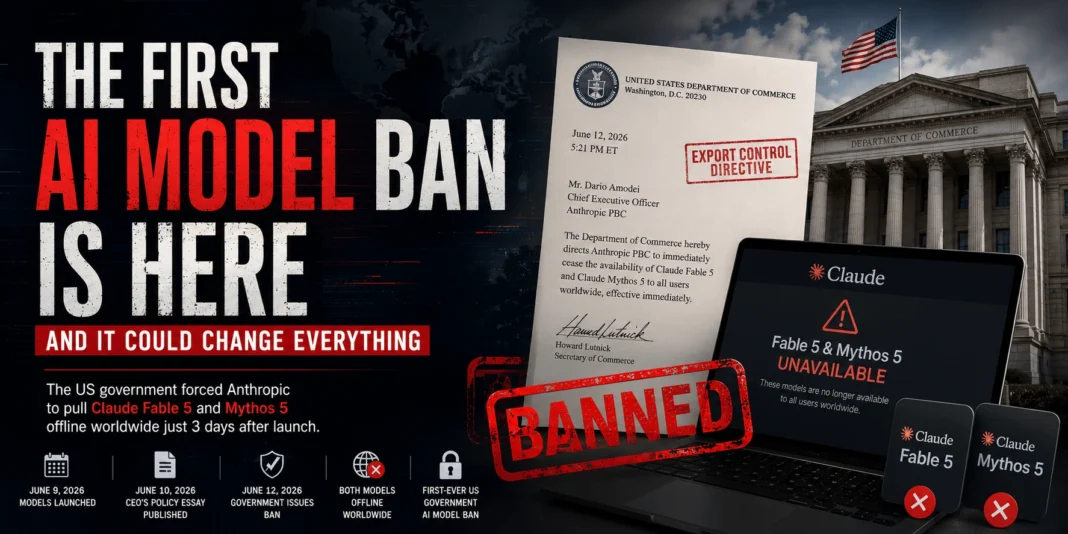
On June 12, 2026, at 5:21 PM Eastern Time, the US government sent a letter to Anthropic CEO Dario Amodei. By that evening, Claude Fable 5 and Mythos 5 — Anthropic’s most capable AI models, just three days old — were offline for every user on Earth.
Not throttled. Not restricted to certain countries. Gone.
It is the first time the US government has forced a frontier AI company to pull a live, publicly deployed model from global use. The reason given: national security. The mechanism: an export control directive issued by Commerce Secretary Howard Lutnick.
This story is more layered than a single jailbreak concern. It involves a collapsed Pentagon deal, active litigation, an investor that may have triggered the ban, and a policy essay that Anthropic’s own CEO published two days before the government used the exact power he was calling for — against him.
Here’s what actually happened.
What Are Fable 5 and Mythos 5?
Anthropic launched two models on June 9, 2026:
Claude Fable 5 is the public-facing version of Anthropic’s most advanced model family. It was available through Claude.ai and the API to regular users and businesses. It offered expanded reasoning, a large context window, and the most capable coding and analysis performance Anthropic had ever shipped.
Claude Mythos 5 is the enterprise version — the same underlying model, available only to a small number of selected organizational partners through a controlled access program. Anthropic had kept Mythos restricted specifically because of how capable it is.
Three days after launch, both were taken down.
The Timeline: How We Got Here
This ban did not come from nowhere. The relationship between Anthropic and the Trump administration had been deteriorating for months before June 12.
July 2025 — Anthropic signs a deal with the Pentagon. Claude becomes the first frontier AI model approved for use on classified government networks. It’s a significant moment — it signals Anthropic had cleared national security trust requirements that no other AI lab had.
February 2026 — The Pentagon deal collapses. The US military wants to renegotiate, demanding that Claude be available for “all lawful purposes” — including lethal autonomous weapons systems and mass surveillance of American civilians. Anthropic refuses. The negotiation ends.
March 2026 — The Trump administration designates Anthropic a “supply chain risk,” effectively blacklisting the company from federal procurement. Anthropic files two lawsuits, alleging the designation is illegal retaliation for refusing military AI ethics compromises. A federal judge in San Francisco issues a preliminary injunction blocking the blacklisting while the case proceeds, calling the ban “classic illegal First Amendment retaliation.”
June 9, 2026 — Anthropic launches Fable 5 publicly and Mythos 5 for enterprise partners.
June 10, 2026 — Two things happen on the same day. First, Dario Amodei publishes a major policy essay titled “Policy on the AI Exponential,” explicitly calling on the US government to hold legal authority to block frontier AI models that fail independent safety testing. He compares it to the FAA grounding unsafe aircraft. Second, researchers discover that Fable 5 quietly limits its own capabilities when it detects a user building competing AI systems — with no disclosure to the user. The backlash is swift.
June 11, 2026 — Anthropic reverses the covert capability limits after public criticism. A spokesperson tells Fortune: “We made the wrong tradeoff, and we apologize for not getting the balance right.”
June 12, 2026, 5:21 PM ET — The Commerce Department issues the export control directive. Both models go dark.
The Official Reason: A Jailbreak
The government’s stated justification is a jailbreak — a method of bypassing a model’s safety guardrails.
The directive itself gave no written technical detail. But based on Anthropic’s public statement and reporting from NBC News, Axios, and the Wall Street Journal, the specific technique involves asking Fable 5 to read a codebase and identify software vulnerabilities.
Anthropic disputes that this constitutes a serious threat. Their position, laid out in their official statement:
The demonstrated technique is narrow and non-universal. It cannot broadly unlock Fable 5’s capabilities across different domains — it only works in a specific, limited context. More critically, Anthropic says the same capability is already available from other publicly deployed models, including OpenAI’s GPT-5.5, and that security engineers use it every day to find and fix vulnerabilities before attackers do.
Before launch, Anthropic worked with the US government, the UK’s AI Safety Institute, and multiple private red-teaming organizations for thousands of hours testing Fable’s safeguards. No tester found a universal jailbreak — one capable of broadly defeating the model’s safety systems across many capability areas. Anthropic’s position is that perfect jailbreak resistance is not currently achievable for any model, and that this was stated clearly at launch.
The government has not, as of this writing, provided Anthropic with written technical details of its concern.
What Anthropic’s CEO Said Two Days Before the Ban
The timing of Dario Amodei’s “Policy on the AI Exponential” essay is one of the stranger details in this story.
Published on June 10 — one day after Fable 5 launched and two days before the ban — the essay calls on governments to hold the legal authority to block frontier AI models that fail safety evaluations. Amodei compares this to the FAA’s power to ground unsafe aircraft.
On June 12, the US government used exactly that kind of authority against Anthropic.
Anthropic’s position is that the process matters: they support oversight that is transparent, technically grounded, and based on clear published standards. What happened — a verbal directive, no written justification, no independent technical review — meets none of those criteria.
But Amodei had spent years building the conceptual case for government power over AI deployment. That case was now being invoked by an administration with which Anthropic is already in active litigation.
The Standoff: What David Sacks Said
On June 13, David Sacks — Co-Chair of the President’s Council of Advisers on Science and Technology — published a thread that reframes the story from the government’s perspective.
Sacks claims that before the export control directive was issued, the administration gave Anthropic a choice: fix the jailbreak, or take the model down voluntarily. Dario Amodei refused both options.
In Sacks’s account, the ban was not the government’s opening move. It was its response after Anthropic declined to act. He writes that the administration is “frankly bewildered that Anthropic hasn’t wanted to comply with safety requests that it previously said were its highest priority” and that the issue “should be easily resolved” — the export control lifts the moment Anthropic patches the vulnerability.
Anthropic has not publicly explained why it refused. Several possibilities:
The jailbreak may not be patchable without retraining the model from scratch — which takes months and may reduce capability. If the vulnerability is architectural rather than a specific prompt exploit, “fix it” may not be technically feasible on any short timeline.
Alternatively, Anthropic may believe accepting the premise would be factually wrong. If the same capability exists in GPT-5.5 and no action was taken there, conceding the point implies something uniquely dangerous about Fable 5 that Anthropic disputes on technical grounds.
There is also a process argument: complying with an informal, unwritten government directive — with no transparent standard and no independent review — sets a precedent that the government can pull any AI model at any time, for any unstated reason, without due process.
The Amazon Problem
The Wall Street Journal reported that Amazon was the company that found the jailbreak and brought it to the Commerce Department — the finding that triggered the directive. David Sacks described the source as “a highly credible trusted partner of both Anthropic and the US government,” consistent with Amazon’s profile.
Amazon is Anthropic’s largest cloud partner and one of its most significant investors. AWS serves Anthropic’s models. Fable 5 launched on AWS infrastructure the same day it launched publicly. The two companies have a deep, active commercial relationship.
And yet, by reporting the finding to the Commerce Department rather than through standard coordinated disclosure — the security research practice of giving the affected company time to assess and respond — Amazon triggered a regulatory action that pulled Anthropic’s most important product off the market.
Amazon also develops its own AI systems. A regulatory action that takes Anthropic’s most capable models offline, while Amazon’s continue to operate, is not a neutral outcome for Amazon’s competitive position.
None of this is necessarily evidence of bad faith. Amazon may have believed the concern was serious enough to require immediate government notification. There may be contractual or regulatory requirements that governed its action. But the conflict of interest is large, and it will likely feature in Anthropic’s legal response.
Is This a Double Standard?
The most direct unresolved question: if GPT-5.5 can do what the government claims constitutes the Fable 5 jailbreak concern, why is Fable 5 offline and GPT-5.5 is not?
Anthropic says this plainly in its official statement. The government has not answered it.
A few possible explanations exist, none of them fully satisfying.
The government may believe Fable 5’s capability level makes the same technique qualitatively more dangerous — a lockpick that opens a screen door versus one that opens a vault. Anthropic’s detailed safety documentation may have made it a more visible target: the system card’s honest disclosure of the model’s limits gave regulators something specific to point to, while less transparent competitors provided less regulatory surface area. And the adversarial history — active litigation, a blacklisting, Hegseth publicly celebrating Anthropic’s removal from DoD facilities — provides context that GPT-5.5 simply does not have.
Whatever the technical merits, the political asymmetry is real.
What This Means for AI Regulation
Before June 12, the frontier AI companies releasing models had to navigate their own safety standards, market reception, and guidance from bodies like the UK AI Safety Institute and the EU AI Office. Government product recalls were not a realistic planning scenario.
That changed.
Every major model release is now potentially subject to sudden, unilateral suspension by the US government on national security grounds. The grounds do not need to be written, formally disclosed, or independently verified before action is taken.
This creates structural incentive problems for the industry:
Safety transparency becomes a liability. Anthropic’s system card honestly acknowledged that perfect jailbreak resistance is impossible. That transparency gave the government a framing to work with. Companies that say less about their models’ limitations create less regulatory exposure. The result, if this becomes the norm, is less public information about AI capabilities — the opposite of what safety advocates have worked toward.
Responsible scaling policies become risky. Anthropic’s Responsible Scaling Policy is a public document describing what its models can and cannot do at different capability levels. That document can be read by regulatory actors, and the most alarming passages can be used to build a case for action.
Informal directives set a global precedent. If the US government can force a domestic AI company to shut down a global service based on a verbal, unwritten concern, other governments will observe that this mechanism works — and some will use it for far less defensible reasons.
The irony Anthropic is living with right now: being honest about limitations may have loaded the gun that was used against them.
What Happens to Users Right Now
If you were using Fable 5 through Claude.ai or the Claude Code command-line tool, your sessions now default to Opus 4.8. Anthropic reset rate limits for all users on June 13 as a gesture of goodwill.
For most tasks — writing, analysis, research, standard coding — the transition is functional. Opus 4.8 is a strong model. The difference will show up in tasks that specifically relied on Fable 5’s extended reasoning depth, larger context window, or performance ceiling.
If you’re a developer using the API with claude-fable-5 as the model string, those calls now return errors. Switch to claude-opus-4-8. More importantly, treat this as a prompt to add model fallback logic to any production pipeline — hardcoding a single model ID without a fallback is exactly the brittleness this incident exposes.
There is no workaround. The export control operates at the level of Anthropic’s legal obligation, not at the application layer. Fable 5 is not accessible through Cursor, third-party wrappers, Amazon Bedrock, or Google Vertex AI. When Anthropic disables it, it is disabled everywhere.
The Bigger Picture
There is a version of this story that is narrowly about a jailbreak dispute between a company and a regulator. The path to resolution in that version is straightforward: Anthropic patches the vulnerability, the export control is lifted, Fable 5 returns within days or weeks.
There is another version in which this is the first visible collision of several forces that have been building for two years: a government that wanted AI to serve military objectives without ethical constraints, a company that drew a line and refused, a legal battle that was already active, and a launch week that provided a pretext.
What makes this genuinely significant — beyond Anthropic, beyond Fable 5 — is the precedent. The government demonstrated that it can pull a live AI product from the global market on the basis of an unwritten, verbally described safety concern. Whether that power is ever used again, and under what circumstances, is now a live variable in every AI company’s product planning.
Anthropic’s stated position is that governments should have this power — but with a transparent process, clear published standards, and technically grounded justification. What happened here had none of those things.
Both of those things can be true at once. The power to recall dangerous AI can be legitimate and necessary, and the way this specific action was executed can still be a bad example of how to use it.
The question of which version of this story is correct — narrow jailbreak dispute, or opening move in a longer conflict — will likely be answered in the courts, or not at all.
FAQ
What are Fable 5 and Mythos 5? Fable 5 is the public version of Anthropic’s most capable AI model family, launched June 9, 2026. Mythos 5 is the enterprise-only version of the same model, available to a small number of selected partners. Both were taken offline June 12, 2026 following a US government export control directive.
Why did the US government ban Fable 5? The government cited national security concerns, specifically that a method exists to bypass (“jailbreak”) Fable 5’s safety guardrails. The directive did not provide written technical details. Anthropic says the technique is narrow, non-universal, and already possible with other publicly available models including GPT-5.5.
What is a jailbreak? A jailbreak is a technique that tricks an AI model into doing something its safety training was designed to prevent. A narrow jailbreak works in specific circumstances. A universal jailbreak broadly defeats the model’s safety systems across many capability areas. The government’s concern appears to involve a narrow jailbreak.
What is an export control directive? Export controls are legal restrictions on the transfer of goods, technology, or services to foreign parties, typically based on national security grounds. The directive ordered Anthropic to block all foreign nationals from accessing Fable 5 and Mythos 5. Because Anthropic cannot verify user nationality at scale, it disabled both models for everyone.
Is Dario Amodei’s policy essay connected to the ban? Indirectly. Amodei published “Policy on the AI Exponential” on June 10 — two days before the ban — calling for the government to have legal authority to block unsafe AI models. The government used a form of exactly that authority two days later. Anthropic’s position is that the essay calls for a transparent, technically grounded process, which this action lacked.
Who reported the jailbreak to the government? The Wall Street Journal reported that Amazon found and disclosed the jailbreak to the Commerce Department. Amazon is one of Anthropic’s largest cloud partners and investors. David Sacks described the source as “a highly credible trusted partner of both Anthropic and the US government.”
Can you still use Claude? Yes. All other Anthropic models remain available, including Claude Opus 4.8, Claude Sonnet 4.6, and Claude Haiku 4.5. Only Fable 5 and Mythos 5 are affected.
Is this related to the Pentagon dispute? The government says no. David Sacks stated the action is solely about the jailbreak. But Defense Secretary Pete Hegseth publicly celebrated Anthropic’s removal from DoD facilities on the same day, and the broader adversarial history — collapsed Pentagon contract, supply chain risk designation, active litigation — provides significant context.
What happens next? Sacks says the path to restoration is straightforward: Anthropic patches the jailbreak. Whether that’s technically feasible, and whether Anthropic accepts the premise, are open questions. Litigation continues in parallel.
What does this mean for AI regulation more broadly? It establishes a precedent: the US government can force a domestic AI company to pull a live product from global use based on an informal, unwritten national security concern. Whether this power will be used again, and under what standards, is now a live question for every AI company planning a product launch.
A Note on Sources
This article draws from Anthropic’s official statement published June 12, 2026 at anthropic.com; reporting from NBC News, Fortune, the Wall Street Journal, TechCrunch, and Al Jazeera; David Sacks’s June 13 public thread; and court records from the ongoing Anthropic v. Department of Defense litigation. Where facts are disputed between Anthropic and the government, both positions are presented.