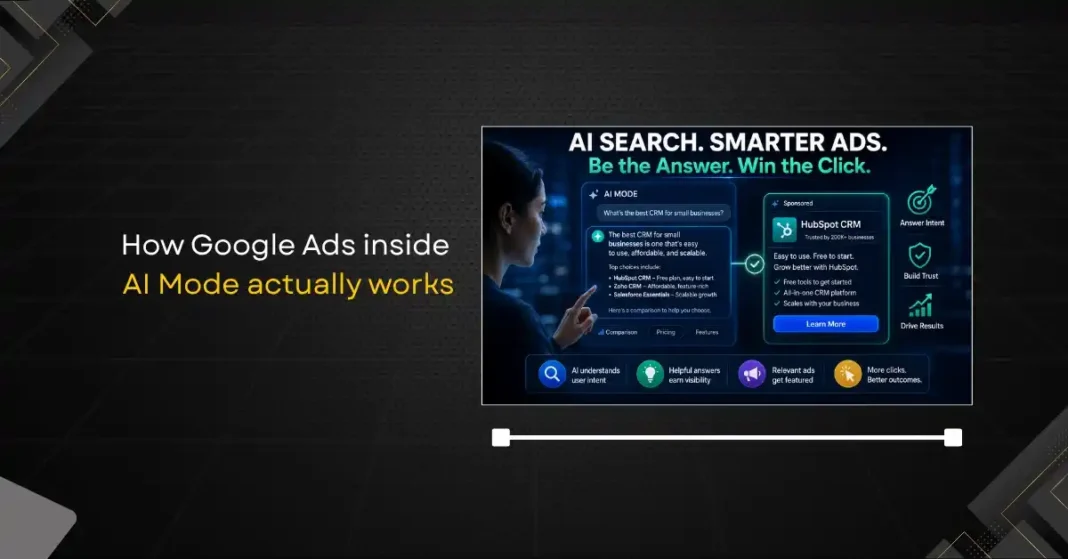
Google has spent years telling advertisers that the format of an ad doesn’t matter as much as the relevance. AI Mode is the version of that argument with teeth. Inside AI Mode, ads no longer look like ads in the traditional sense. They appear as part of a conversational answer, suggested by the AI as relevant options for the buyer’s question. The new rule, repeated across Google Marketing Live 2026 and the company’s advertiser blogs, is that the best ads in AI Mode are answers themselves.
For Google Ads veterans, this is the biggest format change since responsive search ads replaced expanded text ads. The bidding mechanics, the creative requirements, the measurement framework, and even the basic mental model of what an ad is have all shifted. Advertisers who still think in terms of headlines, descriptions, and quality score are working with an outdated playbook.
Here’s how ads actually work inside AI Mode in 2026, what changes for campaign structure and creative, how performance is measured, and how to adapt your Google Ads strategy without throwing away what already works.
How AI Mode Ads Are Different
In classic Google Search, an ad is a clearly demarcated block at the top or bottom of the results page. The format is standardised. The user sees an ad label, a headline, a description, and links. They can choose to click or scroll past.
In AI Mode, that format doesn’t fit. The user is having a conversation. They asked a question and the AI is producing an answer. An ad block in the middle of that answer would feel jarring and break the flow.
Google’s solution is to make ads part of the answer. When the AI generates a response to a commercial query, it can include recommended products or services as part of the natural answer. The recommendations are labelled as sponsored, but they sit inside the AI’s reply rather than appearing as a separate block.
The ad is selected based on a combination of the AI’s judgment about what’s most relevant, the advertiser’s bid, the quality of the landing page, and whether the product fits the user’s described needs. This is more complex than the traditional auction model and gives Google more control over which ads show up.
What this means in practice is that ads in AI Mode look more like editorial recommendations than traditional advertising. The line between organic content and paid content gets blurrier, which makes both the user experience and the regulatory questions more complicated.
The ‘Ads as Answers’ Framework
The phrase ‘the best ads must be answers’ captures what Google wants advertisers to optimise for. An ad in AI Mode works when it genuinely addresses what the user is asking about. An ad that’s just a generic promotion of a product or brand doesn’t get selected, even with high bids.
This shifts the creative work significantly. Headlines and descriptions still matter, but they matter less. What matters more is whether the product itself is a good answer to the question, whether the structured information about the product is rich enough for the AI to evaluate, and whether the landing page actually delivers what the AI promised.
For advertisers, this means investing more in product information and less in ad copy gymnastics. A product feed with accurate, detailed, structured data outperforms cleverly written ads pointing to thin product pages. The AI is pulling from the underlying data, not just reading the ad headline.
It also means that some advertiser categories struggle in AI Mode. Brand-only campaigns, where the goal is awareness rather than conversion, don’t fit the answer framework well. Performance campaigns with clear products and clear value propositions perform much better.
Google has been clear that this is a structural shift, not a temporary phase. The ad model in AI Mode is going to keep moving in this direction. Advertisers who adapt early have an advantage. Those who keep optimising for the classic format are losing ground.
What Changed for Campaign Structure
Performance Max campaigns are now the default for AI Mode-eligible advertising. The Google Ads team has been pushing advertisers toward Performance Max for several years, and AI Mode makes the move more or less mandatory. The reason is that AI Mode needs flexible creative assets and signals to feed the model, which is exactly what Performance Max provides.
Standard search campaigns still work for classic search results, but they don’t get the full reach in AI Mode. If you’re running only standard search, you’re leaving inventory on the table.
Shopping campaigns have been folded into a unified product-led structure. Product feeds matter more than ever because the AI uses feed data to decide which products to recommend. A clean, complete, accurate product feed is now a baseline requirement for performance.
Asset groups in Performance Max are how you give Google the raw materials to assemble ads dynamically. Headlines, descriptions, images, videos, and product information all feed into the AI’s selection process. The more variety you provide, the more options the AI has to construct relevant recommendations.
Audience signals are inputs, not targeting. You tell Google about the audiences you think will respond well, and the AI uses that as a hint while making its own decisions about who to show ads to. This is a significant shift from the old model where you targeted specific demographics or interests directly.
Bidding and the New Auction
The classic auction is straightforward. You bid on keywords, your bid plus quality score determines your ad rank, the auction picks winners. AI Mode complicates this in several ways.
First, the trigger is not a keyword but a conversational query that may not match any specific keyword in your account. Google’s AI maps the query to relevant products and offers across all advertisers, then runs a modified auction among the candidates.
Second, the auction considers more factors. Bid is still important, but so is the AI’s judgment about which products are the best answer to the question, the quality of the structured data, the landing page experience, and historical performance.
Third, the auction can produce different types of results. A query might trigger a featured product recommendation inside the AI answer, a shopping carousel below the answer, a classic search ad on the page, or some combination. Different placements have different bid floors and different value to advertisers.
Smart Bidding strategies like Target ROAS and Maximize Conversions are now strongly recommended. The bidding models have been retrained to understand AI Mode dynamics, and manual bidding misses signals that automation captures. Advertisers who insist on manual bidding tend to underperform in AI Mode.
Budget allocation is also more fluid. Performance Max spreads budget across surfaces dynamically. If AI Mode is delivering better returns than classic search for your products, the system shifts spend there automatically. You set the overall budget and ROI target. The AI handles the rest.
Creative for AI Mode
Creative requirements have changed in subtle but important ways. The classic playbook of writing compelling headlines and descriptions still applies, but it’s less central. What matters more is the underlying product or service information.
Product titles in feeds should be clear and specific. Generic titles like ‘Premium Black Shoes’ lose to specific ones like ‘Men’s Waterproof Leather Hiking Boots, Size 9, Black’. The AI uses the specific information to match products to queries accurately.
Descriptions should focus on attributes, benefits, and use cases rather than promotional language. The AI is more likely to recommend a product whose description clearly states what the product does and who it’s for than one full of marketing claims.
Images are increasingly important. AI Mode often shows product images alongside recommendations, and high-quality images perform better. Multiple angles, lifestyle context, and consistent visual style all help.
Video is becoming a baseline asset. Short product videos, often six to fifteen seconds, get used in AI Mode answers where the format allows. Advertisers without video assets miss inventory that those with video can access.
Structured data on landing pages matters for ad eligibility and quality. Product schema, review schema, and price schema all support the AI’s understanding of what you’re offering and whether it matches the query.
Measurement and Attribution
Measuring performance in AI Mode is harder than in classic search. The same impression can lead to a conversion through multiple paths, including a click on a recommended product, a click on a classic ad below the AI answer, a visit later after the user remembered the brand, or a conversion through an entirely different channel after the AI Mode interaction shaped the buyer’s understanding.
Google has expanded its attribution models to handle this complexity. Data-driven attribution is now the default for most accounts, using machine learning to credit conversions across the entire user journey. Last-click attribution is still available but is increasingly discouraged.
Conversion lift studies have become more useful. By comparing performance with and without AI Mode ads in controlled tests, advertisers can measure the incremental impact of the new format. Google has built tools to make these studies easier to set up.
Brand awareness and consideration metrics now matter more, even for performance advertisers. AI Mode often shapes buyer decisions before any conversion happens, and the value of showing up in AI Mode answers extends beyond the immediate click.
Ask Advisor, Google’s AI campaign management agent, is heavily used for measurement queries in 2026. Asking Ask Advisor ‘how did AI Mode contribute to my conversions last month’ produces a synthesised answer drawing from multiple data sources, which is faster than building custom reports.
What This Means for Different Advertiser Types
For direct-to-consumer brands with clear product catalogues, AI Mode is mostly a positive shift. Products that answer specific buyer questions get recommended in AI Mode answers, which can drive new high-intent traffic. The investment is in feed quality, structured data, and Performance Max optimisation.
For agencies running campaigns on behalf of clients, the shift requires reskilling. Manual keyword research, granular bid management, and traditional A/B testing of headlines are all less central than they used to be. New skills around feed optimisation, audience signal design, and AI-driven creative assembly are more valuable.
For local businesses, AI Mode is a mixed bag. Local intent queries often produce AI Mode answers that include nearby businesses, which can boost visibility. But the competitive dynamics are different from classic local search, and businesses without strong online presence and accurate location data fall behind.
For services businesses, the shift is harder. Services don’t fit product feeds cleanly, and AI Mode is better at recommending products than services. Lead generation through AI Mode requires different ad formats, including conversational ad units that capture user intent through dialogue rather than clicks.
For brand advertisers focused on awareness, AI Mode is a smaller opportunity. The format favours performance over awareness. Brand campaigns continue to work better in classic display and video formats than in AI Mode.
Risks and Open Questions
The biggest concern from advertisers is loss of control. Performance Max already pushed advertisers to give up granular control in exchange for AI-driven performance. AI Mode pushes further in that direction. Advertisers who want to know exactly where their ads appear, who sees them, and what they cost are increasingly frustrated.
Transparency is a related concern. Google provides aggregate reporting on Performance Max and AI Mode performance, but query-level data, placement-level data, and bid-level data are limited or unavailable. Advertisers have to trust Google’s reporting more than they used to.
Brand safety is a question that hasn’t been fully answered. Ads inside AI-generated content can appear next to topics the brand might not want to be associated with. Google has controls for excluding certain topics or categories, but the level of control is less than what’s available in classic search.
Disclosure is the regulatory question of the moment. The line between organic AI recommendations and sponsored AI recommendations is thin, and regulators in multiple jurisdictions are looking at whether the current disclosure standards are sufficient. Stricter rules could change how ads appear in AI Mode.
Competitive pressure on small advertisers is real. The AI tends to favour established advertisers with rich data and proven performance. New entrants face higher barriers to getting selected for AI Mode answers than they would have for classic search ads.
Frequently Asked Questions
Do my existing Google Ads campaigns work in AI Mode?
Standard search campaigns get some AI Mode inventory, but Performance Max campaigns are designed for it and get significantly better reach. If you want full participation in AI Mode, migrating to or adding Performance Max is the recommended path.
How much should I spend on AI Mode ads?
There’s no separate AI Mode budget. Performance Max and Search campaigns automatically allocate spend across surfaces including AI Mode based on your overall budget and goals. Set the budget at the campaign level and let Smart Bidding handle the rest.
Are AI Mode ads more expensive than classic search ads?
Cost per click in AI Mode is generally comparable to classic search, but the conversion rate and quality of traffic tend to be higher for AI Mode placements, which often means better return on ad spend even at similar CPCs.
Can I control which queries trigger my AI Mode ads?
Less directly than in classic search. You provide audience signals, product feeds, and creative assets, and Google’s AI decides when to show your ads. You can use negative keywords and audience exclusions to limit unwanted impressions, but the level of control is lower than traditional keyword targeting.
How do I measure if AI Mode is working for my campaigns?
Use data-driven attribution to see how AI Mode placements contribute to conversions across the user journey. Run conversion lift studies to measure incremental impact. Track quality metrics like time on site and conversion rate from AI Mode traffic compared to other sources.
What’s Ask Advisor and how does it help?
Ask Advisor is Google’s Gemini-powered campaign management agent. It connects Google Ads, Analytics, and Merchant Center into one conversational interface, helping advertisers understand performance, get recommendations, and execute changes without navigating the standard interface.
Final Thoughts
AI Mode is not a temporary feature. It is the new default for how Google Search works for an expanding share of queries. The advertising model inside AI Mode is structurally different from classic search ads, and the advertisers who adapt now have a meaningful head start.
The good news is that the underlying logic still rewards the same fundamentals. Clear products with clear value propositions, rich and accurate data, strong landing pages, and proven conversion performance all win in AI Mode just as they did in classic search. The execution has changed, but the principles haven’t.
The hard part is letting go of control. Performance Max already required this, and AI Mode requires more of it. Advertisers who want to know exactly which keyword triggered which impression are going to be frustrated. Advertisers who can think in terms of outcomes, signals, and structured data are going to do well.
For Indian agencies and SMEs running Google Ads campaigns, the practical advice is to invest in three things. First, get your product feed clean and complete if you sell products. Second, build out Performance Max alongside or replacing standard search campaigns. Third, develop the analytical skills to interpret Performance Max reporting and Ask Advisor outputs, which are different from traditional Google Ads analysis.
The phrase ‘the best ads must be answers’ is going to age well as a description of the next few years of paid search. Whether it’s Google Ads, Bing Ads, or whatever ads ChatGPT eventually rolls out, the underlying shift toward AI-mediated advertising is structural. Adapt the strategy, keep what still works, and let go of what doesn’t.