For most of the internet’s history, shopping online meant the same basic sequence. You searched for something. You clicked a link. You landed on a product page. You added something to a cart. You checked out. That sequence has barely changed since Amazon launched in 1995.
Agentic commerce is the first serious attempt to replace it.
Google announced its agentic commerce framework at NRF 2026 in January, and expanded it significantly at Google Marketing Live on May 20, 2026. The short version is this: instead of helping you find products, Google’s AI now aims to find products for you, recommend them based on your context and preferences, and complete the purchase without you having to navigate through multiple websites.
It sounds like a small convenience upgrade. It is not. It is a structural shift in how retail works on the internet.
What “Agentic” Actually Means
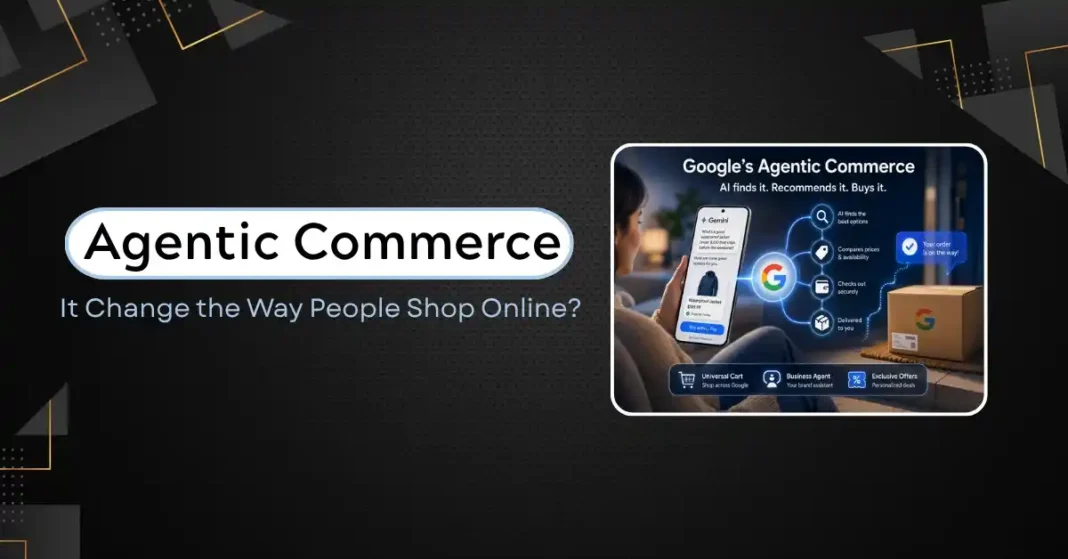
The word “agentic” gets thrown around a lot in AI discussions right now. In this context it has a specific meaning. An agent is an AI system that can take actions on your behalf, not just answer questions. A standard chatbot responds to what you type. An agent executes tasks. It searches for products, compares prices, checks availability, applies promo codes, and completes a checkout, all based on a goal you gave it.
This is why “agentic commerce” is a bigger deal than “AI-assisted shopping.” The latter means AI helps you shop. The former means AI shops for you.
Amazon gave us the first mainstream example with its “Buy for Me” agent, which launched in late 2025 and purchases products from third-party sites on the shopper’s behalf. ChatGPT launched Instant Checkout in September 2025, letting its 900 million weekly users buy products directly inside a conversation. Google’s version is the most architecturally ambitious of the three, and the one with the most retail industry support behind it.
How Google’s System Works
Google’s agentic commerce framework has three main components: the Universal Commerce Protocol, Business Agent, and Direct Offers.
The Universal Commerce Protocol (UCP) is the technical foundation. Think of it as a common language that lets AI agents and retailer systems communicate cleanly. When the Gemini app or AI Mode in Search wants to check a product’s availability, pricing, and shipping options, UCP is how that conversation happens. Google developed UCP in partnership with Shopify, Etsy, Walmart, Target, and more than 20 other companies including American Express, Macy’s, Visa, and Stripe.
The front-end experience lives inside the Gemini app and AI Mode within Google Search. A user who asks Gemini “what is a good waterproof jacket under $200 that ships before the weekend?” gets a response that goes through the actual product inventory of UCP-enabled retailers, checks current pricing, and surfaces specific options the user can purchase without leaving the Gemini interface. Google Wallet stores the shipping information, so the checkout is pre-filled. The retailer remains the merchant of record throughout.
Business Agent lets brands operate their own virtual sales associate inside Google Search results. A shopper who finds a product listing can ask questions about sizing, availability, compatibility, or return policies and get answers in the brand’s voice without clicking through to the website. Eventually, Business Agent will handle checkout directly.
Direct Offers is the advertising component. Google’s system reads conversational context to identify when a shopper is actively considering a purchase and surfaces a brand-exclusive promotion at that moment. Someone comparing hiking boots at a specific price point might see a 15% discount from a retailer who has set up a Direct Offer.
What the Numbers Suggest
The scale of what is being predicted for agentic commerce makes some people skeptical, and reasonably so. AI predictions tend to be optimistic on short timelines and underestimate on long ones. But the numbers here come from serious research shops, not from the AI companies themselves.
McKinsey projects agentic commerce will drive between $900 billion and $1 trillion in US retail revenue by 2030, and between $3 trillion and $5 trillion globally. Morgan Stanley’s AlphaWise survey shows AI agents already capturing 10 to 20 percent of e-commerce value, somewhere between $190 billion and $385 billion. Forrester predicts 20 percent of B2B sellers will face agent-led quote negotiations before the end of 2026.
These numbers reflect a behavior shift that is already happening. Forty percent of Gen Z now prefer TikTok or AI assistants over Google for search. When the search behavior moves, the shopping behavior follows.
Why Retailers Are Nervous
Agentic commerce creates a genuine problem for retailers, even the ones signing up for it.
The traditional retail website is a controlled environment. The brand decides what the user sees, in what order, with what photography and copy. Product recommendation algorithms, upsell prompts, loyalty program integrations, email capture forms, all of these are revenue and relationship-building tools that retailers have spent years refining.
Agentic commerce strips most of that away. When a purchase happens inside a Gemini conversation, the retailer gets the transaction but loses the interaction. No browsing behavior data. No email address collected at checkout. No opportunity to show complementary products on a thank-you page. No visibility into what question the customer asked or what alternatives were considered before the purchase.
Kartik Hosanagar, a marketing professor at the Wharton School who studies retail tech, put it plainly: “I kind of think that this is going to shake up retail just like the internet did.”
Retailers like Walmart, Target, and Etsy are signing up anyway, partly because the revenue opportunity is real and partly because there is an element of necessity. When ChatGPT’s Instant Checkout launched, OpenAI noted that enabling Instant Checkout would be a factor in how it ranked merchants for the same product. Not participating means losing visibility.
The Product Feed Problem
Google’s current agentic shopping experience is only as good as the product data feeding it. This is not a temporary limitation, it is a structural feature of how the system works.
When a Gemini agent searches for a waterproof jacket under $200, it does not browse websites. It queries structured product feeds. If a retailer’s feed is missing size information, has outdated pricing, or does not include relevant attributes like waterproof rating or materials, the product simply does not appear in the response. The agent cannot infer information that is not in the data.
Google launched an AI performance insights tool in Merchant Center that shows brands how they are performing on AI surfaces and how their share of voice compares to similar brands. Getting into that tool and understanding where your product data is falling short is, right now, one of the most valuable things a retail marketing team can do.
Strong product descriptions matter more than they did a year ago. Not because of keyword stuffing but because Gemini reads and synthesizes that description content when forming recommendations. A product description that accurately captures what the item is, who it is for, and what makes it distinct is doing direct selling work inside AI-generated responses.
What Changes for Shoppers
Most shoppers will not think about any of this infrastructure. They will just notice that buying things is easier.
The Universal Cart is probably the most tangible experience change. Today, if you add something to a cart on a retailer’s website and then close the tab, that cart is gone unless you have an account. With the Universal Cart, a product you consider on Google Search follows you into the Gemini app and can still be there days later when you decide to buy it. The cart also automatically tracks price drops on items you have added, which is a feature that previously required third-party browser extensions.
The conversational discovery experience changes something more fundamental. Right now, knowing what to search for requires the shopper to already know what they want. “Running shoes” is easy to search. “Running shoes for someone with plantar fasciitis who runs on mixed surfaces and wants something under $150 that comes in wide widths” is much harder to type into a search bar but straightforward to describe in a conversation. AI Mode handles the second version naturally, matching the description against product inventory in real time.
This is what Google means when it frames agentic commerce as compressing the distance between discovery and purchase. The research phase of shopping, which has historically taken hours or days across multiple sites, collapses into a conversation.
How Far Along Is This, Really?
Honest answer: it depends on the category and the retailer.
For products sold by UCP-enabled retailers, Walmart, Target, Shopify merchants, Etsy sellers, the experience is working now in the US. Eligible shoppers can browse, get AI recommendations, and complete checkout inside Google’s AI interfaces. It is not perfect, and early reviews of Amazon’s competing “Buy for Me” feature noted frustrations, but the underlying capability is real and live.
For brands not yet enabled on UCP, or categories where the product data is more complex (furniture, made-to-order products, anything requiring customization), the experience is much earlier stage.
Emily Pfeiffer, a principal analyst at Forrester who covers AI and commerce, observed that the industry is at a moment where everyone has FOMO but nobody has fully figured out the right approach. That feels about right. The direction is clear. The execution is still being worked out.
The retailers getting ahead of it now are the ones cleaning up their product feeds, connecting with UCP, building out Business Agent responses, and paying attention to how their products appear inside AI-generated responses rather than just in traditional search results.
That work does not take years. It takes months. And the brands that do it while the channel is still early will have an advantage over those who wait until it is crowded.