Google Marketing Live 2026 happened on May 20, one day after Google I/O. Every year the event is big. This year it felt different. Not because Google announced more things than usual, but because the things it announced are structurally changing what a marketing team actually does on a day-to-day basis.
The short version: Gemini is now running the advertising stack. Not assisting it. Running it.
Here is everything that was announced, what it means, and what you should do about it now.
The Big Shift Nobody Is Saying Loudly Enough
Google has been adding AI features to its ads platform for years. Performance Max, Smart Bidding, responsive search ads. Each of these chipped away at manual control while promising better results. Google Marketing Live 2026 is the moment that shift became total.
The theme of this year’s event, as Google VP Vidhya Srinivasan put it, was “the only way to win in the age of AI is with AI.” That is not a marketing slogan. It is a description of what the platform now requires. If you are still writing individual keywords, managing granular bids, and hand-crafting every ad variation, you are not just behind. You are working against how the platform now distributes budgets and rewards creative.
This matters more than any individual announcement. Every feature below is a piece of that larger shift.
New Ad Formats Built for AI Mode in Search
The biggest structural announcement was two new Gemini-powered ad formats designed specifically for AI Mode, Google’s conversational search experience.
These ads appear as natural parts of the AI Mode response rather than as separate sponsored results. Google uses Gemini to match each ad to both the user’s query and the AI-generated content surrounding it, so the ad reads as relevant to the conversation already in progress. If someone asks for fragrances that make a home smell like a luxury hotel, Gemini surfaces a product recommendation that answers that question, with the advertiser’s product embedded in the response.
This is worth pausing on. AI Mode queries are running three times longer than traditional searches. Someone typing “best running shoes” is giving you very little signal. Someone asking “what running shoes would work for someone with wide feet who does half marathons on road and trail” is giving you a complete picture. Ads built for AI Mode need to answer those longer, more specific questions. Copy written for short keywords will underperform here.
The second format is a Conversational Ad that creates a custom mini-agent inside the ad unit itself. A user can ask a question directly inside the ad and get an answer pulled from the advertiser’s website. They can then submit a pre-filled lead form without ever leaving the ad. By the time that lead reaches the advertiser, they have already engaged with the product content and self-selected as interested.
Google is currently testing this in education, automotive, and real estate. PPC professionals who have seen early results are cautiously optimistic. The concern is the same one that followed Performance Max: that the format works when Google’s AI has enough good signal to work with, and produces waste when it does not.
Universal Cart: Shopping Across Every Google Surface
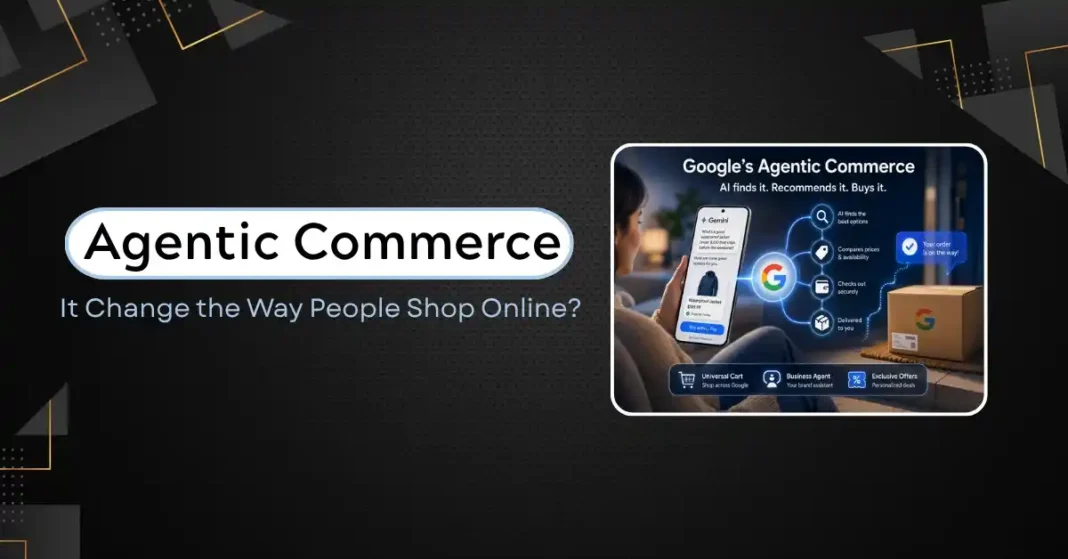
Google announced its Universal Cart, powered by the Universal Commerce Protocol (UCP) it launched in January 2026. The idea is that a shopper can add a product from Google Search, then pick up that cart in the Gemini app, then complete checkout from Gmail. The cart moves with the user across Google properties.
This is Google’s answer to Amazon’s end-to-end shopping experience. Amazon owns the product discovery, consideration, and purchase loop. Google has historically owned discovery and then lost the user to another site for checkout. The Universal Cart changes that.
For marketers, this means two things. First, product feeds need to be in excellent shape. The AI surfaces products from structured data, and anything missing from that feed is invisible in agentic commerce. Second, the Universal Cart automatically tracks price drops and back-in-stock alerts for products a user has added. That is an engagement mechanism that did not exist before, and it means product availability and pricing need to stay current.
Walmart, Target, and Shopify are the first retail partners enabled for UCP checkout.
Ask Advisor: One Agent to Replace Four Different Tools
The most operationally significant announcement for agency teams was Ask Advisor.
Google has been rolling out individual AI advisors inside its products for a while. Ads Advisor reached all English-language accounts in December 2025. Analytics had its own version. Merchant Center was getting one. Ask Advisor consolidates all of these into a single conversational agent, built on Gemini, with a shared memory layer that retains context as you move between tools.
What this means in practice: instead of pulling a campaign report in Google Ads, cross-referencing it with Analytics, and then checking Merchant Center to see why certain products are underperforming, you can ask Ask Advisor one question and get an answer that draws from all three sources.
The shared memory layer is the detail that matters. If you tell Ask Advisor that your Q3 goal is to grow return on ad spend by 15% while protecting brand search volume, it retains that context. When you ask it three days later why it recommended a budget shift, it explains the recommendation in terms of your stated goal rather than generic optimization logic.
Ask Advisor is in beta globally for English-language accounts. The time saved on cross-platform analysis will be significant for teams currently managing reporting across multiple dashboards.
AI Max Turns One and Gets Smarter
AI Max, Google’s intent-based search campaign type that launched in 2025, picked up several new capabilities at GML 2026.
The most useful is expanded reach into “search universe” traffic, which refers to queries happening across Google properties beyond core Search. Shopping intent showing up in Discover, YouTube, and Maps now falls within AI Max’s reach. For advertisers who have been seeing AI Overviews reduce their traditional search traffic, this is a meaningful expansion.
Google also announced that DSA (Dynamic Search Ads) campaigns will migrate to AI Max in September 2026. This is not optional. DSA campaigns that have not been migrated by September will be automatically transitioned. If you are running DSA campaigns, the migration planning needs to start now, not in August.
The September deadline is the most underreported part of GML 2026. There are a lot of accounts still running significant DSA budget, and the migration involves reviewing AI Max’s URL expansion settings, confirming brand exclusions, and checking that the product feed is complete enough to support intent-based targeting.
Asset Studio Gets Multimodal Gemini Integration
Asset Studio, Google’s creative production tool inside Google Ads, is getting full Gemini Omni integration. Previously it could generate static image variations and basic video adaptations. With Gemini Omni, it can now work with video input, audio, and combinations of different media types to generate creative variations at scale.
The practical use case: upload a 30-second brand video and a product catalog, and Asset Studio generates tailored ad creative for different audience segments, placements, and aspect ratios without requiring a separate production workflow for each variation.
Early feedback from agencies is that the output quality is good enough for performance creative but still falls short of brand-level creative for awareness campaigns. The distinction matters. For campaigns where the primary goal is conversion and the creative needs to perform rather than impress, Gemini-generated assets are increasingly usable. For brand campaigns where the creative represents how the company wants to be perceived, human creative direction is still doing real work.
Direct Offers: Exclusive Deals Inside AI Mode
Direct Offers is a new ad format that lets advertisers deliver exclusive discounts directly within AI Mode conversations. Google’s system analyzes purchase intent in the conversation and surfaces the offer at the moment a user is evaluating a product.
The mechanic is straightforward: a user asks about laptops in a specific price range, Google’s system identifies high purchase intent, and a Direct Offer from an eligible advertiser appears with a discount code or promotional price. The offer is exclusive to the AI Mode interaction.
This is early-stage and currently in pilot. It is worth watching because the intent signal in a conversational AI query is far richer than a keyword search. Knowing that someone is actively comparing products and has a specific budget is more valuable than knowing they searched for “laptop deals.”
Business Agent: Your Brand Inside Search
Business Agent allows advertisers to embed a brand-voiced conversational agent directly within Google Search results. When a user finds a business listing, they can ask the Business Agent product questions, get detailed answers, and eventually move toward checkout, all without visiting the advertiser’s website.
Google describes it as a virtual sales associate. That framing is accurate. A user who asks the Business Agent “does this jacket come in a women’s cut and is it waterproof?” and gets an immediate, accurate answer is much further along the purchase path than someone who clicked a search result, landed on a product page, and had to hunt for the sizing information.
The Business Agent pulls from the advertiser’s existing product content and policies. Keeping that content accurate and current becomes a new operational priority for any brand planning to deploy it.
Bidding and Budgeting Updates
Beyond the headline formats, Google announced several bidding and budget changes worth noting.
AI-powered pacing is getting a real-time demand adjustment feature, meaning campaign budgets flex during demand spikes rather than running at a fixed daily pace. This is useful for retail brands with seasonal or event-driven demand patterns, but it requires that campaign budgets have enough headroom to absorb the spikes without overspending the monthly target.
Google also announced improvements to audience expansion within Performance Max, with more visibility into which audience signals the AI is finding valuable. This addresses a long-standing complaint that Performance Max operates as a black box. The additional reporting does not give advertisers keyword-level control back, but it does let teams understand whether the AI’s audience choices align with the business’s actual customer profile.
What This Means for Your Team
The honest summary of GML 2026 is that the job of a paid search professional has shifted. Keyword strategy and manual bid management are, at this point, diminishing returns activities. The value agencies and in-house teams provide now lives upstream of those tasks.
Specifically, the inputs that drive AI performance: first-party data quality, product feed completeness and accuracy, creative briefs detailed enough to give Gemini good material, measurement frameworks that give the bidding system a real signal to optimize against. These are the areas where human judgment still makes a material difference.
The September DSA migration deadline gives a useful forcing function for teams that have been meaning to reassess their search strategy but have not yet done so. Start there. Get the migration done, assess what AI Max is doing with the budget, and use Ask Advisor to build a picture of performance across Google properties before the holiday quarter starts.
The window to get ahead of these changes is still open. Based on what Google announced this week, it probably will not stay open much longer.