Overview of the Foxconn Ransomware Attack
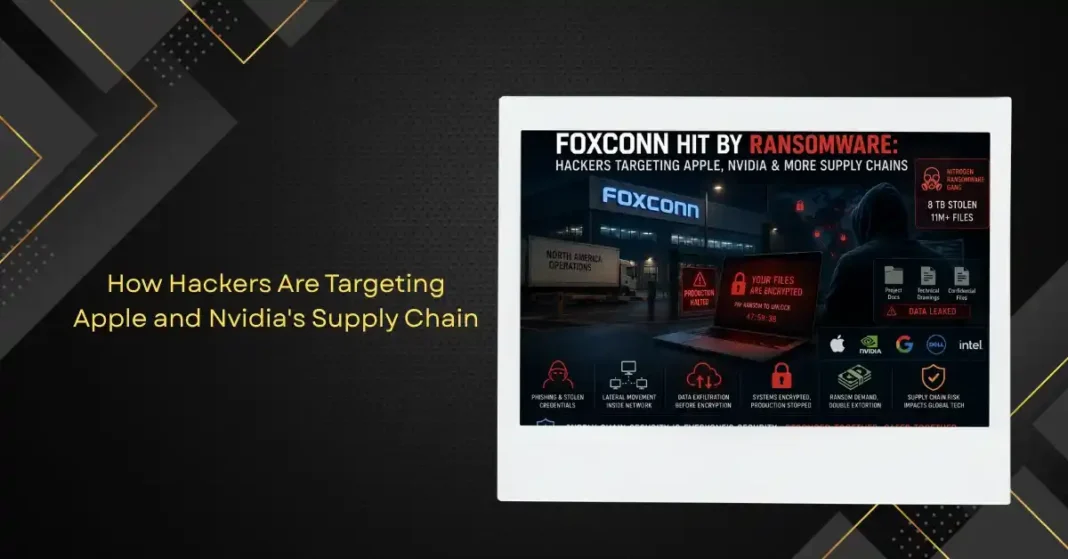
In early May 2026, Foxconn, the world’s largest contract electronics manufacturer and a critical supplier to Apple, Nvidia, Google, Dell, and Intel, suffered a significant ransomware attack on its North American operations. The Nitrogen ransomware gang claimed to have stolen 8 terabytes of data, amounting to more than 11 million files, including confidential instructions, project documentation, and technical drawings linked to the world’s biggest technology companies.
This attack demonstrates why supply chain targeting has become the preferred strategy for organised ransomware crews, and why no amount of money your company spends on its own security matters if your supplier’s defences are weaker than yours.
What Happened at Foxconn
Foxconn’s Wisconsin manufacturing plant experienced a multi-day IT outage in early May 2026 that halted production and forced employees offline. On 12 May, the Nitrogen group listed Foxconn on its dark web leak site, claimed responsibility for the attack, and posted sample files as alleged proof of the breach.
A Foxconn spokesperson stated: “Some of Foxconn’s factories in North America suffered a cyberattack. The cybersecurity team immediately activated the response mechanism and implemented multiple operational measures to ensure the continuity of production and delivery. The affected factories are currently resuming normal production.”
Foxconn declined to confirm whether any customer data had been compromised. Internal communications visible to security researchers suggest the response was reasonably well-handled once detection occurred. The bigger question is why detection took as long as it did.
Who Is the Nitrogen Ransomware Gang
Nitrogen first emerged as a distinct ransomware operation in 2023. Researchers believe the group is linked to ransomware operators based in Eastern Europe and may have connections to the BlackCat/ALPHV ransomware cartel, one of the most prolific criminal organisations in the history of ransomware.
Nitrogen typically gains initial access through a small set of well-understood methods: phishing emails with malicious attachments, fake software download sites that distribute trojanised installers, malicious Google and Bing search advertising that points to lookalike domains, and stolen or purchased login credentials sourced from previous breaches.
Critical warning: Coveware researchers warned in February 2026 that a programming error in the Nitrogen decryptor prevents it from successfully recovering encrypted files on VMware ESXi systems. If your company runs critical workloads on VMware ESXi, paying the Nitrogen ransom does not get your data back. Several mid-sized companies have paid Nitrogen ransoms only to discover the decryption process simply does not work on the systems most likely to have been hit.
How a Supply Chain Ransomware Attack Actually Works
Understanding the mechanics matters because it explains why these attacks are so effective and so hard to prevent.
Stage 1: Initial Access
Attackers gain entry through a phishing email opened by an employee, an exposed VPN endpoint without multi-factor authentication, an unpatched server running an old version of a remote access tool, or stolen credentials purchased on a dark web marketplace.
The manufacturing sector, on average, is several years behind the banking sector in IT security maturity. Industrial control networks, legacy ERP systems, and older Windows servers running mission-critical applications are common targets.
Stage 2: Reconnaissance and Lateral Movement
Once inside the network, attackers spend days or weeks quietly mapping the environment. They identify file shares with valuable data, map out the Active Directory environment, and look for ways to elevate their privileges. Privilege escalation to domain admin typically happens 48 to 72 hours before the encryption stage begins.
Stage 3: Exfiltration
Before encrypting anything, attackers copy the most valuable data out to anonymous cloud storage or attacker-controlled servers. This is the modern double extortion model: pay or we leak your data. For manufacturing victims, the leak threat is often more painful than the encryption threat.
Stage 4: Encryption
Finally, systems are encrypted and the ransom note appears. By this point, the attackers have already removed the data they care about. The encryption is the leverage; the exfiltration is the payload.
Stage 5: Negotiation
A negotiation usually follows on a dark web portal. Most ransomware groups have professional negotiators on staff. They know what the company can afford, what its cyber insurance covers, and they price accordingly.
Why Does Foxconn Keep Getting Targeted
This is not Foxconn’s first encounter with ransomware. In 2024, LockBit claimed to have infected Foxsemicon Integrated Technology, a semiconductor equipment subsidiary within the Foxconn Technology Group.
Foxconn employs more than 900,000 people across 24 countries and reported revenues exceeding $260 billion in 2025. Its central role in the hardware supply chains of every major technology company makes it a uniquely high-value target. If attackers can access proprietary instructions, technical drawings, and project documentation from Foxconn’s systems, they gain leverage over not just Foxconn but every company whose products pass through its factories.
Large contract manufacturers run thousands of customer projects in parallel. A breach of the central document management system can leak data from hundreds of unrelated customers in a single incident.
What Data Was Stolen
Nitrogen’s leak post claims the cache contains confidential instructions, project documents, and technical drawings totalling 8 terabytes. Independent security researchers who examined the posted sample files noted that some of them did appear to match claims about Google components. Initial reviews did not fully corroborate the claims about Apple, Dell, and Nvidia specifically. Foxconn has neither confirmed nor denied the full scope of the breach.
Technical drawings and project documents can expose how components are physically built, the tolerances they are tested to, and the integration sequence used to assemble final products. This information can be leveraged for:
- Industrial espionage by competitors with state backing
- Vulnerability discovery in hardware that is not yet shipped
- Compromise of subsequent batches via tampered components
- Counterfeit hardware production
What Should Businesses Learn From This Attack
Supplier security is your security. If your contract manufacturer, payroll provider, or cloud backup vendor has weaker security than you do, an attacker will target them. Your contracts should require minimum security standards, and implementation needs to be audited.
Disable Office macros by default across your environment. Macros remain one of the top initial access vectors in 2026.
Monitor domain admin activity closely. Privilege escalation usually happens 48 to 72 hours before encryption begins. This is one of the highest-leverage detective controls.
Implement segmentation between your IT network and your operational technology (manufacturing, industrial control). A breach on the corporate side should not be able to walk straight into the production environment.
Have an incident response plan that does not assume paying a ransom will restore your data. Know who has authority to authorise payment, your bank’s process for emergency wires, which negotiators you trust, and your regulatory notification obligations.
Keep tested, immutable, offline backups of your most critical data. If your backups are reachable from the same network that gets encrypted, they are not real backups.
What This Means for the Wider Technology Supply Chain
The Foxconn attack is part of a broader trend that will shape technology procurement decisions through 2027. Major customers (Apple, Nvidia, Google) will start demanding more rigorous, independently audited cybersecurity from their contract manufacturers. Cyber maturity will become a meaningful factor in sourcing decisions alongside price, quality, and delivery reliability.
For contract manufacturers, cybersecurity is no longer a back-office concern. It is a competitive differentiator and a precondition for keeping the biggest contracts.
For consumers, the practical impact is mostly indirect: minor delivery delays, possible upward pressure on prices as security investment passes through the supply chain, and an extremely small statistical risk of hardware-level tampering.
The Bottom Line
The Foxconn ransomware attack is significant not because it is unique but because it is representative. Manufacturing supply chains have become a primary target for organised ransomware crews because the data is valuable, the security is weak, and the downstream leverage is enormous. The companies that come out of this period in the strongest position will be the ones that took supplier security seriously before they had to.
Frequently Asked Questions
Who attacked Foxconn in 2026?
The Nitrogen ransomware gang claimed responsibility for the May 2026 attack on Foxconn’s North American factories, alleging they stole 8 terabytes of data.
Was Apple or Nvidia’s data stolen in the Foxconn breach?
Nitrogen claimed the stolen data included files related to Apple, Nvidia, Google, Dell, and Intel. Independent researchers partially corroborated claims about Google components, but initial reviews did not fully confirm the Apple, Dell, and Nvidia claims. Foxconn has not confirmed the full scope.
What is the Nitrogen ransomware gang?
Nitrogen is a ransomware group that emerged in 2023 and is believed to be linked to Eastern European operators with possible ties to the BlackCat/ALPHV cartel.
What is a supply chain ransomware attack?
A supply chain ransomware attack targets a supplier or vendor rather than the end company, exploiting weaker security at manufacturing or logistics partners to gain access to data and leverage over larger downstream customers.
Does paying the Nitrogen ransom recover encrypted files?
Not reliably. Coveware researchers warned in February 2026 that a programming error in Nitrogen’s decryptor prevents it from successfully recovering encrypted files on VMware ESXi systems.
How can companies protect against supply chain ransomware attacks?
Key steps include vetting supplier cybersecurity, monitoring for unusual data movement, enforcing multi-factor authentication, patching systems, segmenting IT and operational networks, disabling Office macros, and maintaining tested offline backups.