The world is still adapting to 5G. Many cities are only partway through their 5G rollouts. Rural coverage in most countries lags urban deployment by years. And yet, the global technology industry has already moved on. Not in deployment, but in research and development. Right now, laboratories in the United States, South Korea, Japan, China, India, and Europe are working on what comes after 5G: sixth-generation wireless technology, or 6G.
This guide explains what 6G actually is, how it differs from what we have today, what new applications it will enable, and (crucially) when you can realistically expect it to arrive on your phone.
What Is 6G
6G is the sixth generation of cellular technology and the successor to 5G. It is not simply a faster version of 5G. It is intended to be a different kind of network platform, designed for a world where machines, vehicles, devices, sensors, and humans communicate seamlessly, often without human involvement in the loop at all.
While 5G introduced high-speed mobile broadband and enabled emerging applications like autonomous vehicles, augmented reality, and dense IoT deployments, 6G is designed to go significantly further. The mental model that works best is this: 5G is the foundation for smart devices and automation. 6G is the platform for intelligent, ambient computing experiences at a scale that is currently difficult to imagine.
The technical specifications, the applications, and the rollout timeline are all still being worked out, but the broad shape of the technology is now clear enough to describe with reasonable confidence.
How Is 6G Different From 5G
There are six main dimensions where 6G is designed to meaningfully exceed 5G.
Speed
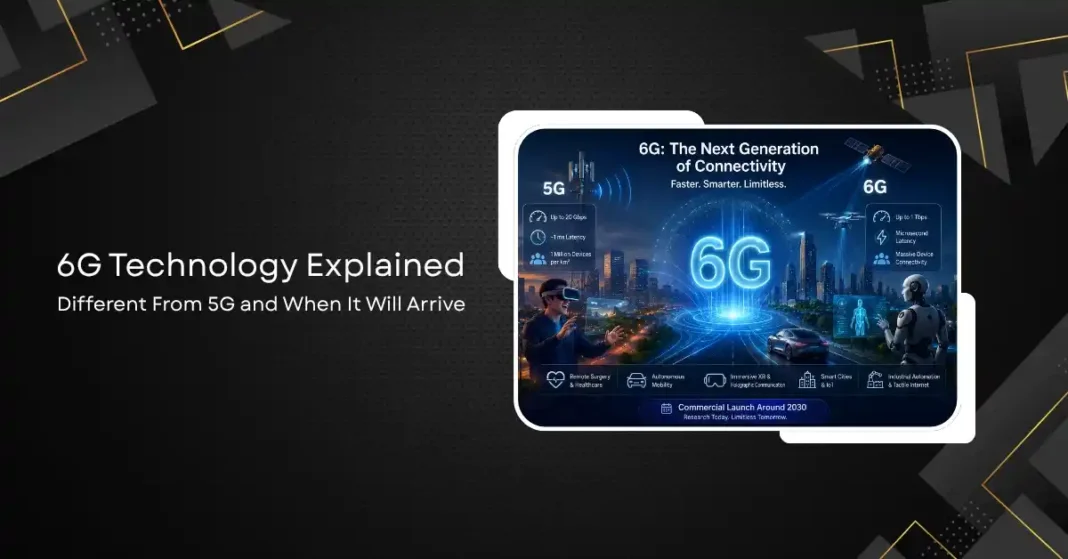
5G has a maximum theoretical transmission speed of 20 Gbps. In real-world conditions, most 5G users experience speeds between 100 Mbps and 1 Gbps depending on location, network congestion, and device.
6G aims for theoretical speeds of up to 1 terabit per second, potentially 1,000 times faster than 5G. In practical terms for typical users, 6G is expected to deliver speeds consistently above 100 Gbps in well-served areas.
To put that in perspective. Downloading a 3GB high-definition movie on a typical 5G connection takes roughly two minutes. On a 6G network, it would be effectively instantaneous. Downloading the entire current Netflix library would still take a while, but it would be measured in minutes rather than days.
Latency
5G promises latency as low as approximately 1 millisecond in ideal conditions, which was already a massive improvement over 4G’s typical 30 to 50 milliseconds.
6G is designed to achieve microsecond latency, one thousand times lower than 5G. This near-zero delay is critical for applications such as remote surgery, real-time haptic feedback in virtual environments, autonomous vehicle coordination at high speeds, and tactile internet experiences where physical and digital actions must feel simultaneous.
Capacity and Coverage
5G can theoretically support up to 1 million connected endpoints per square kilometre, depending on the radio environment. 6G is designed for substantially higher device density, which becomes essential as the Internet of Things continues to expand and as cities deploy denser networks of environmental sensors, smart vehicles, and wearable devices.
6G also envisions tight satellite integration that could deliver connectivity to remote, aerial, and maritime environments where terrestrial networks cannot economically reach. Combined with high-altitude platforms (HAPS) and low-earth-orbit satellite constellations, 6G could approach true global coverage, including over oceans and in sparsely populated regions.
Frequency Spectrum
6G will use higher radio frequencies than 5G, including Extreme High Frequency (EHF) spectrum, sometimes called terahertz (THz) bands. These deliver ultra-high speeds and massive capacity over short distances.
The trade-off is significant. THz signals do not travel as far as lower-frequency signals and are more easily blocked by physical objects such as walls, foliage, and even human bodies. Managing this limitation will require intelligent reflecting surfaces (specialised panels that bounce signal around obstacles), dense networks of small cells, and adaptive beamforming. The infrastructure requirements for 6G are meaningfully more complex than 5G in this respect.
AI Integration
Perhaps the most distinctive feature of 6G relative to all previous generations is that AI is not an add-on. It is fundamental to the network design itself.
6G is intended to be a cognitive network: one that uses AI to dynamically allocate spectrum, manage energy consumption, predict congestion before it happens, route traffic intelligently, and optimise performance in real time. The network itself thinks and adapts continuously, learning from usage patterns and adjusting its behaviour to maintain quality of service.
This is a fundamentally different design philosophy from previous generations. 5G uses AI to optimise specific functions. 6G is designed around AI from the foundation.
Energy Efficiency
6G targets significantly better energy efficiency per bit transmitted than 5G. This matters because the energy footprint of telecom networks is becoming a substantial sustainability concern. The combination of AI-driven optimisation, more efficient hardware, and smarter sleep states for unused infrastructure is intended to keep total network energy consumption manageable even as data volumes grow.
What Will 6G Make Possible
The speed and latency numbers are abstract. The applications they enable are more tangible. Here is what 6G is expected to make practical that 5G cannot.
Healthcare
Remote surgeries conducted by robots, guided by a surgeon located in another city or another country, with no perceptible delay. Continuous health monitoring by connected biosensors that detect early warning signs of cardiac events, strokes, or diabetic emergencies before they become medical emergencies. Real-time AI-assisted diagnostics in field hospitals and remote clinics.
Autonomous Vehicles
Vehicle-to-vehicle and vehicle-to-infrastructure communication at speeds and scales that 5G cannot reliably support. This enables safer high-speed autonomous transport, denser traffic flow with closer vehicle spacing, and coordinated response to unexpected events such as accidents or weather changes.
Immersive Experiences
Holographic communication where remote participants appear in three dimensions, mixed-reality environments that blend digital and physical seamlessly, and lifelike virtual worlds that require bandwidth and latency well beyond what 5G can deliver. Entertainment, education, and remote work all change shape significantly.
Smart Cities and Agriculture
Dense sensor networks that monitor urban infrastructure (bridges, water mains, electrical grids, traffic systems) in real time. Precision agriculture where every plant in a field is monitored individually and irrigation, fertilisation, and pest control are optimised at the plant level. Energy grids that respond dynamically to weather, demand, and renewable generation in real time.
Industrial Automation
Factories with thousands of wireless robots coordinating in real time. Real-time digital twins of complex industrial processes. Predictive maintenance based on continuous high-resolution sensor data from every piece of equipment. The cost reductions and quality improvements possible in manufacturing are substantial.
Tactile Internet
A genuinely new category of application that 5G cannot really support: experiences where touch, force feedback, and physical interaction are transmitted in real time. Remote training of skilled trades, telepresence for delicate manual work, and entirely new entertainment formats.
When Will 6G Arrive
The honest answer is not soon enough to influence your next phone upgrade. Here is the realistic timeline as the industry currently understands it.
Now to 2026
Research and early prototype development. In September 2025, scientists in the US and China demonstrated a full-spectrum 6G chip capable of transferring data at 100 Gbps. Test beds and university research facilities are being established globally. India launched its Bharat 6G initiative in 2023 and is targeting an active role in 6G standards development.
2026 to 2028
Standardisation. Industry bodies including 3GPP are beginning the formal work on 6G standards. The 3GPP Release 21, expected around 2028, is anticipated to include the first formal 6G specifications. Samsung has stated publicly that it believes commercial services could be available as early as 2028 in leading markets, although most independent analysts believe 2030 is a more realistic target.
2030
First commercial 6G networks launch in leading markets, including the US, South Korea, Japan, China, and parts of the EU. Initial coverage will be limited to urban centres in those countries. Compatible consumer devices will start appearing, although they will be expensive and limited to those urban areas where 6G coverage exists.
2030 to 2035
Gradual expansion. As with 4G and 5G before it, mass adoption will take several years after initial commercial launch. Indian rollout is likely to begin in this window, although the specific timeline will depend on the spectrum auction process and operator investment decisions.
2035 and beyond
6G becomes the dominant cellular technology in most developed markets, with widespread consumer availability and a mature application ecosystem. 5G remains in service in less-developed regions and as a fallback in 6G-served areas.
It is worth noting that 5G is not going away. Just as 4G and 5G have coexisted for years and will continue to do so, 6G and 5G are expected to operate together for an extended period. The 6G Industrial Consortium estimates that 5G has a 20-year lifespan, meaning it will remain commercially relevant well into the 2040s.
What Is 5G-Advanced
Before 6G arrives, consumers and businesses will benefit from 5G-Advanced, an enhanced version of 5G that incorporates several early 6G concepts. It is already rolling out, with commercial availability from 2025 and 2026 in leading markets.
Key improvements of 5G-Advanced over current 5G include deeper AI integration into network management, reduced energy consumption per bit, improved reliability in dense urban environments, better support for extended reality applications, and meaningful improvements in coverage and consistency. Think of it as a bridge between today’s 5G and tomorrow’s 6G, delivering some of the benefits sooner without requiring the full hardware and infrastructure replacement that 6G will require.
For most consumers, 5G-Advanced is what you will actually be using for the next five to seven years, and it is a meaningful upgrade over the original 5G specifications.
The Geopolitics of 6G
One dimension worth flagging that often gets overlooked in technical discussions. 6G development is a major geopolitical priority for several large nations, and the standards process is going to be shaped by international competition as much as by purely technical considerations.
The United States, China, South Korea, Japan, India, and the European Union all have significant national 6G research programmes. The standards-setting process at 3GPP and the ITU will reflect the competing priorities of these stakeholders. The question of which countries’ technical proposals get adopted into the formal standards has significant economic and security implications, because the companies based in those countries gain meaningful advantages in patents, equipment manufacturing, and downstream technology services.
For India specifically, the Bharat 6G initiative represents an effort to be a standards-shaping participant rather than just a technology adopter, which is a meaningful shift from previous generations.
The Bottom Line
6G is real, it is being built, and it will fundamentally reshape what wireless networks can do. But it is not arriving on your phone in 2026, and probably not in 2028 either. The realistic target is 2030 for first commercial deployments, with broader availability through the early to mid 2030s.
For the rest of this decade, 5G and 5G-Advanced are the wireless technologies that matter for everyday consumer and business use. 6G is the longer-term horizon, and the work being done now is laying the groundwork for the next major shift in how networks, devices, and intelligent systems interact.
Frequently Asked Questions
Q1: How fast will 6G be compared to 5G?
A: 6G is expected to achieve theoretical speeds of up to 1 terabit per second, potentially 1,000 times faster than 5G’s maximum of 20 Gbps. In practical terms, most users could expect speeds consistently above 100 Gbps in well-served areas.
Q2: When will 6G be available to consumers?
A: The first commercial 6G networks are expected to launch around 2030 in leading markets such as the US, South Korea, Japan, China, and parts of the EU. Widespread consumer availability will take several years beyond that initial launch, with Indian rollout most likely in the early to mid 2030s.
Q3: What is the latency difference between 5G and 6G?
A: 5G achieves latency as low as approximately 1 millisecond. 6G is designed for microsecond latency, 1,000 times lower, which is critical for applications such as remote surgery, tactile internet, and real-time autonomous vehicle coordination.
Q4: Will 6G replace 5G?
A: Not immediately. Just as 4G and 5G currently coexist, 6G and 5G are expected to operate alongside each other for many years. The 6G Industrial Consortium estimates that 5G has a 20-year lifespan and will remain relevant well into the 2040s.
Q5: What is 5G-Advanced and how does it relate to 6G?
A: 5G-Advanced is an enhanced version of 5G that incorporates early 6G concepts, including deeper AI integration and reduced energy consumption. It is currently rolling out in 2025 and 2026 and serves as a bridge between today’s 5G and future 6G networks.
Q6: What new applications will 6G enable?
A: 6G is expected to enable holographic communication, remote surgery with no perceptible delay, advanced autonomous vehicle coordination, immersive mixed-reality experiences, tactile internet, dense smart city sensor networks, and large-scale industrial automation that current networks cannot reliably support.