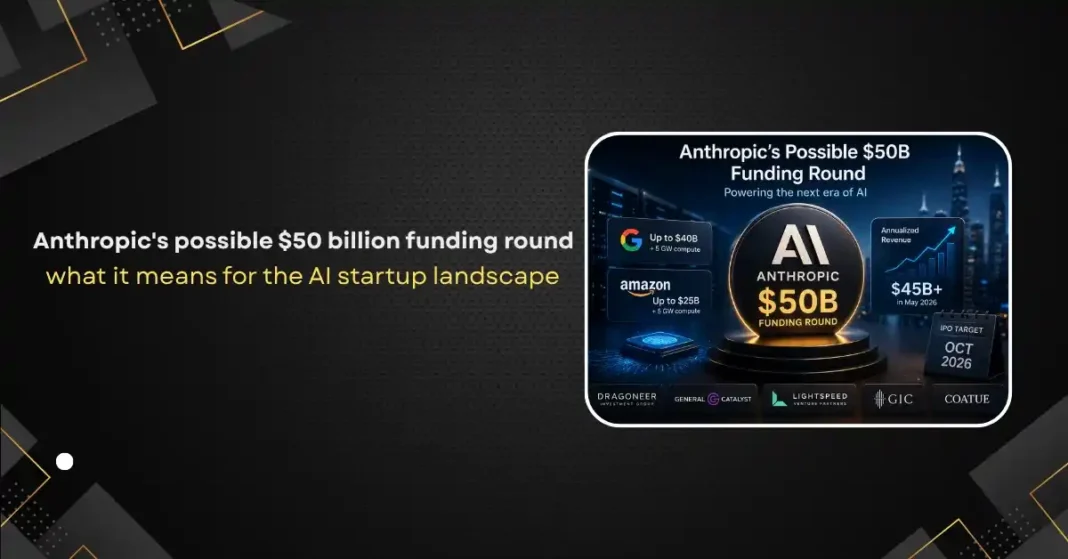
In May 2026, the Financial Times and Bloomberg both reported that Anthropic is in discussions to raise up to $50 billion in a new funding round that would value the company at somewhere between $900 billion and $1 trillion.
To put that in context: Anthropic was valued at $380 billion just three months ago, in February 2026, when it closed a $30 billion round. That round was already described as the second-largest private funding round in history. Now the company is reportedly pursuing something nearly twice as large, at a valuation that would put it in a tier occupied by only a handful of the world’s largest public companies.
This is an unusual story. Here is what is actually happening and why it matters beyond the headline number.
What the Round Looks Like
The discussions are still early. Bloomberg noted that no offers have been finalized and there is no guarantee a deal gets done. Anthropic declined to comment.
What is reported: the round would raise between $30 billion and $50 billion. The valuation discussion is in the $850 billion to $950 billion range pre-money, with some sources citing a near $1 trillion figure. The round is expected to close within two months if it proceeds.
Investors circling the deal include Dragoneer Investment Group, General Catalyst, and Lightspeed Venture Partners. Anthropic’s existing backers Google (approximately $10 billion invested, with options for up to $40 billion more) and Amazon (which pledged up to $25 billion and 5 gigawatts of compute capacity) are also part of the picture. GIC, Singapore’s sovereign wealth fund, and Coatue led the February round.
One detail from the reporting stands out. Per the Financial Times, some venture investors have offered to sell personal assets to get access to shares. This is not normal investor behavior, and it signals something about the current demand.
The round may also be Anthropic’s last private fundraise. Bloomberg reports a potential IPO as early as October 2026. TechCrunch sources describe this possible $50 billion round as the company’s final capital raise before going public.
Why Anthropic Needs This Much Money
The short answer is compute. The longer answer requires understanding what it actually costs to build and run frontier AI models in 2026.
Training a state-of-the-art large language model currently costs hundreds of millions of dollars. That is just for one training run. Running it at scale for millions of users requires ongoing infrastructure at a cost that scales with usage. Companies like Anthropic, OpenAI, and Google DeepMind are in an infrastructure race where access to GPUs, TPUs, and cloud capacity is a direct competitive input, not a nice-to-have.
Anthropic has already secured major compute commitments. Amazon agreed to invest up to $25 billion and provide 5 gigawatts of compute capacity. Google committed up to $40 billion and an additional 5 gigawatts. But Anthropic’s model Mythos, its most recent frontier release, requires more at scale than existing commitments can deliver. A primary funding round gives Anthropic balance sheet flexibility to purchase compute directly, beyond what its strategic partners have allocated.
Unlike traditional tech fundraising focused primarily on hiring and operational expansion, the majority of Anthropic’s capital requirements go toward infrastructure. This is now true for every company building at the frontier.
The Revenue Story
The valuation discussion would be hard to justify on traditional metrics, but Anthropic’s revenue trajectory is not traditional.
At the end of 2025, Anthropic’s annualized revenue was approximately $9 billion. By May 2026, that figure is expected to surpass $45 billion annualized, a fivefold increase in roughly five months. The company forecast 2026 revenue of $18 billion earlier this year and then revised those numbers upward as enterprise adoption accelerated faster than projected.
For comparison, OpenAI was valued at $852 billion in a March 2026 funding round. If Anthropic closes at $900 billion, it would surpass OpenAI as the most valuable private AI company in the world, despite being founded later and with a smaller public profile among consumers.
The revenue figure is what makes this more than speculative enthusiasm. Investors “ready to throw any dollar amount at Anthropic,” as one investor told the Financial Times, are responding to a company that has figured out how to monetize AI at scale, particularly in enterprise. Claude is embedded in workflows at companies across finance, healthcare, legal, and software development.
What This Means for the AI Startup Ecosystem
The funding dynamics around Anthropic tell a story about the broader AI startup environment that goes beyond this single company.
The first thing it tells you is that the cost of playing at the frontier has permanently separated from the cost of building AI applications. A startup can build useful AI products on top of existing models for a few million dollars. Building the models themselves now requires capital at a scale that only sovereign wealth funds, hyperscalers, and a handful of the world’s largest institutional investors can provide.
This bifurcation is already reshaping the venture capital world. Earlier-stage AI startups are raising at high valuations based on the expectation of API revenue from companies like Anthropic, OpenAI, and Google. But the runway for a pure foundation model startup is now effectively closed to anyone without access to billions in capital and major cloud partnerships. The window that existed in 2020 to 2023, when a well-funded team could plausibly build a competitive frontier model, has closed.
The second thing it tells you is that compute relationships have become the most important strategic asset in AI. Anthropic’s partnerships with Amazon and Google are not just financial. They are infrastructure deals that give Anthropic access to the training and inference capacity needed to compete. Startups that do not have equivalent access are building on top of the infrastructure controlled by their own competitors.
The third implication is geopolitical. AI infrastructure investment at this scale is now a national security consideration. The US government has taken an interest in ensuring that frontier AI development remains concentrated among US-based companies, which partially explains the extraordinary valuations. Geopolitical risk premium is baked into these numbers.
The IPO Timeline
Anthropic’s possible October 2026 IPO date makes the timing of this funding round more legible. A company planning to go public in six months needs to demonstrate financial strength and market confidence. A $50 billion round at a near-$1 trillion valuation does both simultaneously.
The IPO would be among the largest in technology history if it proceeds at these valuations. For context, Meta’s 2012 IPO valued the company at $104 billion. Anthropic at $1 trillion would be in a different category entirely.
Whether that valuation holds through public market scrutiny is a different question. Public investors apply different discipline than private ones. Revenue multiples, path to profitability, competitive moat, management depth, these are the questions a public filing forces companies to answer in detail. Anthropic is cash-flow-positive according to its own projections, but its target date for that has shifted, with the company previously delaying its cash-flow-positive target to 2028 due to increasing compute costs.
What It Means If You Work In or Around AI
If you are building an AI company, the clear message from this funding round is that differentiation at the application layer matters more than ever. Nobody is raising $50 billion to build another general-purpose chatbot. The money chasing Anthropic is chasing a company with a technical reputation (Claude’s safety approach, low hallucination rates in coding benchmarks), enterprise traction, and compute infrastructure. Competing on those dimensions is not accessible to most startups.
What is accessible is building on top of those models for specific use cases with genuine workflow integration. The enterprise companies signing seven-figure contracts with Anthropic are doing so because Claude solves a specific operational problem. Building those solutions is where most of the AI startup opportunity actually sits in 2026.
If you are watching this as an observer, the funding round is a useful indicator of where the technology is in its development curve. Companies raise money at scale when the use cases are real enough to support large revenue projections but the infrastructure costs are high enough to require external capital. That description fits AI in 2026 exactly.
The more interesting question for the next two years is what happens to the competitive dynamics when Anthropic is a public company. Public markets will demand transparency that private companies can avoid. The competitive picture between Anthropic, OpenAI, Google DeepMind, and Meta AI is going to become much clearer once at least one of those companies files an S-1.