Something changed in enterprise software in late 2024. For the first time, AI systems began reliably completing multi-step professional tasks from start to finish without constant human intervention. Not just drafting text or summarising documents, but filing expense reports, coordinating across systems to schedule complex meetings, analysing data and producing actionable recommendations, routing customer inquiries through resolution, and reviewing contracts end to end. The category that emerged to describe these systems is enterprise AI agents, and it has become the fastest-growing investment category in venture capital.
Enterprises are not buying these agents because they are impressed by the technology. They are buying them because the return on investment is visible in quarterly reports. Companies that have deployed AI agents in back-office functions are reporting productivity gains that range from 30 percent to over 200 percent in specific processes, alongside cost reductions that compound as the agents improve with use. Those numbers are driving purchasing decisions faster than almost any enterprise technology category in recent memory.
What Enterprise AI Agents Actually Do
The term “AI agent” gets used loosely, which creates confusion. For the purposes of this analysis, an enterprise AI agent is a software system that can receive a high-level task instruction, break it into steps, call appropriate tools or data sources to complete each step, make decisions about how to proceed at each branch point, and deliver a completed output without requiring human involvement at each step. It is the difference between asking an assistant “draft a reply to this email” and asking them to “handle all routine customer service inquiries this week.”
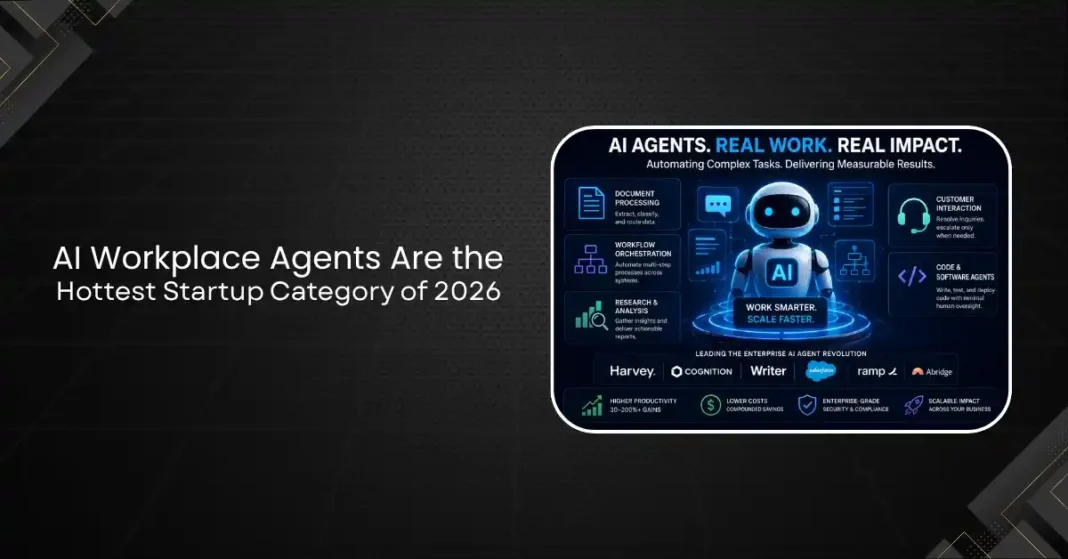
In practice, enterprise AI agents in 2026 are operating across five broad categories. Document processing agents handle reading, extracting, classifying, and routing information from high volumes of documents, including contracts, invoices, insurance claims, loan applications, and regulatory filings. Workflow orchestration agents automate multi-system processes that previously required human coordination, like employee onboarding, procurement approval chains, or IT ticketing resolution. Research and analysis agents gather information from multiple data sources, synthesise findings, and produce structured reports that would previously require hours of analyst time. Customer interaction agents handle complex multi-turn conversations for customer service, sales development, and technical support, escalating to humans only when genuinely novel situations arise. Code and software agents write, test, and deploy code changes for defined categories of tasks, handling routine maintenance, bug fixes, and feature implementations without developer intervention.
The Companies Leading the Category
The enterprise AI agent market is still fragmented but is beginning to show signs of consolidation around a handful of platforms. On the general-purpose agent side, companies like Cognition (developer of the Devin coding agent), Writer, and Salesforce Agentforce are competing for the broad enterprise market. On the vertical side, specialist companies have established strong positions in specific industries.
Harvey AI is the most frequently cited success story in legal AI agents. The company, backed by Sequoia and General Atlantic at a $3 billion valuation, deploys AI agents across contract review, legal research, regulatory compliance, and due diligence workflows for major law firms and corporate legal departments. Its retention rates are reported as exceptionally high because the agent improves with use and because law firms have invested significant effort in customising it for their specific workflows.
In finance, companies like Ramp, which uses AI agents to manage expense management and procurement, and Addepar, which deploys AI agents for wealth management analysis, are handling billions of dollars in transactions through AI-managed workflows. In healthcare, Abridge deploys AI agents that transcribe and summarise clinical conversations in real time, with deployments across major US health systems.
The common characteristic of the leading enterprise AI agent companies is that they picked one vertical and went deep rather than trying to build a horizontal platform from day one. The vertical depth gave them access to the proprietary data and domain knowledge needed to build agents that outperform general-purpose AI on specific tasks, and that performance advantage translated into customer retention rates that justified their valuations.
The Technology Stack Behind AI Agents
Enterprise AI agents in 2026 are built on a stack that combines several components. Foundation models, most commonly Claude, GPT-5, or Gemini 3.5, provide the reasoning and language capabilities. Tool-use frameworks, increasingly standardised through the Model Context Protocol (MCP), allow agents to interact with external systems like databases, APIs, and enterprise software. Memory systems allow agents to maintain context across sessions, which is essential for the kind of long-running tasks that enterprise work involves. Orchestration layers manage the sequencing of sub-tasks and handle error recovery when individual steps fail.
The orchestration layer is where most of the competitive differentiation is happening in 2026. Running a foundation model is not difficult. Building an orchestration system that reliably coordinates a dozen sub-agents, handles failures gracefully, maintains an audit trail for compliance purposes, and integrates with the specific enterprise software stack of a given customer without extensive custom engineering is genuinely hard. Companies that have solved that engineering problem well have a durable advantage over companies that are still working through it.
Why Enterprises Are Buying Now
Enterprise AI adoption has historically been slow because the risk of AI failure in professional contexts is high. An AI system that produces a wrong answer in a consumer application causes annoyance. An AI system that produces a wrong answer in a legal brief, a financial report, or a medical record causes serious harm and significant liability. That risk profile kept many enterprises in extended pilot mode through 2023 and 2024.
What changed in 2025 was a combination of improved model reliability and improved risk management tooling. The generation of models that arrived in mid-2025 showed meaningfully lower hallucination rates on domain-specific tasks when deployed with appropriate retrieval systems. Simultaneously, AI monitoring and evaluation platforms made it possible for enterprise buyers to verify agent performance on their specific task distributions before deployment and to maintain oversight of agent outputs at scale. Those two developments together moved the risk calculus enough that procurement decisions started flowing.
The other factor is competitive pressure. Enterprise buyers who have watched competitors deploy AI agents and reduce their cost structure are no longer willing to wait for the technology to mature further. The competitive cost of waiting is now visible in financial results, and that visibility is accelerating purchasing decisions.
The Investment Outlook
Enterprise AI agent companies received approximately $4.2 billion in venture investment in the first four months of 2026, according to aggregated data from PitchBook and Crunchbase. The median Series B valuation for enterprise AI agent startups in this period was $380 million, up from $120 million in the same period of 2025, a tripling that reflects both the growth of validated revenue in the category and the intensification of investor competition for positions in leading companies.
The categories that are attracting the most capital within the enterprise AI agent space are legal and compliance automation, financial services automation, and healthcare workflow automation. All three share the characteristic of high regulatory complexity, high labour costs in current processes, and demonstrated willingness from enterprise buyers to pay significant sums for reliable automation. The revenue multiples being applied to leading companies in these subsectors range from 25 to 50 times forward revenue, which is aggressive but not unprecedented for software categories that are growing at 150 percent or more annually.
The Risks
The enterprise AI agent market has real risks that are not always visible in investment pitches. Foundation model providers, primarily Anthropic, OpenAI, and Google, are themselves building agent capabilities and enterprise offerings that compete directly with the companies building on top of them. A startup that builds an enterprise agent product on Claude faces the risk that Anthropic develops a competing product for the same market. That risk has materialised in adjacent AI markets and will likely materialise in the agent market as foundation model providers seek to capture more of the value chain.
There is also an enterprise customisation problem. Agents that work well on standardised task distributions often require significant engineering effort to perform reliably on the specific workflows of individual enterprise customers. That customisation cost eats into the margin structure that agent companies are selling investors on. The companies that have built strong professional services capabilities alongside their software products are better positioned to manage this reality.
Despite those risks, the enterprise AI agent market in 2026 has more validated momentum than almost any technology category since cloud computing in the early 2010s. The companies that navigate the competitive and execution risks well are building businesses with the potential to be significantly large. The ones that do not will be absorbed into larger platforms or wind down. Distinguishing between those outcomes in real time is the core challenge for investors writing large checks in this space right now.