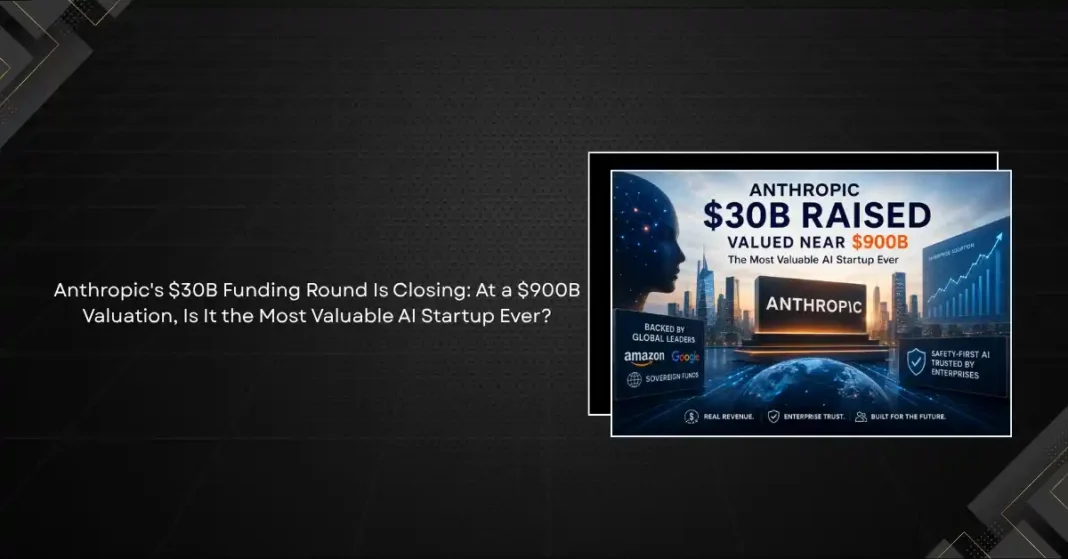
In the summer of 2025, Anthropic raised $3.5 billion at a $61.5 billion valuation and was widely considered one of the most valuable AI companies in the world. Twelve months later, those numbers look almost modest. Reports from May 2026 indicate that Anthropic is closing a funding round worth approximately $30 billion at a valuation approaching $900 billion, a figure that would make it the most valuable private startup in history, overtaking SpaceX, which sat at roughly $350 billion as of early 2026, by a factor of more than two.
To understand how a company founded in 2021 by former OpenAI researchers has reached this valuation, and whether the number reflects genuine economic value or a speculative bubble, you need to look at what Anthropic has built, who is investing, and what the competitive dynamics of the frontier AI market actually look like right now.
How Anthropic Got Here
Anthropic was founded by Dario Amodei, his sister Daniela Amodei, and several other former OpenAI employees who left over disagreements about the pace and governance of AI development. The company’s stated focus was safety-first AI research, which initially read as an idealistic differentiator in a market dominated by performance benchmarks. That reputation for safety turned out to be commercially valuable in ways the founders probably did not anticipate.
The Claude model family, which Anthropic began releasing in 2023, gained traction rapidly among enterprise customers who were nervous about the reputational and legal risks of deploying AI systems that could behave unpredictably. Claude’s Constitutional AI training method, which bakes in specific values and refusal patterns during training rather than as a post-hoc filter, produced a model that enterprise legal teams found easier to defend than the alternatives. That trust premium translated directly into contract values.
By 2025, Anthropic had signed major enterprise agreements with financial institutions, healthcare systems, and government agencies that were uncomfortable with the governance structures around OpenAI and Google’s AI products. Amazon’s $4 billion strategic investment in 2023, followed by further commitments that brought Amazon’s total exposure to around $8 billion, validated the enterprise thesis and gave Anthropic cloud computing credits and distribution reach it could not have built independently.
Google’s separate investment, also in the multi-billion range, created an unusual situation where two of the world’s most powerful technology companies were simultaneously competing with Anthropic and financially backing it. That dynamic reflects how seriously both companies take the possibility that Anthropic could develop the leading frontier model and how much they want access to that technology regardless of which company ultimately builds it.
The $30 Billion Round: What It Includes
The reported structure of the May 2026 funding round is more complex than a standard venture round. The headline $30 billion figure includes a mix of primary investment (new cash going into Anthropic), secondary transactions (existing investors selling portions of their stakes to new buyers at a premium), and committed cloud credits from Amazon Web Services that count toward the funding total.
The distinction matters. If $10 to $15 billion of that figure represents cloud computing credits rather than usable cash, Anthropic’s actual operating capital increase is meaningfully smaller than the headline number suggests. The company burns significant compute in training frontier models, so cloud credits are not worthless, but they are also not the same as unrestricted capital that can be used for hiring, acquisitions, or product development.
The valuation itself, estimated at between $850 billion and $950 billion depending on the source, is calculated on a fully diluted basis that includes options and warrants. On a simple current-share basis, the effective valuation may be somewhat lower. These distinctions are standard in late-stage private company financing but worth noting before drawing conclusions about where Anthropic stands relative to publicly traded tech companies.
Who Is Investing and Why
The investor list for this round reportedly includes sovereign wealth funds from the Middle East, large institutional investors from the United States and Europe, and technology companies from South Korea and Japan that want access to frontier AI technology without the reputational complexity of building it themselves. The participation of sovereign funds is notable. It signals that governments are treating frontier AI capacity as a strategic asset comparable to energy infrastructure or semiconductor supply chains, and that being financially connected to a leading AI lab is a hedge against being locked out of the technology later.
The $900 billion valuation implies investors believe Anthropic can eventually generate revenues and profits that justify that price. At a generous 40x revenue multiple for a high-growth technology company, Anthropic would need to reach approximately $22 billion in annual revenue to support the current valuation. The company’s reported annual recurring revenue was in the range of $2 to $3 billion as of early 2026. Getting from there to $22 billion requires compounding growth that is achievable but not guaranteed.
Is This a Bubble?
The honest answer is: somewhat yes, somewhat no. The case for a bubble is straightforward. Anthropic is losing money on a significant scale, spending heavily on compute and talent in a market where the product, frontier AI models, may commoditise faster than the current valuations assume. OpenAI, Google, Meta, Amazon, xAI, Mistral, and Cohere are all investing heavily in the same capability race. If model performance continues to improve across the board, the competitive moat for any single AI lab narrows.
The case against a pure bubble is also coherent. Enterprise AI is not a speculative market. The contracts Anthropic has signed are real, the revenues are real, and the growth rates are real. The company has demonstrated that its safety-first approach is commercially differentiated, not just philosophically differentiated. And the switching costs for enterprise customers who have built workflows around Claude are non-trivial. Replacing a model that is integrated into your legal review process, your customer service infrastructure, or your medical records system is not a simple procurement decision.
The more honest framing is that the valuation has gotten ahead of current revenues by a large margin, pricing in a future in which Anthropic is one of two or three dominant providers of enterprise AI infrastructure globally. That outcome is plausible but not certain, and the path to it runs through several competitive threats that are not trivial to navigate.
What a $900B Valuation Means for the AI Startup Landscape
Anthropic’s valuation does not exist in isolation. It sets a reference point that affects how every other AI startup is valued and how every potential acquirer thinks about the cost of frontier AI capability. When a frontier AI lab is worth $900 billion, the second-tier AI companies start to look cheap. Startups building on top of foundation models, in categories like AI-native legal tech, AI-native medical diagnosis, or AI-native financial analysis, get valued more aggressively because the market is pricing in the growth of the underlying AI ecosystem.
It also changes the calculus for large technology companies that have not yet made strategic AI investments at scale. A company like Salesforce or SAP, which relies on AI to power its next generation of products but does not have a frontier model lab of its own, now has to think hard about whether to build, buy, or partner. At a $900 billion Anthropic valuation, outright acquisition is not a realistic option for most buyers. That means partnership deals and deep integration agreements become the practical alternative, and Anthropic has significant leverage in those negotiations.
The Road to an IPO
Anthropic’s investors will eventually want liquidity. The current funding structure includes provisions that reference a public market event, most likely a traditional IPO, though a direct listing or SPAC merger remain theoretical options. The timeline most commonly cited is 2027 to 2028, by which point the company would ideally have revenue figures that support a public market valuation at or above the current private round price.
The risks on the path to IPO are real. Regulatory scrutiny is increasing. The EU AI Act, now in full effect, imposes compliance obligations on high-capability AI providers that add cost and complexity to Anthropic’s operations in European markets. US congressional attention to AI governance is intensifying. And the company’s existing investor base, which includes strategic investors with their own competitive interests, creates governance complexity that institutional public market investors may scrutinise closely.
None of those risks are insurmountable, but they are meaningful and they are not fully priced into a $900 billion private valuation where liquidity is still years away and the competitive environment can shift materially in that time.
Conclusion
Anthropic’s $30 billion funding round at a near-$900 billion valuation is the largest private capital raise in technology history and a milestone that reflects the genuine conviction among sophisticated investors that frontier AI is worth backing at almost any price. Whether that conviction is justified depends on outcomes that are not yet determined: whether Claude maintains its enterprise differentiation as competing models close the performance gap, whether AI model revenues continue to grow at current rates, and whether regulatory pressure shapes the market in ways that favour incumbents or challengers.
What is clear is that Anthropic has moved from being a well-funded research lab with commercial ambitions to being a company that the global financial system is treating as a pillar of the next technology era. That transition happened faster than almost anyone predicted. Whether the valuation turns out to be prescient or premature, the fact that it is happening at all tells you something important about where the world thinks AI is going.