When Samsung announced that Perplexity would be pre-installed as the default AI assistant on new Galaxy devices, the tech press mostly treated it as a minor product footnote. It was not. It was one of the more revealing signals about where the phone AI market is heading and how the established order of assistants, the Google Assistants and Siris that have dominated for a decade, is starting to fracture.
To understand why Samsung chose Perplexity over OpenAI’s ChatGPT, or why it did not simply double down on its own Bixby, you need to understand what phone users actually want from an AI assistant in 2026, and why the answer to that question is different from what it was even two years ago.
The Deal: What Samsung and Perplexity Actually Agreed To
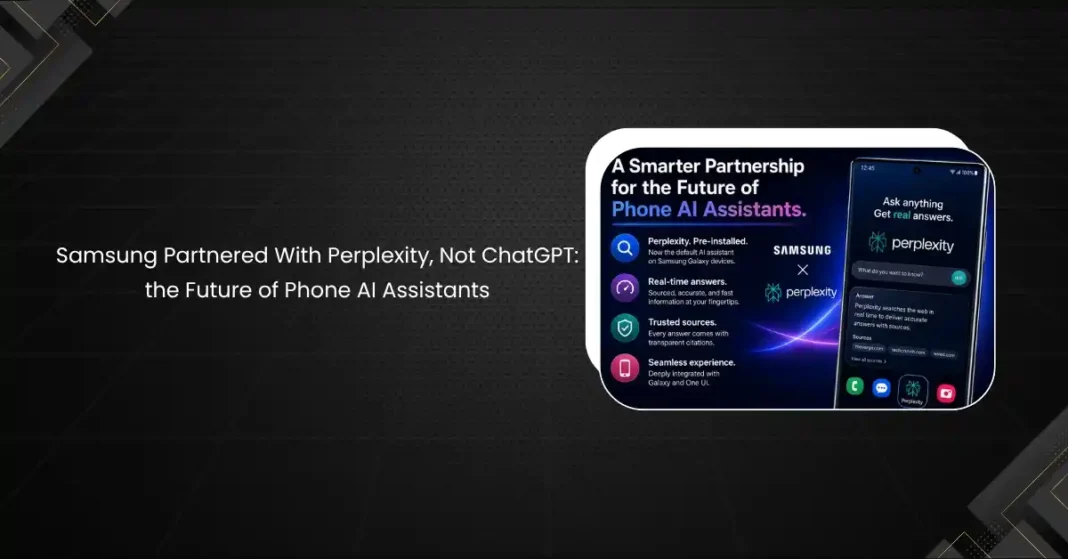
The partnership between Samsung and Perplexity was confirmed in early 2026 and covers Samsung’s mid-range and flagship Galaxy devices shipping from that point forward. Perplexity’s AI search assistant is pre-installed on these devices, meaning users encounter it before they have made any choices about which AI tools they want. In markets where carrier deals or regional agreements allow it, Perplexity is set as the default AI assistant, which is the digital equivalent of landing the airport terminal slot.
The financial terms were not disclosed, but the structure almost certainly involves a revenue-sharing arrangement tied to Perplexity’s Pro subscriptions, similar to how Google pays Apple billions annually to be the default search engine on Safari. Samsung gets either a flat integration fee or a cut of conversions from Galaxy users who upgrade to Perplexity Pro after discovering the app on their device.
For Perplexity, the deal is transformative. The company has been competing for user attention in a market dominated by ChatGPT, Google Gemini, and Microsoft Copilot. Pre-installation on Samsung Galaxy devices, which shipped roughly 230 million units in 2025, hands Perplexity a distribution channel that no amount of app store optimisation or marketing spend could replicate.
Why Not ChatGPT?
The obvious question is why Samsung did not go with OpenAI’s ChatGPT, which has significantly higher brand recognition globally and a user base that dwarfs Perplexity’s. The answer comes down to a few factors that are worth examining carefully because they reveal something about how Samsung thinks about product strategy.
First, ChatGPT is now a direct competitor to Samsung in ways that Perplexity is not. OpenAI has announced hardware ambitions, including the Jony Ive collaboration project and its own device initiative. Samsung, which makes consumer electronics, does not want to deepen its dependence on a company that might be selling competing hardware in two years. Perplexity is a pure software play with no hardware ambitions, which makes it a safer long-term partner.
Second, Perplexity’s core functionality, real-time search with cited sources, fills a gap that ChatGPT does not address as cleanly. ChatGPT is excellent for generation tasks: writing, coding, brainstorming. But for phone users who want quick, accurate answers to factual questions, Perplexity’s search-native design is more appropriate than a general-purpose chatbot. Samsung’s data almost certainly showed that the most common use cases for phone AI assistants were lookup tasks, not creative generation tasks.
Third, there is a negotiating leverage argument. Samsung is a sufficiently large distribution partner that it could negotiate terms with a mid-tier AI company like Perplexity that it could not achieve with OpenAI, which is currently the most sought-after AI brand in the world. Perplexity needed this deal more than OpenAI did, and that asymmetry translated into better commercial terms for Samsung.
What Happened to Bixby?
Samsung’s own AI assistant Bixby has been a punchline in tech circles for years. Launched in 2017 alongside the Galaxy S8, Bixby was positioned as a smarter, more capable alternative to Google Assistant. It never fulfilled that promise. User satisfaction scores were consistently low, and many Samsung users immediately disabled Bixby or remapped its dedicated button to launch Google Assistant instead.
The Perplexity deal is not officially the end of Bixby, but it is a strong signal that Samsung has accepted the outcome. Rather than continuing to invest in building a first-party AI assistant from scratch, Samsung is taking the same approach that Apple appears to be taking with Siri by outsourcing the intelligence layer to a specialist company and focusing its own engineering resources on hardware and integration.
Bixby still handles certain device-specific commands that require deep integration with Samsung’s One UI software, things like ‘open camera in night mode’ or ‘set do not disturb until 8am’. For those tasks, a locally running assistant with tight OS integration is more appropriate than a cloud-based search assistant. But for anything requiring actual intelligence or knowledge, Perplexity handles it.
The Broader Shift: What This Means for Phone AI Assistants
Samsung’s choice reflects a wider pattern playing out across the industry. The era of single-company AI assistants that handle everything from alarm setting to complex research is ending. The replacement model is layered: device-native assistants for hardware control and system tasks, plus specialist AI tools for research, writing, and analysis.
Apple has effectively acknowledged this with the reported Siri and Google Gemini partnership, where Gemini handles complex queries while Siri manages device controls. Google has the advantage of owning both the device OS (Android) and a leading AI model (Gemini), which gives it a structural edge. But even Google is finding that users on non-Google Android devices are willing to switch assistants if the experience is better elsewhere.
Perplexity’s design philosophy fits this layered model well. The app is built around a single core interaction: ask a question, get a sourced, accurate answer quickly. It is not trying to be a scheduling assistant, a shopping tool, or a creative writing partner. That focus is a feature, not a limitation, for users who are tired of general-purpose assistants that try to do everything and execute nothing particularly well.
The implication for the AI assistant market is that differentiation will increasingly come from vertical depth rather than horizontal breadth. The assistant that is best at research will win research tasks. The assistant best at code will win coding tasks. The assistant best at scheduling will win calendar tasks. The single-assistant model that defined the 2010s is giving way to a portfolio model where users have multiple AI relationships for different purposes.
What This Means for Developers and Marketers
If Perplexity becomes the default AI search assistant on hundreds of millions of Samsung devices, it matters for anyone whose business depends on being found through digital search. Perplexity answers questions by pulling information from the web and presenting synthesised answers with citations. If your brand’s content is not structured in a way that Perplexity’s retrieval systems can parse effectively, you will be invisible to a growing slice of mobile search traffic.
This is a version of the same problem that Google’s AI Overviews created for SEO professionals. When the search interface itself generates an answer rather than presenting a list of links, the rules for what constitutes good content change. For Perplexity specifically, the factors that matter include clear factual statements that can be extracted and cited, authoritative backlinks from sources Perplexity’s ranking system trusts, structured data markup that makes content easier to parse, and content freshness, since Perplexity weights recent sources more heavily than Google’s traditional algorithm does.
For app developers, the Perplexity integration raises questions about discoverability. If Samsung Galaxy users are increasingly using Perplexity as their entry point for information needs, apps that previously relied on Google search for user acquisition need to think about how to appear in Perplexity-powered answers. That means owning your factual content layer: publishing documentation, FAQs, and product information in formats that answer engines can find and cite.
The Competitive Response
Google’s position is worth watching carefully. Google Assistant comes pre-installed on Android devices through its agreements with most Android manufacturers, and Gemini is increasingly the front end for those interactions. Samsung’s deal with Perplexity is a direct challenge to Google’s distribution moat on Android.
Google’s response options are limited. It cannot prevent Samsung from pre-installing Perplexity because doing so would risk antitrust scrutiny on top of the cases it is already defending in the US and EU. It can compete on product quality, which it is doing aggressively with Gemini 3.5 Flash and the deeper Android 17 integration announced at Google I/O 2026. And it can negotiate more aggressively with Samsung on the commercial terms of its own pre-installation arrangements.
Microsoft, which has been trying to push Copilot onto Android devices through Bing’s search agreement, is less directly threatened by the Samsung-Perplexity deal but has reason to pay attention. If Perplexity’s distribution strategy of partnering with device makers proves successful, Microsoft may face the same model on Windows Mobile or surface devices in future negotiations.
OpenAI, for its part, has not been idle. The company has been in discussions with several Android OEMs about ChatGPT integration, and the launch of its own ad platform in May 2026 suggests it is building the commercial infrastructure for exactly these kinds of distribution deals. The Samsung deal that went to Perplexity this time around may motivate OpenAI to move faster on hardware partnerships.
The User Experience Question
The ultimate measure of the Samsung-Perplexity partnership is whether Galaxy users find it useful enough to keep using. Pre-installation guarantees discovery but not retention. If users try Perplexity once, find it confusing or limited, and switch to another assistant, the deal’s value deteriorates quickly.
Early user feedback from markets where Perplexity has been active for several months suggests that retention is driven by two things: the quality of the sourced answers for factual questions, and the speed of the experience on mobile networks. Perplexity has invested heavily in both. Its mobile app response times are consistently faster than ChatGPT’s, and its citation model, which shows the sources for every claim in an answer, builds trust in a way that unsourced AI responses do not.
The friction points are real too. Perplexity Pro’s subscription costs money, and free users hit capability limits fairly quickly. For Samsung to see the retention numbers it needs from this deal, either Perplexity needs to offer a more generous free tier to Galaxy users or Samsung needs to bundle Perplexity Pro access as a Galaxy perk, similar to how Apple bundles Apple TV+ with new device purchases.
Looking Ahead
The Samsung-Perplexity deal is the opening move in what will be a multi-year battle for the default AI assistant position on mobile devices. The stakes are significant. The company that owns the default mobile AI relationship owns the most important distribution channel in consumer technology because it sits between users and everything else they want to do or know.
For Perplexity, the task now is to convert distribution advantage into lasting user habit. For Samsung, the question is whether this partnership improves user satisfaction enough to show up in device retention metrics. For the rest of the industry, the message is that the phone AI assistant market is not settled and that distribution, not just model quality, will determine who wins it.
What is clear is that the era of platform-default AI is here, and the companies that secure those default positions early will have compounding advantages that are difficult to displace. Perplexity just secured one of the most valuable default positions available. What it does with that position in the next eighteen months will tell us a great deal about whether a search-native AI model can compete with the general-purpose giants that currently dominate the space.